Which part of a descriptor can you teach next?
A rubric names qualities you want to judge. A revision instruction tells a student what to do next. To connect them, read the descriptor beside the work and finish this sentence: “The reader still needs to understand…” The answer should identify a gap you can demonstrate, rather than repeat a label such as “develop your ideas”.
For a concrete example, the official NAPLAN Persuasive writing marking guide lists this Category 4 descriptor under Ideas on page 10: “ideas are elaborated and contribute effectively to the writer’s position”. Both parts matter. An added explanation needs to develop the idea and help the argument. A longer paragraph can still wander away from its position.
The classroom material below is invented for this guide. It practises part of that criterion; it is not an official NAPLAN exemplar, a replacement rubric or a prediction of a score. Judge real assessment work using the complete relevant guide and agreed marking process. The broader guide to aligning feedback with success criteria covers how to keep comments connected to the task.
What does the gap look like in an actual paragraph?
Use this invented practice scenario: a school is considering a roof over its existing outdoor lunch benches. The benches become wet when it rains, and students then stand under a narrow veranda to eat. Students are asked to recommend whether the school should install the roof and explain a reason. These supplied details are fictional task material, not claims about a real school.
A starting response reads: “The school should put a roof over the lunch benches. A covered lunch area would help because it would be better.” The writer has a position, but “better” leaves the reader to supply the benefit. A comment saying “add more detail” does not identify the missing explanation.
Give a targeted action: “Explain who benefits, what changes and why that supports your recommendation. Use a detail from the scenario.” Before the student writes, ask them to point to the wet benches. This keeps the task tied to available information rather than inviting an invented statistic about attendance or health.
How can you model a useful revision without making a formula?
A possible revision is: “The school should put a roof over the lunch benches. A roof would keep seats dry during rain, so students could still sit together to eat. That would give them somewhere to have lunch instead of standing under the narrow veranda.” Read it beside the original. The revision supplies a mechanism, identifies a benefit and connects that benefit to the recommendation.
Now compare a less useful addition: “The roof could be a beautiful blue, and blue is my favourite colour.” This adds specific detail, but it does not explain why a roof would solve the lunch problem. Ask students to name the job each added detail does. If they cannot connect it to the position, they need to change or remove it.
This model explains one benefit. It does not answer questions about cost, construction or other possible solutions. Do not present the improved paragraph as a complete argument or award a rubric category from this short exercise. Another student might develop a different relevant reason. The goal is a defensible connection, not reproducing these sentences.
If a student already explains the wet-seat problem clearly, the same action would be redundant. Their next task might be to remove an irrelevant point or explain why their chosen solution is preferable. Keep the reference criterion steady while changing the instruction to fit the evidence in front of you.
What goes in the completed and blank planning grids?
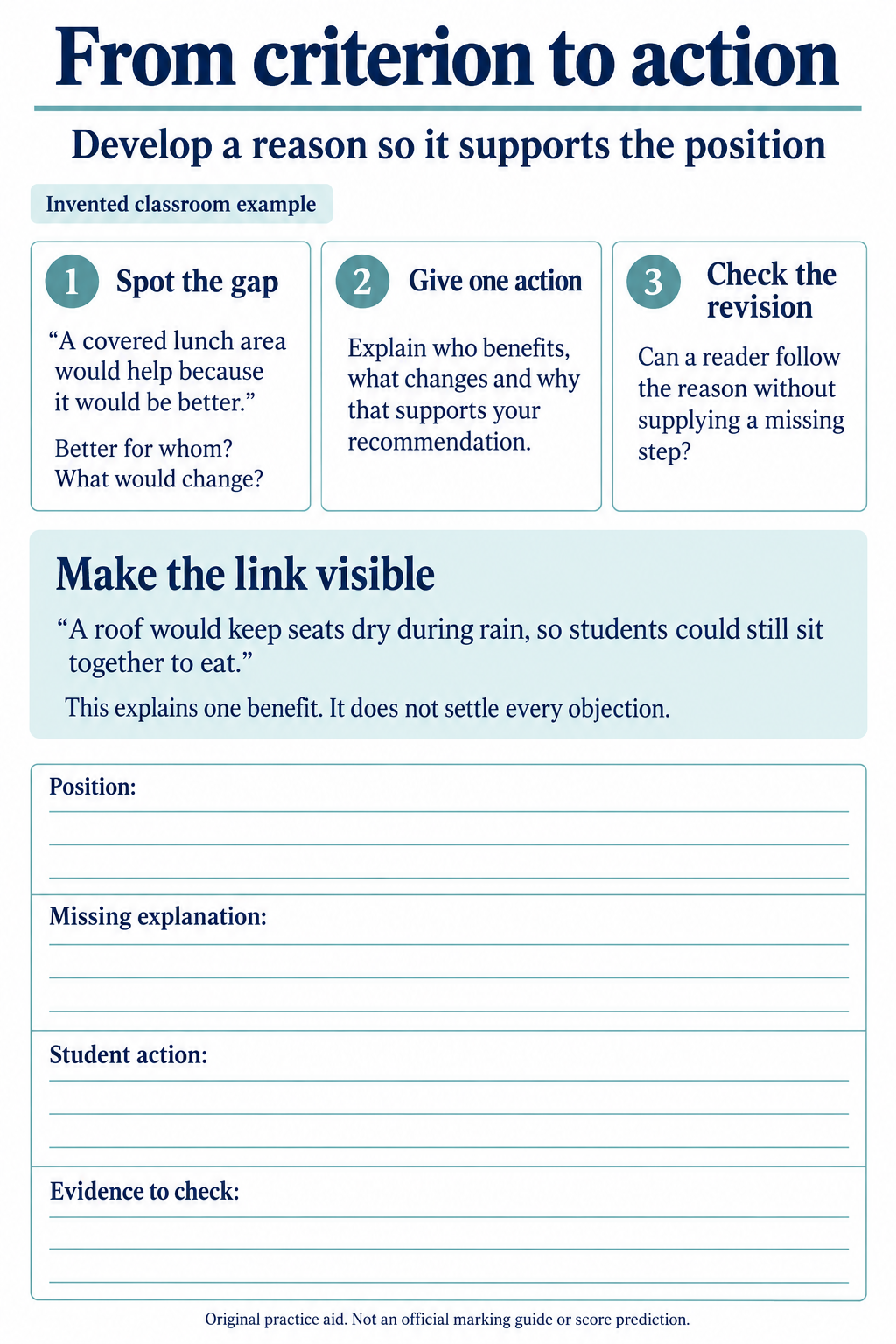
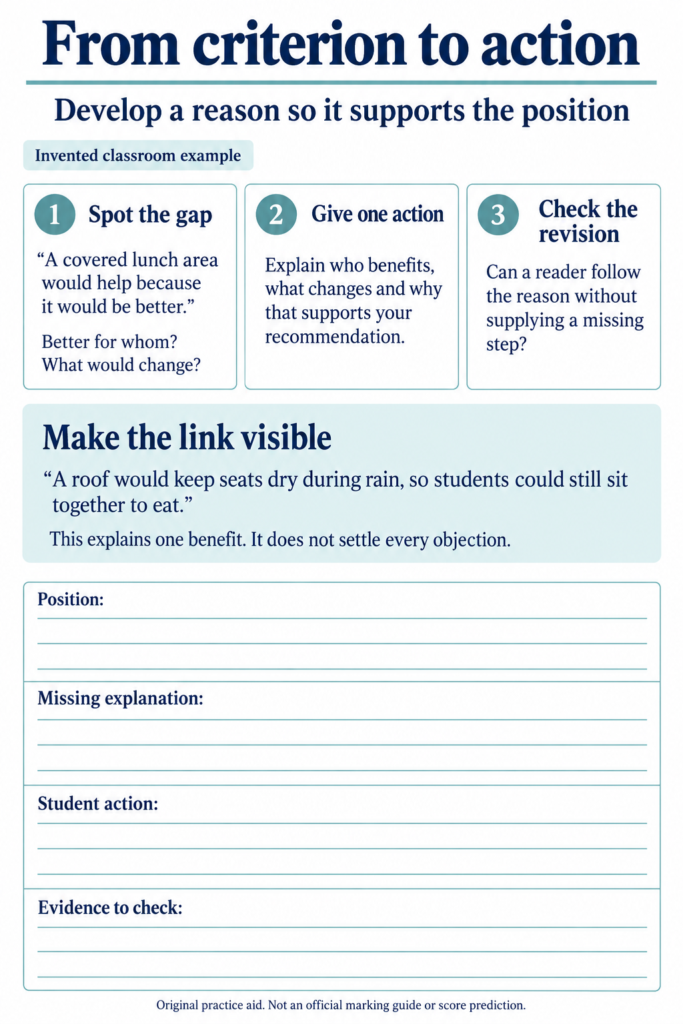
The completed grid below records the path from criterion to observation, action and check. Copy the blank grid for a different response. Write the actual descriptor in your own working copy, then identify the part you will teach today. Keep the original beside it so that a convenient classroom instruction does not become a new marking rule.
For this example, the check is whether a reader can follow how the roof improves the lunch arrangement. Counting extra sentences would miss the point: the blue-roof sentence adds length without providing that explanation. Likewise, a student could make the connection clearly in one sentence. Avoid converting quality into an arbitrary word or sentence quota.
You can store an adaptable version in the feedback comment bank. Leave space for the particular observation and requested action, rather than saving a comment that assumes every student has the same gap.
How do you check whether students can use the idea again?
Give a fresh invented scenario: a classroom’s shared reference books are scattered across several cupboards. Students lose lesson time looking for the right book. The proposal is to put the books on one labelled shelf. Ask students to develop this starting response: “We should use a labelled shelf because it would be helpful.” Keep the lunch model out of view for this attempt.
One possible answer is: “We should keep the reference books on one labelled shelf so students can find the book they need without checking several cupboards. That would leave more lesson time for using the book.” Accept another answer if its explanation is supported by the scenario and strengthens the recommendation. Students do not need to use the model’s exact vocabulary.
Ask the student to explain which part of the revision does the persuasive work. If they name a detail but cannot explain its relevance, model that connection again. If they can explain it orally but struggle to write it, help them compose the sentence. If they produce a relevant explanation independently, give them a new opportunity to apply it in their own work.
AERO’s formative assessment explainer recommends examining students’ thinking and using what you learn to choose the next teaching step. The fresh task here is an original classroom application of that approach, not an exercise tested by AERO. The ten-minute returned-feedback lesson offers a separate structure for making time to revise and check.
How can a faculty use this when reviewing feedback?
Bring a permitted, de-identified response and its rubric to a short discussion. Each teacher identifies the missing explanation, drafts an action and says what they would inspect afterwards. Compare the reasoning before choosing the wording. Agreement about the wording alone does not establish that you diagnosed the right gap.
When reviewing an AI-generated suggestion, make the same comparison against the response and criterion. A suggestion to add three reasons would not necessarily address an existing reason that the student has left unexplained. The guide to checking inaccurate feedback includes practice cases where a precise instruction is still wrong.
If your faculty is considering JeddAI, get in touch to discuss how your rubric and teacher review process would fit the feedback workflow. Bring a permitted practice task that makes your requirements concrete. Teachers can also use the secondary free-account option below to explore with a familiar example.
| Planning step | Worked entry |
|---|---|
| Criterion focus | Develop the reason and connect it to the recommendation. |
| Evidence in this response | “It would be better” names no specific benefit. |
| Student action | Explain who benefits, what changes and why; use the wet-bench detail. |
| Possible revision | Dry seats would let students sit together to eat rather than stand under the veranda. |
| Check | Can the reader follow how the roof changes the lunch arrangement? |
| Fresh attempt | Explain why one labelled shelf would help students use the reference books. |
| Planning step | Your notes |
|---|---|
| Descriptor and source | Exact wording and where to find it: ______ |
| Evidence in this response | What is already present, and what is missing? ______ |
| Student action | One change that addresses this gap: ______ |
| Model or contrast | A useful revision and a less useful alternative: ______ |
| Check | What would you need to see or hear? ______ |
| Next teaching step | Independent fresh task, further modelling or writing support: ______ |