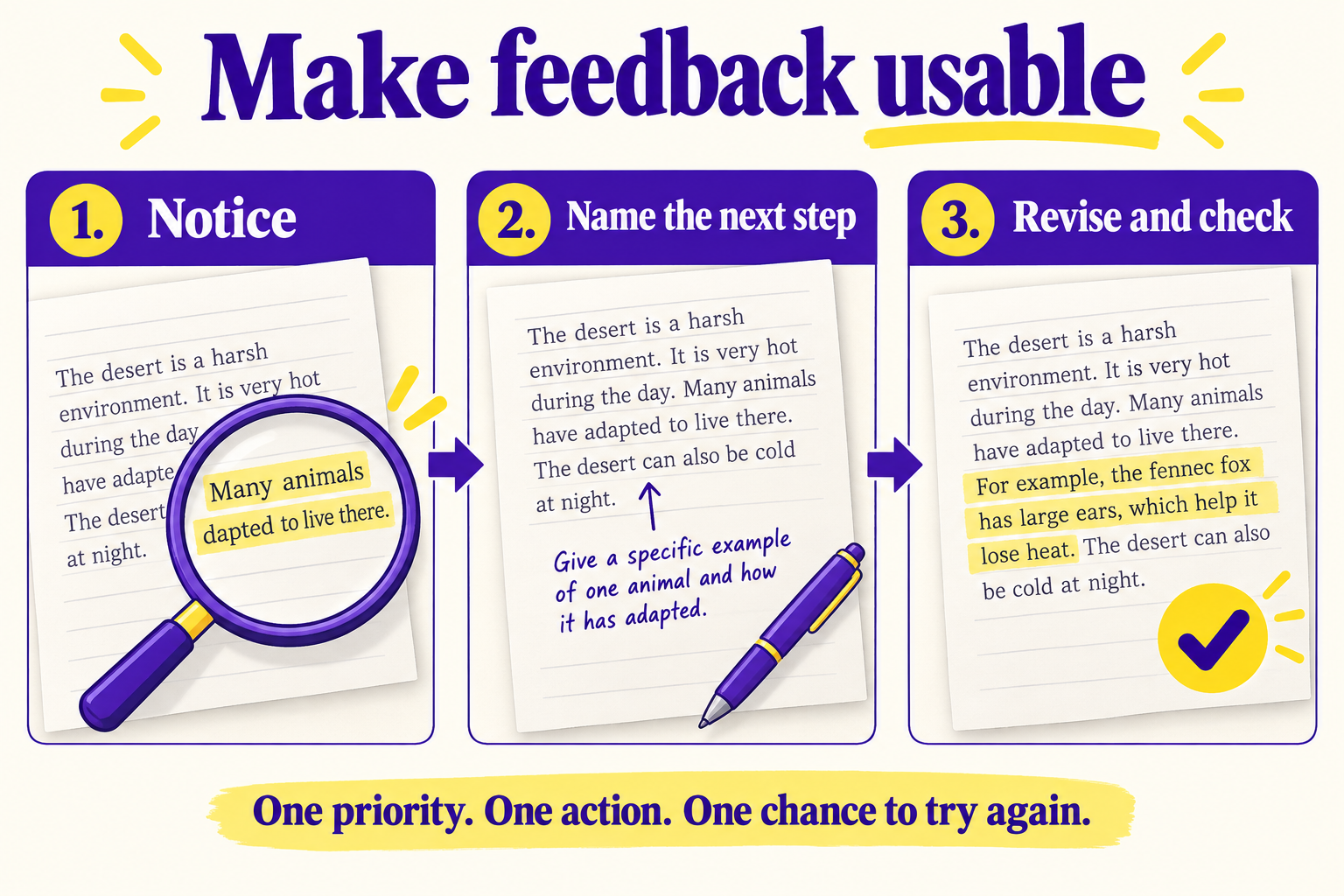
Find a precise next step for evidence, analysis, structure or expression. Adapt each comment to the student's actual work, then give them time to use it.
Notice: You have included relevant evidence, but its connection to your claim is not yet clear.
Next step: After the quotation, explain which word or detail supports your claim and how it does so.
Check: Could a reader follow the link without guessing?
Evidence
An example that is too broad
Notice: The paragraph makes a clear claim but refers to the text or topic in general terms.
Next step: Replace one general reference with a precise moment, fact or short quotation. Explain why that example fits.
Check: Does the evidence support this exact claim rather than the topic as a whole?
Evidence
Too much quotation
Notice: The quotation takes up space that you could use to explain your thinking.
Next step: Keep only the words needed for your point. Use the space you recover to interpret their significance.
Check: Is your own explanation doing more work than the quotation?
Evidence
An unsupported factual claim
Notice: A factual claim needs a reliable source or a more careful qualification.
Next step: Check the claim against your course material. Add the relevant evidence, or rewrite it to say only what the evidence supports.
Check: Can you point to the source that supports the revised claim?
Analysis
Retelling instead of explaining
Notice: This section tells us what happened, but not why it matters to your argument.
Next step: Keep one sentence of context, then explain the effect, cause or implication that matters to the question.
Check: Does the paragraph offer an interpretation rather than a sequence of events?
Analysis
A named technique without an effect
Notice: You have identified a technique. The next step is to explain what it contributes here.
Next step: Focus on the actual words, image or detail. Explain how it shapes meaning in this particular example.
Check: Would the explanation still work if you replaced the example? If so, make it more specific.
Analysis
A jump in reasoning
Notice: The conclusion moves beyond what the evidence currently establishes.
Next step: Write the missing reasoning step between the evidence and your conclusion, or narrow the conclusion.
Check: Can you defend each step using the evidence you have supplied?
Analysis
A comparison that stays separate
Notice: Both examples are explained, but the relationship between them is left to the reader.
Next step: Add a sentence that identifies a meaningful similarity or difference and explains why it matters.
Check: Does the comparison reveal something that two separate descriptions would not?
Argument
Answer the actual question
Notice: Your response explains the topic but does not yet answer the question's specific demand.
Next step: Underline the command word and key terms. Rewrite your main claim so it takes a position on those terms.
Check: Could the revised claim serve as a direct answer to the question?
Argument
A claim that is too absolute
Notice: Words such as 'always' or 'everyone' make this claim broader than your evidence allows.
Next step: Identify the relevant conditions or exceptions. Rewrite the claim with a scope you can support.
Check: Have you kept a clear position while avoiding an unsupported generalisation?
Argument
A conclusion that introduces a new idea
Notice: The conclusion introduces a point that the body has not developed.
Next step: Move the new idea into a supported body paragraph, or remove it and explain what your existing argument establishes.
Check: Does every major conclusion follow from reasoning in the body?
Structure
Two jobs in one paragraph
Notice: The paragraph develops two different claims, making its direction harder to follow.
Next step: Choose one controlling idea. Move the second claim into a new paragraph with its own evidence and explanation.
Check: Can you summarise each paragraph's job in one sentence?
Structure
A topic sentence that only names a theme
Notice: The topic sentence announces a theme without making an arguable point about it.
Next step: Rewrite it as a claim that advances your answer to the question. Check that the evidence below supports it.
Check: Does the sentence tell the reader what you will argue, not just what you will discuss?
Structure
A link that repeats the question
Notice: The final sentence repeats the question but does not show what this paragraph has established.
Next step: State the implication of your evidence for the overall argument in fresh, precise language.
Check: Does the link add a logical connection rather than a repeated phrase?
Expression
A sentence carrying too much
Notice: Several ideas are packed into one sentence, obscuring the relationship between them.
Next step: Split the sentence at the change in idea. Use a precise connective where you need to show cause, contrast or consequence.
Check: Can you read each sentence aloud without losing its main point?
Expression
An unclear reference
Notice: A word such as 'this', 'it' or 'they' could refer to more than one thing.
Next step: Replace the unclear reference with the specific idea, person or process you mean.
Check: Can a reader identify the subject without looking back and guessing?
Accuracy
An answer without working
Notice: The answer is given without enough working or reasoning to check the method.
Next step: Show the important steps, including the rule or relationship used. Keep units and labels visible where relevant.
Check: Could someone find the point of error if the final answer were wrong?
Accuracy
A key term used loosely
Notice: A course term is being used more broadly than its taught meaning.
Next step: Check the definition in your course material. Rewrite the sentence using the term accurately, then give a fitting example.
Check: Does the example demonstrate the definition rather than merely repeat the word?
No examples match. Clear the search or choose another skill.
How to use it well
Choose the most important criterion for this piece of work, rather than correcting everything at once.
Read the example and replace its general wording with the student's sentence, idea or paragraph number.
Ask for a visible action: replace a quotation, explain an inference, move a sentence or test a claim.
Check the revision against the same criterion. A comment has done its job when it changes the next attempt.
These are editable teaching examples, not automatic judgements or official marking descriptors. Keep student names and sensitive information out of shared copies.
Keep the process beside your work. Download the teaching visual · AI-generated illustration, reviewed for this resource.
Compare your current marking time with a workflow that includes setup and careful review. Change every assumption; the result is an estimate, not a promise.
Plan a small, reviewable trial of AI-assisted feedback. Record evidence about accuracy, workload, student revision and data handling before deciding whether to expand.