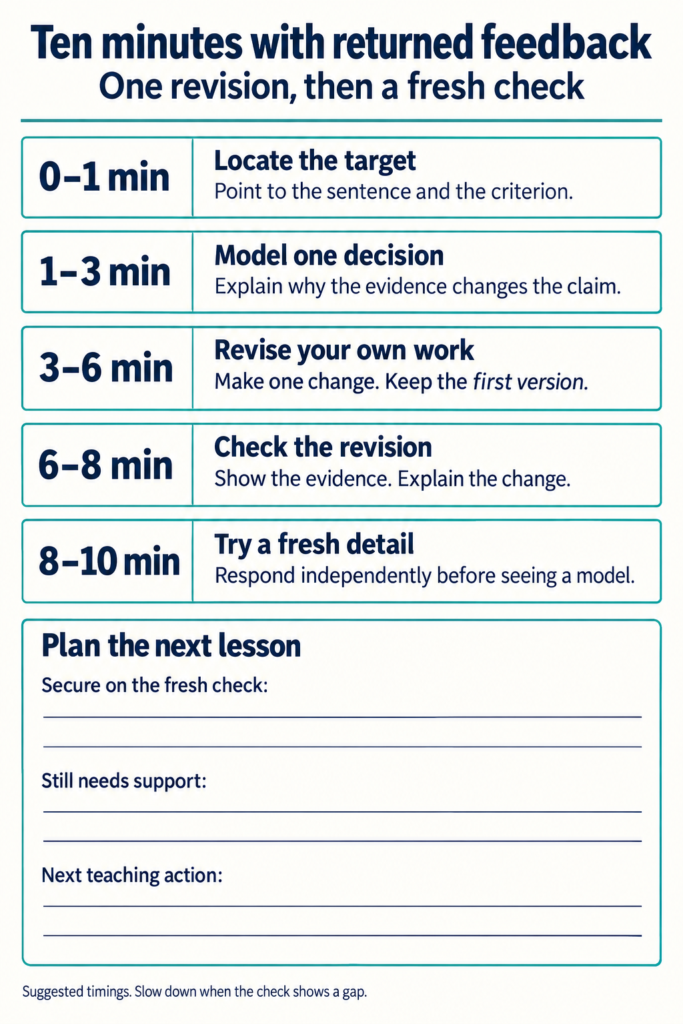
What should you prepare before returning the work?
Start with the work you are returning. Choose a recurring gap that students have already been taught how to address, such as making a claim that fits the evidence. Prepare a short invented example, a possible revision and a fresh detail for the final check. Put the last two out of sight until needed. This sequence is for ordinary practice work; follow the rules of any assessed task before providing models or revision help.
The ten-minute outline is a suggested classroom routine, not a tested promise about how quickly students learn. AERO’s formative assessment guidance supports checking understanding, asking students to explain their thinking and adjusting teaching in response. It also recommends allowing time to reflect and act on feedback. The specific script and examples here are our own application of those principles.
Check the comment itself before planning the lesson. If it only says ‘develop this’, use the worked guide to turning vague feedback into revision tasks first. The lesson below assumes students have a precise target. Its job is to turn that target into observable work and a decision about what to teach next.
What happens in the first three minutes?
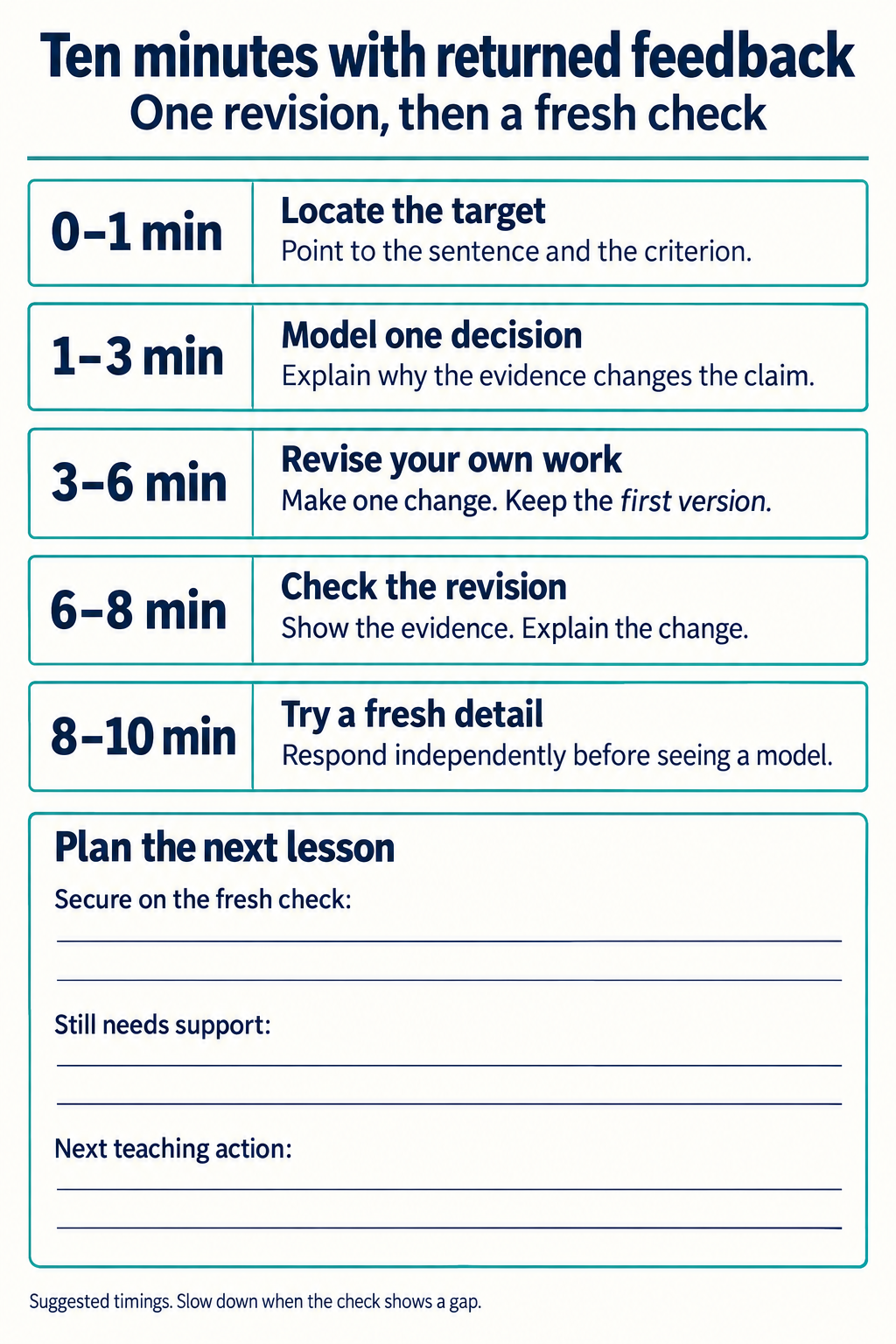
In minute zero to one, ask students to point to the sentence their comment concerns and name the action they will take. For this example, use the criterion: ‘Make a claim about the character that accounts for the relevant details.’ If a student cannot locate the target or explain the instruction, clarify it before asking for a rewrite.
In minutes one to three, display this invented practice passage: ‘Arun packed the last cup, then ran his thumb along the marks on the kitchen doorframe. When the taxi sounded its horn, he closed the box but stayed by the door.’ An invented response says: ‘Packing the cup shows that Arun is eager to leave and has no attachment to the house.’
Model a decision aloud: ‘Packing shows preparation to leave. It does not by itself establish eagerness. Touching the marks and remaining by the door complicate the claim that he has no attachment.’ A possible revision is: ‘Arun prepares to leave, but his attention to the doorframe and his hesitation suggest an attachment to the home he is leaving.’ Explain why the qualification matters, then hide the model before students work. The invented passage supports a reading, not certainty about everything Arun feels.
What should students do in minutes three to six?
Students now work on the target in their own returned response. Ask them to keep the first version, write the revision beneath it and underline the detail that justifies their decision. The instruction is to improve one claim, not rewrite the whole response or replace ordinary words with longer ones. Use familiar, short work so locating evidence does not consume the entire window.
Circulate with two questions: ‘Which detail made you change your mind?’ and ‘What can you now claim that you can defend?’ If a student cannot find relevant evidence, point them back to a manageable part of the material. If they do not understand the material, provide further teaching instead of insisting on independent revision at that moment.
Students whose original claim already fits the evidence need a different job: identify a possible overstatement and explain why they would reject it. They should not damage a sound response simply to produce a visible edit. For other recurring gaps, adapt a starting instruction from the feedback comment bank and choose an example that matches that instruction.
How do you check the revision in minutes six to eight?
Ask students to complete this short record: ‘I changed ___ to ___ because the detail ___ supports ___.’ The sentence is a prompt for reasoning, not a form they must fill with your exact words. Read the old sentence, the new sentence and the cited detail together. A fluent new sentence may still misread the material.
Use the invented example to anticipate responses. ‘I changed eager to reluctant because reluctant sounds better’ does not explain the evidence. ‘I removed no attachment because he pauses over the marks on the doorframe’ identifies a relevant reason. Accept a different interpretation if the student can account for the details; matching the model’s adjective is not the criterion.
A partner can ask the same evidence question, but agreement between two students is not a teacher check. Scan the revisions as they work and note who still needs a closer look. If several responses repeat the same unsupported inference, stop for another short explanation. Extend the routine rather than rushing to the final step just to meet the timer.
What should the last two minutes reveal?
Give a fresh invented detail without a model answer: ‘Nia folds the team shirt into her bag, then pins the team photograph above her desk.’ Ask: ‘A response claims Nia has forgotten the team. Revise that claim using a detail from the sentence, and explain your change.’ Students respond independently before you show or discuss an answer.
One defensible answer is: ‘Although Nia puts the shirt away, displaying the photograph suggests the team still matters to her.’ The explanation should connect the displayed photograph to the revised claim. Putting the shirt away alone does not establish that she has forgotten the team; nor does the sentence establish whether she will play again.
Collect the brief responses. A supported revision followed by a defensible fresh answer is more informative than copying a correction, but one short check does not establish lasting mastery. Plan another opportunity to use the skill later. Keep a response that names evidence without explaining it separate from one that misreads the evidence: they call for different next steps.
How do you use the evidence for the next lesson?
Use the planning sheet below to record what happened, including students you did not manage to check. If the difficulty is confined to a small group, prepare a short follow-up with another example. If it is widespread, revisit the reasoning with the class before adding a harder task. Base that decision on the responses you actually saw, not on whether the room looked busy.
When feedback is drafted with JeddAI, retain the same teacher checks: the comment must fit the response, the requested action must be possible, and students need time to use it. Get in touch to discuss how this revision routine could fit your faculty’s feedback workflow. The useful conversation starts with the task and the evidence of learning you want to see.
If you want to explore the teacher workflow yourself, create a free teacher account. Keep the short lesson, the revision check and the decision about further teaching under your control.
| Time | Prepare or do | Record what you observe |
|---|---|---|
| 0–1 min | Target sentence and one criterion: ______ | Can students explain the action? ______ |
| 1–3 min | Example and decision to model: ______ | Which part needs another explanation? ______ |
| 3–6 min | One change in returned work: ______ | Evidence used for the revision: ______ |
| 6–8 min | Compare first version, revision and reason | Still unsupported or unclear: ______ |
| 8–10 min | Fresh independent check: ______ | Secure / needs support / not checked: ______ |
| Next lesson | Follow-up example or task: ______ | When will you check the skill again? ______ |