What should a student keep from a spoken comment?
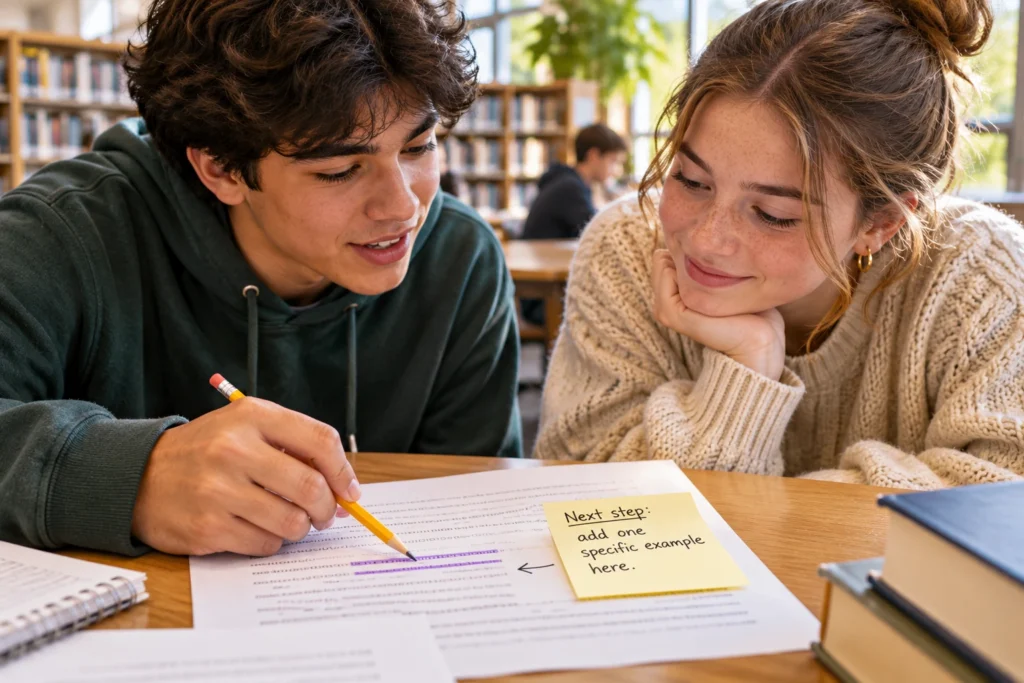
A note such as “explain more” can survive the conversation while losing the decision that made the feedback useful. Before moving on, help the student record where to work, what to keep or change, and how to check the attempt. The record should point back to the task and response, not become a second assignment.
Choose one manageable next step. If the conversation has uncovered several problems, agree which one the student will address first and record any remaining question separately. A student copying rapidly may capture your last sentence while missing the distinction you wanted them to understand.
AERO’s formative assessment guidance recommends asking students to explain their thinking, providing next steps and allowing time to act and reflect. The routine here is an original classroom application of those principles. It is not a tested note-taking programme or evidence that writing down feedback guarantees learning.
What can you use to model an accurate note?
Use this complete original passage: “Leila checked the empty donation tin twice, then placed it behind the display before the visitors entered.” The task is: “Explain what Leila’s actions suggest. Support your interpretation with details from the sentence.”
Give the class this invented response: “Leila stole the donations because she hides the tin.” It identifies an action, but treats a possible story about the money as established fact. The passage does not say that money was collected, who handled it or why the tin is empty.
Read this teacher comment aloud: “Keep the detail that she hides the tin. The sentence does not tell us what happened to any donations. Revise the claim about stealing. Use ‘empty’ and ‘before the visitors entered’ to explain what her actions suggest.” Display the passage and response while students listen.
A useful note is: “First sentence: keep hiding the tin; replace stole because the passage does not establish theft. Explain empty and the timing before visitors arrive. Check that my new claim stays within those details.” It retains the evidence to keep, the claim to reconsider and the reason for the action.
How do you spot a note that changes the advice?
Compare the useful note with “Delete the quotation and add more evidence.” That record reverses part of the advice: the teacher asked the student to keep the hiding detail. Adding another quotation would not necessarily repair the unsupported claim. Ask students to locate the mismatch between the spoken comment and the note.
Another weak record is “Write that Leila is embarrassed.” It turns a possible interpretation into a supplied answer. Her behaviour may suggest concern about visitors seeing the empty tin, but the sentence does not establish an emotion or its cause. Keep the task open enough for the student to justify a reading.
A student can use shorthand, arrows or a brief spoken restatement. The important check is whether the record preserves the decision. Do not mark the note for polished wording. If handwriting, listening or language demands get in the way, offer a pause, a written prompt or appropriate scribing support, then check the intended action with the student.
What should happen before the conversation ends?
Ask the student to point to the part of the response they will work on and explain their plan. For example: “I will keep hiding, but change stole because the sentence does not tell us where the money went. I will explain what the empty tin and the visitors’ arrival suggest.” This makes the action visible before the student leaves to work independently.
If the student says, “I will remove hiding,” correct that specific misunderstanding: “Keep that detail; it is relevant. Reconsider the explanation attached to it.” Let the student change the note and explain the revised plan. Simply asking “Do you understand?” does not show which instruction they have taken away.
If the original spoken comment was unclear, improve the comment too. The student should not have to decode an ambiguous instruction into a confident-looking record. A note such as “Ask which claim needs qualifying” is more honest than filling the space with an action neither person has checked.
A corrected note confirms the agreed next step; it does not confirm that the step will be done successfully. Leave a short opportunity to attempt it. That attempt gives you different evidence from a fluent explanation of the plan.
How do you connect the record to the revised work?
One possible revision is: “Leila checks the empty tin repeatedly and hides it before the visitors enter. Her actions suggest that she does not want them to see the empty tin.” The phrasing presents an inference from the action and timing. It does not claim theft or establish why there are no donations.
Read the revision beside the note and original passage. The student has kept relevant evidence, changed an unsupported claim and explained the timing. A different supported interpretation may also work. Check its reasoning rather than requiring the student to reproduce this model sentence.
Now ask what changed and why. The guide to explaining revisions offers a separate follow-up for that reasoning. Keep the purposes distinct: the note records the agreed instruction before work; the explanation shows what the student made of it afterwards.
If the revision still claims theft, do not assume the student ignored you. Inspect the note and ask how they used it. The record may be inaccurate, the student may not understand the evidence distinction, or they may have found a different part of the task difficult. Each possibility calls for a different follow-up.
What fresh practice checks whether students can record the advice?
Use a new original passage: “Sana folded the invitation carefully and placed it in her coat pocket, then told the others she had forgotten about the party.” The invented response says: “Sana has forgotten about the party.” Keep both visible while you read the next comment aloud.
Say: “Keep the invitation detail. Compare her careful handling of it with what she tells the others. Qualify the claim that she forgot, and explain the difference between her actions and her statement. Do not invent a reason for that difference.” Ask students to record the next step, then check their notes against the spoken comment.
A sound record identifies the claim about forgetting, keeps the invitation detail and asks for a comparison between action and speech. “Add more about the party” is too vague; “Sana definitely plans to attend” invents an outcome. Ask the student to restate the plan if their note leaves the intended comparison unclear.
One possible attempt is: “Sana’s careful handling of the invitation complicates her claim that she has forgotten the party. Her actions suggest she has paid attention to it, although the passage does not explain why she tells the others otherwise.” The passage does not establish whether she attends. This practice checks the recorded instruction and subsequent reasoning separately.
How can you keep the routine practical in a busy lesson?
Use the same small record for one important feedback conversation, then ask students to keep it with the relevant work. A page reference or a few identifying words can be more useful than a long account of everything said. If feedback is still unresolved, record the question and when it can be checked rather than inventing agreement.
Keep useful clarification prompts in the feedback comment bank, such as “Show me which sentence you will change” or “What are you keeping, and why?” Choose the prompt that checks the actual decision. Repeating every prompt after every conversation would add work without necessarily revealing more.
If your department is considering JeddAI for teacher-reviewed feedback, get in touch to discuss how spoken clarification and student revision will fit the process. You can book a meeting below; individual teachers can also create an account. The teacher still needs to check that the student’s next action matches the intended advice.
| Part of the record | Agreed note |
|---|---|
| Where | First sentence: the claim that Leila stole donations. |
| Keep or change | Keep hiding the tin; reconsider stole. |
| Reason and evidence | The passage does not establish theft. Use empty and before the visitors entered. |
| Next action | Make a supported interpretation and explain the relevant details. |
| Check | Does the revision stay within the passage rather than inventing a backstory? |
| Prompt | Student note |
|---|---|
| Where in my work? | Page, paragraph or identifying words: ______ |
| What will I keep or change? | ______ |
| Why; what evidence matters? | ______ |
| What will I try next? | ______ |
| How will I check it? | ______ |
| What still needs clarification? | Question and agreed follow-up: ______ |