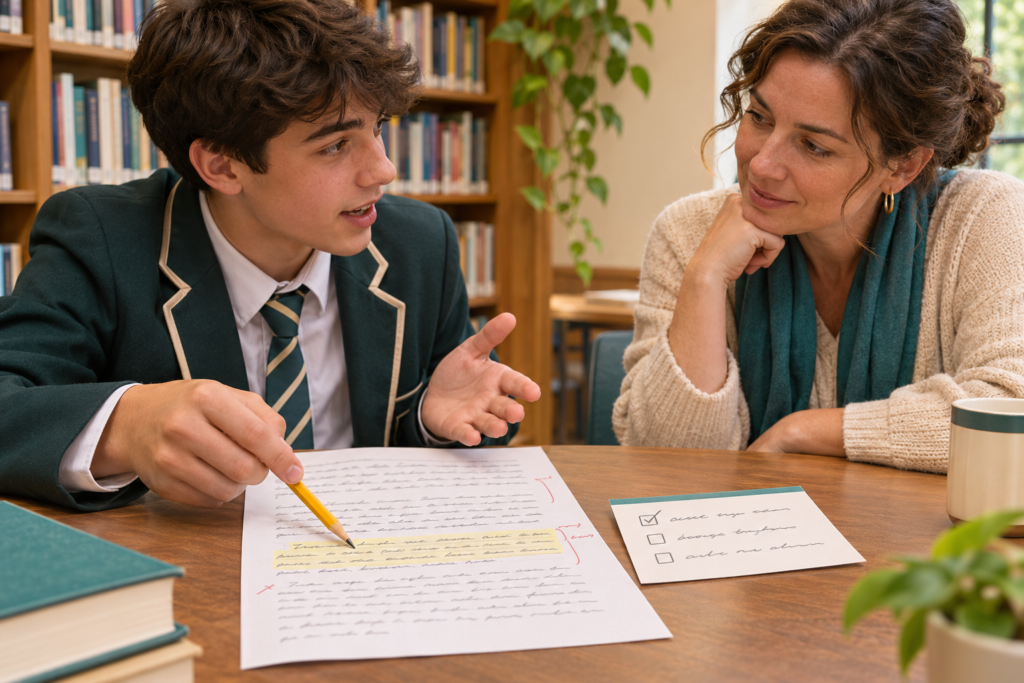
What do students need before they swap work?
“Give your partner some feedback” leaves several decisions unstated. Students may praise the handwriting, correct every spelling error or recommend a longer paragraph without considering the learning goal. Begin with one criterion they have already been taught and can recognise in a response.
For this lesson, use: “Connect the claim to a precise detail from the passage.” Give reviewers the passage as well as the response. Without the source, they cannot check whether a confident-sounding interpretation is supported. Explain that their job is to suggest a next step, not to award a grade or rewrite the answer.
AERO’s formative assessment guidance recommends eliciting students’ thinking and using feedback to guide a further attempt. The lesson below is an original application of that broad principle. It does not establish that peer review is effective in every setting or replace the teacher’s responsibility to check the advice.
What can the class practise reviewing?
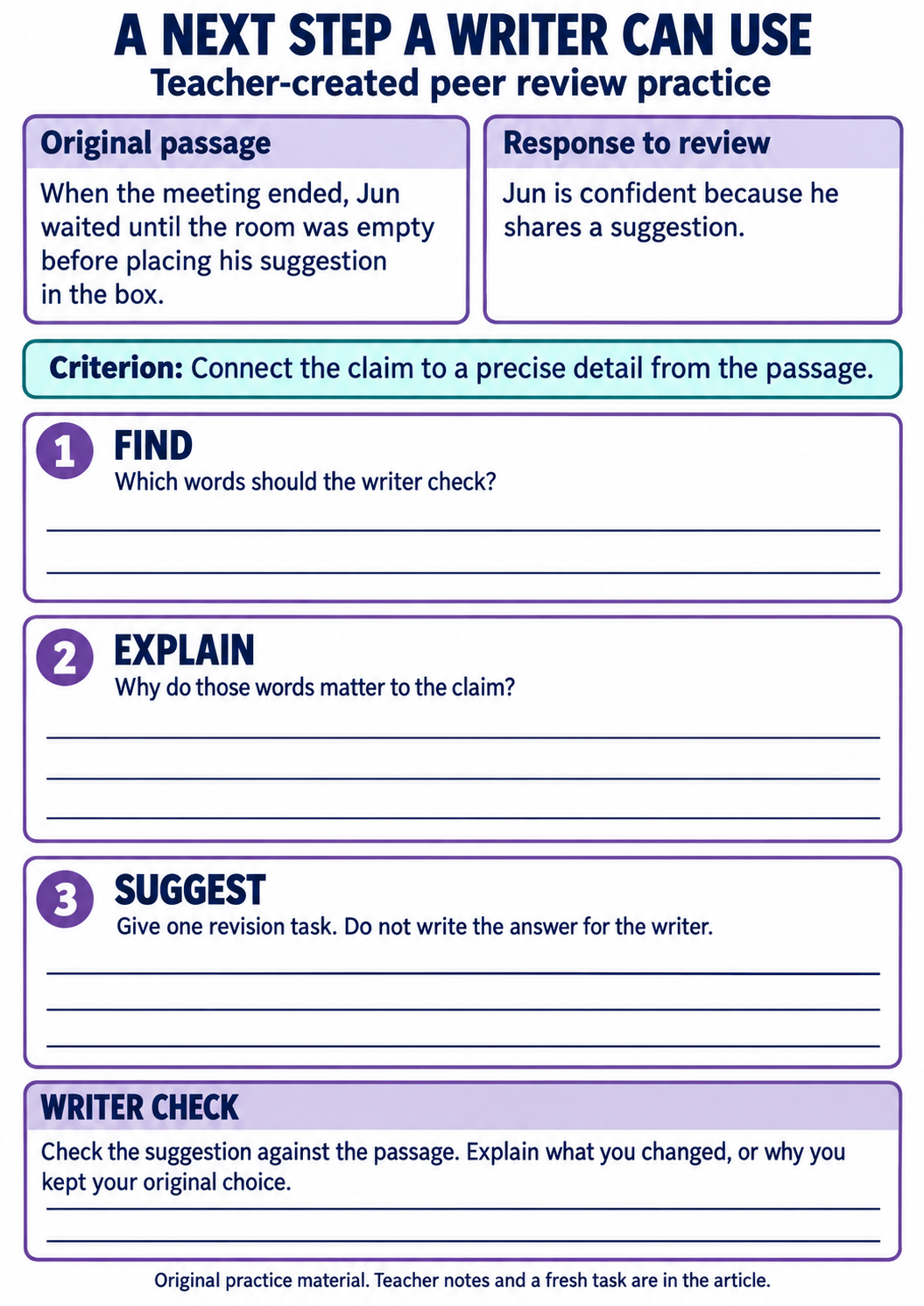
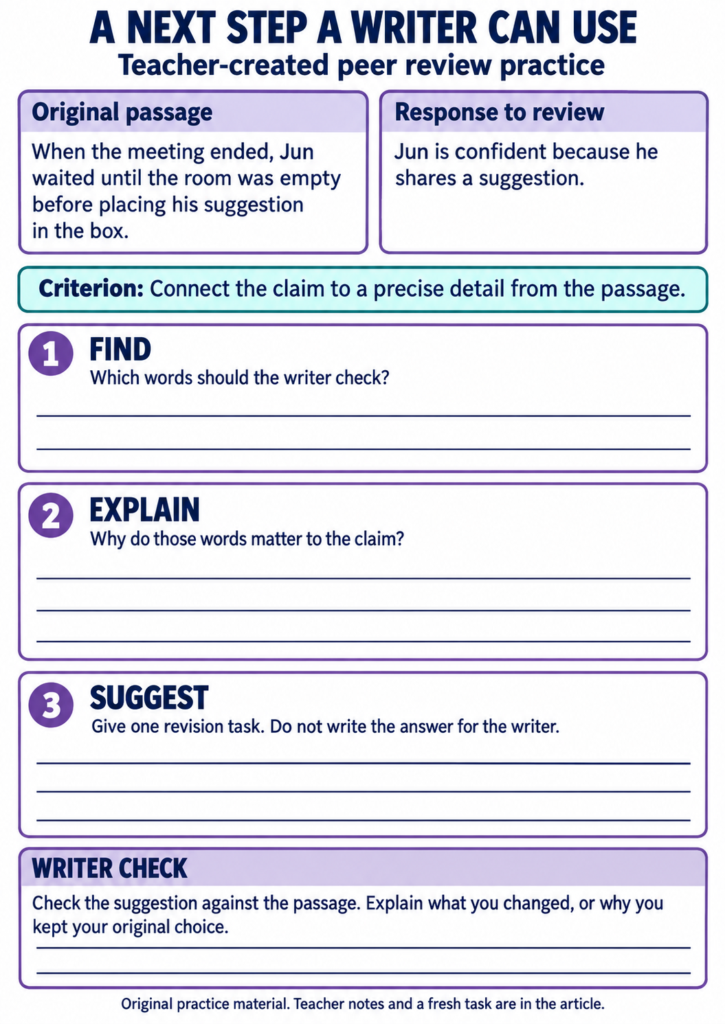
Display this original passage: When the meeting ended, Jun waited until the room was empty before placing his suggestion in the box.
Give students this invented response to review: “Jun is confident because he shares a suggestion.” Ask them to read the whole passage before commenting. Neither the passage nor the response comes from a real student; they are shared practice material.
First ask students which detail the writer has used and which detail the response leaves unexplained. The act of submitting a suggestion supports the idea that Jun wants to contribute. Waiting until the room is empty complicates the claim about confidence. The sentence does not tell us why he waits, so it would also be too strong to diagnose fear or anxiety.
Give everyone a moment to write a first comment independently. This lets you see the decisions reviewers are making before a confident classmate supplies a model. Accept an oral or scribed comment where needed, and note the support used.
How do you turn a judgement into a revision task?
Compare “Good work”, “Add more detail” and “Check the claim about confidence against Jun waiting for the room to empty. Explain how the timing affects your interpretation.” The last comment points to a claim, locates a relevant detail and tells the writer what to reconsider. It does not supply the finished answer.
Model three questions a reviewer can ask: Which words in the response need attention? What evidence makes me say that? What should the writer do next? In this example, the target is “confident”, the evidence is the wait for an empty room, and the action is to reconsider and explain the interpretation.
Do not insist that every comment follows one sentence pattern. A question can be useful if it makes the next action clear: “Why does Jun wait until everyone has left? Add an explanation of how that detail affects your claim.” A question such as “Can you improve this?” leaves the writer with the original problem.
If a student struggles to distinguish an unsupported claim from an unexplained useful detail, the guide to feedback on evidence offers several separate examples. Teach that distinction before expecting the student to diagnose it independently in a partner’s work.
What if the peer comment is specific but wrong?
Try a plausible but faulty comment: “Replace confident with terrified because Jun waits for the room to empty.” It is specific, but the passage does not establish terror. Ask the reviewer to identify the words that support that stronger emotion. If they cannot, they need to narrow the suggestion, not make it sound more certain.
Another faulty comment is “Add a metaphor.” No requirement for a metaphor appears in the criterion, and inserting one into the student’s explanation would not necessarily improve the link between claim and evidence. Return to the agreed criterion rather than rewarding a comment for using a technical term.
Check a few practice comments with the class before moving to peer work. Ask students to explain why a comment is accurate and actionable. If several students cannot justify their advice, continue with the shared example and teacher guidance. Exchanging papers is not, by itself, evidence that students can give useful feedback.
What should the writer do with the suggestion?
Give the writer time to read the comment beside the passage. They should decide what to change and explain why. Accepting every suggestion is not the goal; neither is dismissing every challenge. The source and criterion provide a way to discuss the disagreement.
One possible revision is: “Jun wants to contribute, but waits until the room is empty before submitting his suggestion. That timing suggests he prefers to make this contribution without an audience.” This uses both the action and its timing, while stopping short of claiming that he is always shy or afraid.
The writer could explain: “I replaced confident because submitting an idea does not explain why he waits. I kept the point that he contributes and added what the timing suggests.” If a reviewer had demanded “terrified”, a reasonable response would be: “I will reconsider confident, but terrified goes beyond the passage.”
When the disagreement remains unresolved, ask the teacher to check it. Do not settle a question of evidence by a vote or by assuming the more fluent student must be right. Keep discussion focused on the work. Use invented examples for initial practice, and follow your school’s process when selecting real work to share.
What fresh task checks the reviewer’s judgement?
Remove the model and offer this new original passage: “At the next meeting, Jun raised his hand before the chair asked for suggestions.” The response to review is: “Jun waits for everyone else before contributing.” Ask reviewers to identify a detail, explain the problem and suggest one revision task.
A workable comment is: “Compare ‘waits for everyone else’ with Jun raising his hand before the invitation. Revise the claim to fit that timing, then explain what it suggests about his willingness to contribute at this meeting.” The comment locates the mismatch without inventing events or writing the whole answer.
One possible revised response is: “Jun raises his hand before the invitation, suggesting he is willing to initiate a contribution at this meeting.” This does not prove that he always leads discussions or that the chair chooses him to speak. Read both the reviewer’s comment and the writer’s response to see which decision still needs teaching.
Use the same checking questions with subsequent tasks, but change the source and the claim. A reviewer who copied the model wording may still need help judging a new response. The fresh task is a check of that judgement, not a score for the student’s overall ability.
How can you make the routine manageable?
Keep the first exchange short: one criterion, one passage and one suggested action. Leave time for the writer to check and act. You can expand the scope after students show they can justify their comments. A long list of corrections is difficult to test and can hide the main learning decision.
Use the record below to retain the evidence behind a comment, the proposed task and the writer’s decision. The feedback comment bank can help teachers organise useful prompts, but a saved phrase still needs checking against each new piece of work.
If your department is exploring JeddAI for teacher-reviewed feedback, get in touch to discuss how teachers will check suggested next steps before students act on them. You can book a meeting below; individual teachers can also create an account.
| Record | Example from the first task |
|---|---|
| Criterion | Connect the claim to a precise detail. |
| Detail to check | Jun waits until the room is empty. |
| Decision for the writer | Does confident explain the timing? |
| Suggested action | Reconsider the claim and explain the relevant detail. |
| Writer’s response | Keeps the contribution point; adds the preference for no audience. |
| Teacher check | The revision stays within this passage; no permanent personality label. |