Why does 'develop your analysis' leave students stuck?
It identifies a broad weakness without telling the student what to do next. A student who already knows how to develop an interpretation may understand the shorthand. A student who does not may add another quotation, make the paragraph longer or replace ordinary words with more complicated ones. None of those changes necessarily addresses the problem.
Start by looking at the sentence that prompted your comment. Is the student retelling an event? Naming a technique without explaining its effect? Making a conclusion that goes beyond the evidence? Those are different problems, and they need different revision tasks. The useful unit of feedback is the gap you can actually see in this piece of work.
You do not need to diagnose every weakness at once. Choose a change that matters to the current learning goal and that the student can attempt with the knowledge they have. If the missing step has not been taught, a brief explanation or model may be more useful than an instruction to try harder.
What does a clear revision task look like?
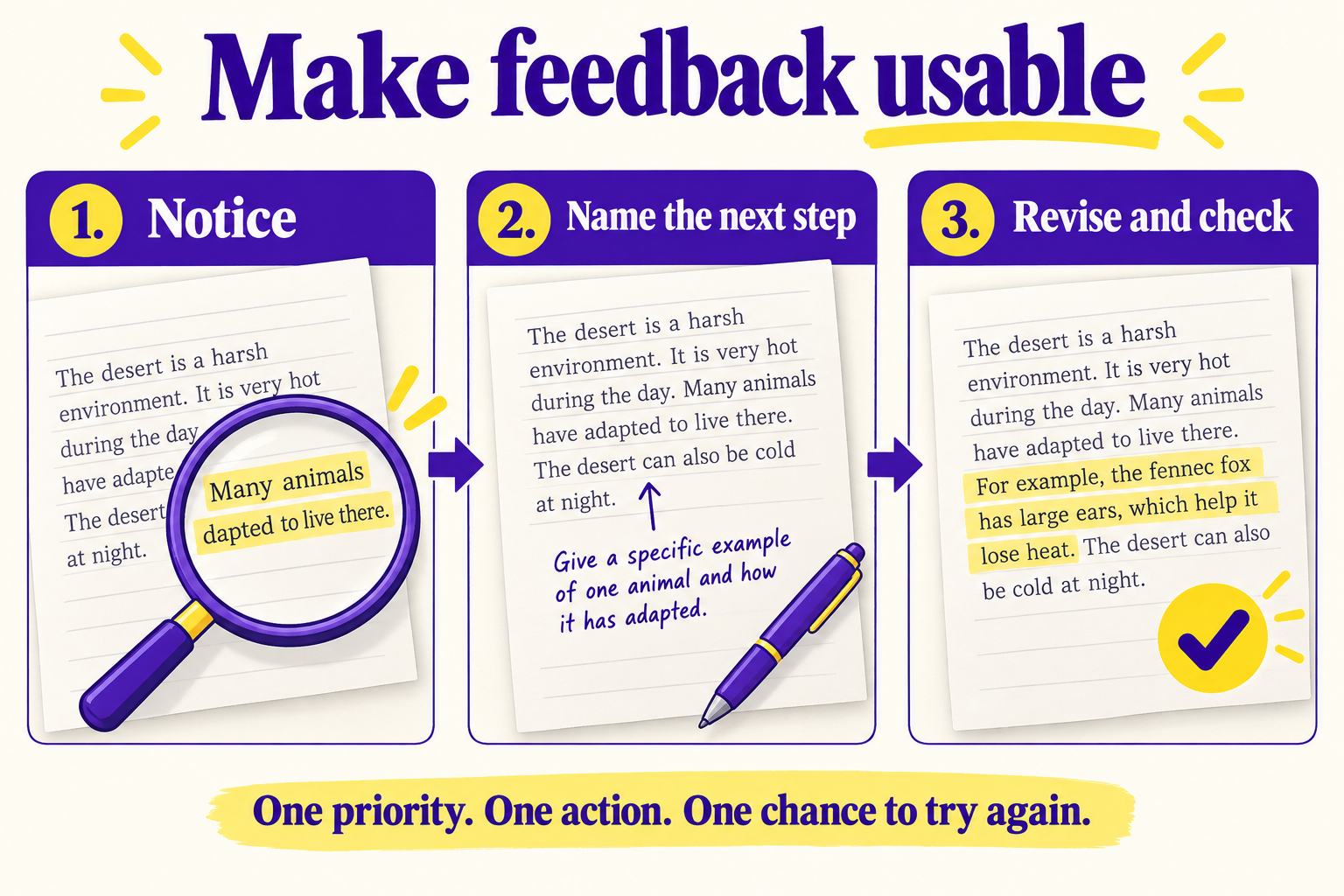
A clear task connects a specific observation with an action and a check. The following example is invented for teaching; it is not a quotation from a prescribed text or an official marking exemplar.
Imagine a student writes: ‘The narrator looks at the empty chair. This uses imagery and makes the reader interested.’ The problem is not simply that the response is short. The student has named a feature and a general reaction without explaining the significance of the detail.
Instead of writing ‘analyse more deeply’, try: ‘You have noticed the empty chair. Replace “makes the reader interested” with an explanation of what the empty chair suggests about the absent person. Point to one detail in the surrounding passage that supports your interpretation.’ The instruction gives the student something to change and something to consult.
A possible revision might be: ‘The empty chair makes the person’s absence visible in a familiar room. If the surrounding description shows that nobody moves it, the detail may suggest that the household is not ready to accept the loss.’ The conditional wording matters. The student still has to check the actual passage; a plausible interpretation is not automatically a supported one.
The check is equally concrete: ‘Does your new sentence connect the detail to an interpretation, and can you identify evidence for that interpretation?’ This is more useful than asking whether the paragraph now sounds sophisticated.
How can you make this manageable across a class?
Group responses by the next action they need, then personalise the location or example. One group may need to explain evidence; another may need to answer the command word; a third may need to correct a misconception before attempting the question again. Shared wording can save repetition without making every student’s feedback identical.
Use the feedback comment bank to find a starting point for evidence, analysis, argument, structure, expression or accuracy. Replace the general wording with a sentence, paragraph or example from the response. Read the finished comment against the work before giving it to the student.
Keep a small set of comments that you have seen students use successfully. If several students misunderstand the same instruction, revise the comment rather than assuming that everyone ignored it. A bank should improve as you learn which wording leads to the intended change.
AERO’s formative assessment explainer describes feedback as part of an ongoing process of checking understanding and adapting teaching. It includes comment banks and whole-class feedback among practical options. The examples on this page are our own applications of that principle, rather than a claim that one comment formula suits every task.
What should happen after you return the work?
Set a short, specific revision task before students close the document or put the paper away. For example, ask them to underline the sentence they changed, write the new version below it and add one sentence explaining why the change meets the criterion. The visible comparison gives you something to inspect.
Start the next lesson with one anonymous or invented example if the same issue affects many students. Model the decision involved, not just a polished final sentence. Show why one interpretation fits the evidence and another does not. Then ask students to make the equivalent decision in their own response.
Check a sample of the revisions while students work. If the gap persists, decide whether the student needs another explanation, different evidence or a smaller task. Copying your model word for word is not enough to show that the underlying skill transfers to a new question.
For your next assessment, record whether the same problem returns. That observation can inform teaching; it should not become a claim that one feedback comment caused an improvement on its own.
Where can AI-assisted feedback fit into this process?
AI can help draft possible comments, but the teacher still needs to check the work, the criterion and the proposed action. Reject a fluent comment if it misreads the response, invents a weakness or asks the student to do something unrelated to the task. The same standard applies to a comment copied from a bank.
Use the marking workload calculator to compare a proposed workflow with your current one. Include setup, reading, checking and editing time; counting only the time taken to generate feedback gives an incomplete comparison. Look at the quality of students’ revisions alongside the time estimate.
If you want to explore this workflow with JeddAI, get in touch to discuss your subject and assessment process. Bring an invented or appropriately de-identified example that your school permits you to share, and agree who will review the feedback before students receive it.