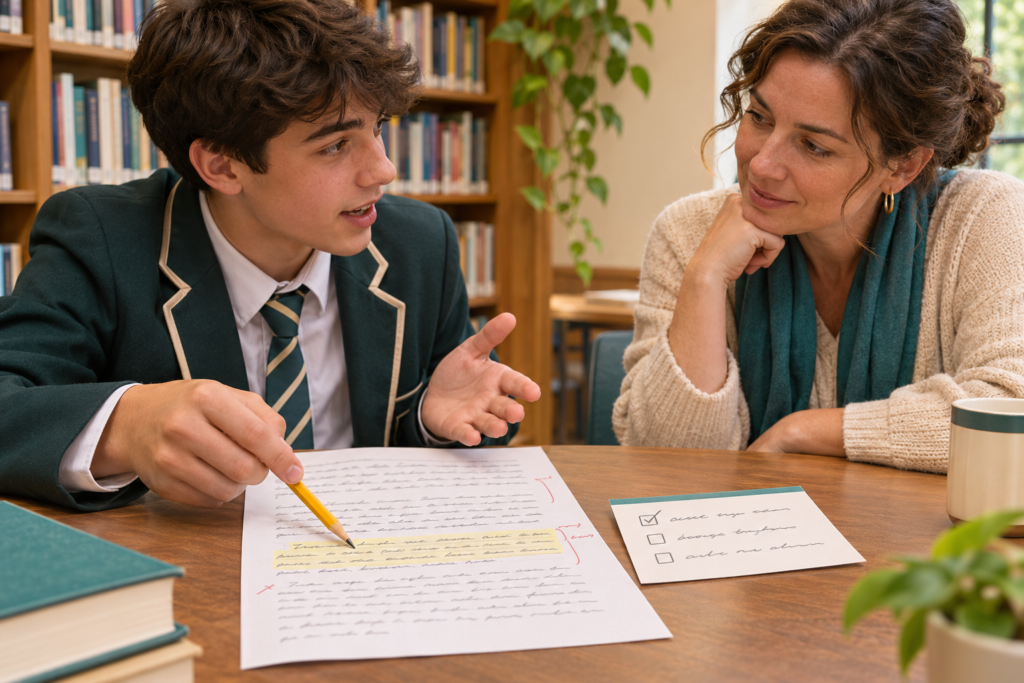
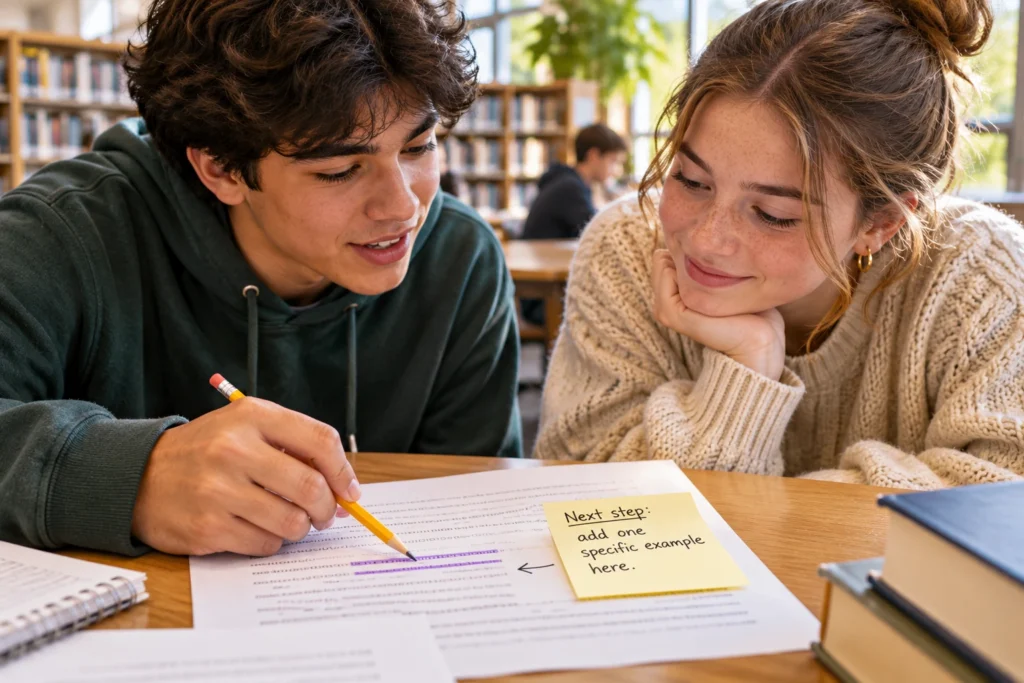
What does a useful feedback question sound like?
“I don’t understand this comment” can be a useful starting point. Help the student find the part that needs explaining: a word in the instruction, the evidence the teacher has referred to, or the change they are being asked to make. A more specific question gives both people something to inspect together.
Try the frame: “The comment says ___. In my work, ___. Could you show me ___?” Let students adapt it rather than recite it. They should be able to question advice without having to produce a perfectly polished sentence. Offer a written note or a quiet conversation when speaking in front of the class would get in the way.
AERO’s formative assessment guidance includes asking students to explain their thinking, giving them steps they can act on and allowing time for reflection. The dialogue practice below is an original way to explore those principles. It is not a tested programme, a real classroom case study or an assessment appeals procedure.
What task can the class use to practise?
Use this invented task: “Compare the two weeks. Give one supported conclusion and one limitation.” The data are counts of bikes at the school racks at 9 am on five days. Week 1 has 14, 18, 16, 12 and 20 bikes from Monday to Friday. Week 2 has 20, 22, 18, 16 and 24. New racks were installed between the two weeks. No other information is supplied.
The daily counts total 80 in week 1 and 100 in week 2. They total 20 more in the second week. These are sums of daily observations, not counts of different students: the same bike may appear on several days. The data also do not isolate the effect of the new racks from other possible changes.
Give students this deliberately imperfect response: “The daily counts totalled 80 in week 1 and 100 in week 2. The new racks caused more students to cycle.” Then show the comment: “You have not compared the two weeks.” Ask students to read the response and comment against the task before deciding what to say.
The first sentence places the two totals side by side and provides a comparison, although adding the difference would make it more explicit. The second sentence claims a cause that these observations cannot establish. The response also omits the requested limitation. A conversation can acknowledge an overlooked comparison and still identify work to improve.
How can a student question a comment that overlooks evidence?
Model the student’s question: “My first sentence gives both weekly totals. Does that count as a comparison, or do you want me to state the difference?” It identifies the relevant sentence and leaves room to clarify what the task requires. “You didn’t read it” offers no similarly precise point to discuss.
Model the teacher’s reply: “You have compared the totals; my comment was too broad. Stating that the second total is 20 higher would make that comparison clearer. We also need to look at ‘caused’ and the missing limitation.” This corrects the comment and makes the remaining issue visible. The student should not have to defend every sentence to get one overlooked detail recognised.
Ask the student to restate the agreed action: “I’ll make the difference explicit, then revise the cause claim and add what the data cannot tell us.” If that restatement does not match the intended advice, clarify it before the student rewrites the paragraph.
What if the comment is vague rather than mistaken?
Now replace the comment with “Explain more.” The student might ask: “Do you mean show how I added the daily counts, explain the difference between the weeks, or explain why I cannot claim a cause?” Each possibility would produce a different revision. A request for clarification should identify that choice.
A useful teacher response might be: “Your totals are correct. Explain the limit of the conclusion: we know what was counted, but we do not know why it changed.” Have the student underline the sentence they will revise. This checks whether the instruction has become an action they can locate.
If the teacher cannot yet identify the problem, reread the task and work together. Do not keep “explain more” simply because it sounds like normal feedback. The guide to checking whether feedback is accurate gives teachers a separate process for examining a comment before returning it.
How should you respond when the original advice is sound?
Use a third comment: “The counts do not establish that the new racks caused the change. Add a limitation.” A student may ask, “But the number went up after the racks arrived. Why can’t I say they caused it?” That question reveals a distinction worth teaching. It does not require withdrawing the advice.
The teacher can explain: “The timing is consistent with that possibility, but we have no comparison that separates the racks from other changes. We also cannot tell how many different students cycled from repeated daily counts.” Ask the student which words in their conclusion now need changing and why.
One possible revision is: “The daily counts totalled 80 in week 1 and 100 in week 2, a difference of 20. More bikes were observed in total during the second week, but these counts do not establish whether the new racks caused the change.” If discussing participation by different students, add that the same bike may have been counted on several days. Check the conclusion against the original question rather than rewarding a longer answer by itself.
How can you rehearse the conversation without making it a contest?
In pairs, give one person the response and the other one of the three comments. The student locates evidence and asks a question; the teacher checks it and states what will happen next. Swap roles with a different comment. Keep the exercise about the task, evidence and next action rather than who can win the disagreement.
Listen for three things: a relevant detail from the work, a question that can be answered by inspecting it, and an accurate restatement of the next action. A calm tone may help, but confidence, accent or fluency should not determine whether a concern gets considered. A brief written question can show the same thinking.
Keep a useful clarification prompt in the feedback comment bank if it helps the class prepare. For example: “Show me the line you think meets this part of the task, and tell me what the comment leaves unclear.” Choose wording that invites evidence instead of treating every question as resistance.
What fresh task shows whether students can use the approach?
Use a new invented task: “Compare the compost collected on Monday, 6 kg, and Friday, 9 kg. State one limitation.” The response reads: “Friday’s collection was 3 kg heavier than Monday’s. The new bins made every family compost more.” The comment says: “Your answer lacks a comparison.” Ask students to write a feedback question and identify any separate issue in the response.
A useful question points to the first sentence: “I compared the masses by giving the 3 kg difference. Is a different kind of comparison required?” The teacher should recognise that comparison. The second sentence still goes beyond the data: two total masses do not show the cause or how each family contributed. A suitable revision keeps the comparison and states that limitation.
Before students leave the conversation, ask what they will change and what evidence will support it. Follow your school’s existing process if a concern involves a formal mark or review. This classroom exercise helps clarify feedback; it does not decide an assessment appeal.
If your team is considering JeddAI for a teacher-reviewed feedback workflow, get in touch with an invented task and the kinds of questions students might ask. Discuss how teachers would check a disputed comment, correct it clearly and help the student understand the next step.
| Day | Week 1 | Week 2 |
|---|---|---|
| Monday | 14 | 20 |
| Tuesday | 18 | 22 |
| Wednesday | 16 | 18 |
| Thursday | 12 | 16 |
| Friday | 20 | 24 |
| Prompt | Your note |
|---|---|
| Task requirement | ______ |
| Comment to discuss | ______ |
| Relevant sentence, calculation or detail in the work | ______ |
| Question to ask | ______ |
| Clarification or correction agreed | ______ |
| Student’s next action and reason | ______ |