What should you check before writing another comment?
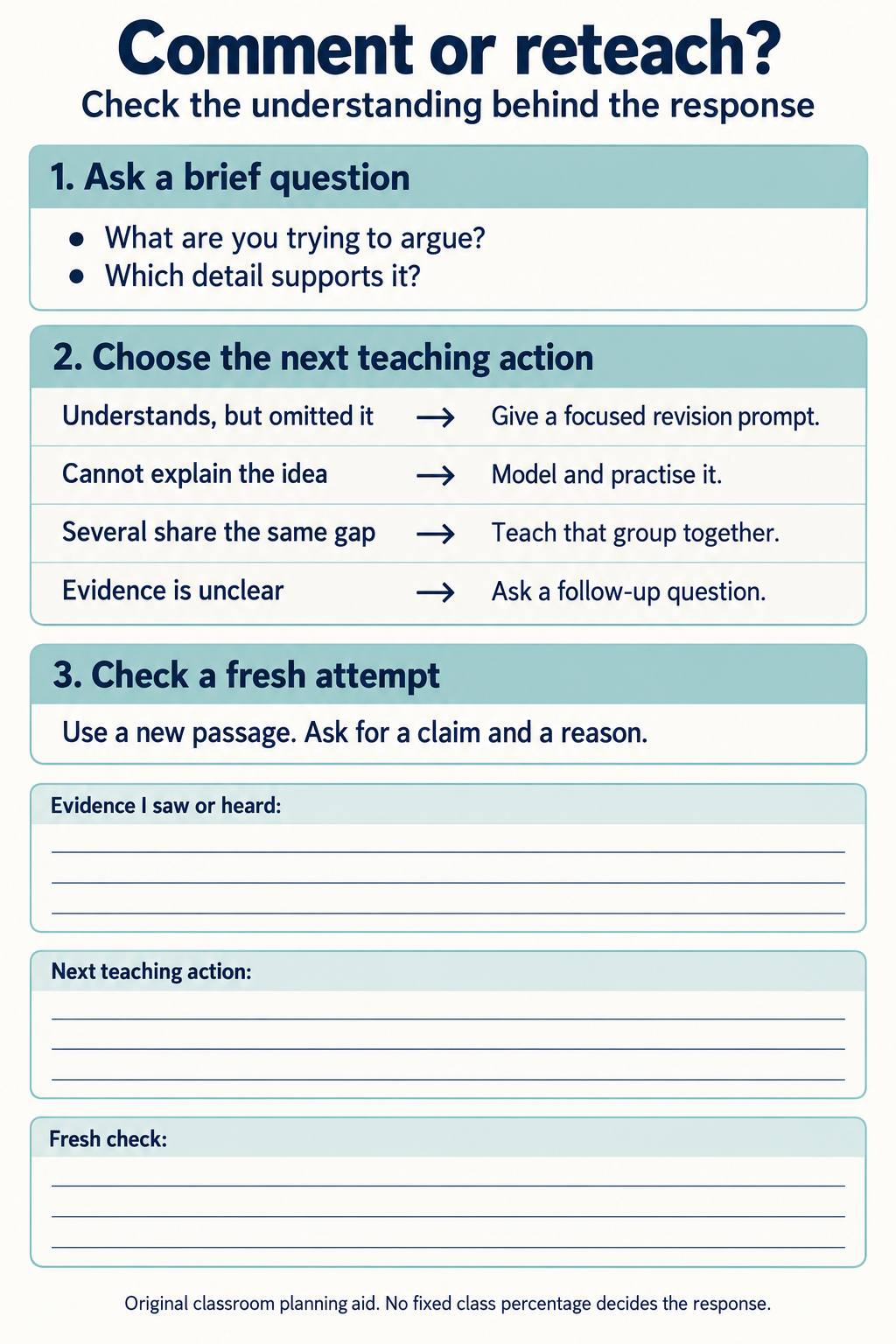
Imagine reading “Develop your thesis” on a draft that already carries the same comment from last week. Before writing it again, ask the student, “What are you trying to argue?” and “Which detail supports that idea?” The answer may reveal an idea they have not written down, a misunderstanding that needs teaching, or uncertainty that needs another question.
Give the student time to think. If writing is getting in the way, let them explain aloud, point to details or use a sketch. Difficulty producing a polished explanation is not enough to conclude that they lack the idea. Equally, repeating your sentence does not establish that they understand it.
AERO’s formative assessment guidance recommends examining students’ thinking and adapting feedback and teaching accordingly. The routine here applies that principle to an English argument. It is an original classroom exercise, not a tested intervention, a marking rubric or an account of real students.
How can a short thesis task expose different needs?
At 00:46, the on-screen checklist in the accompanying thesis video cautions against stopping at naming or describing ideas. Use that distinction as a starting point, without making every argument follow one formula. The fictional passages and teaching decisions below are original; they are not examples taken from the video.
Read this invented passage: At the council meeting, Mara laid her prepared speech beside the microphone. “Nothing needs to change,” she began. When the last bus passed the window without stopping, she folded the page. “Actually, some of us can’t get home after work.” She looked towards the chair, then kept speaking.
Ask: “How does the passage present changing one’s position?” Collect one sentence and an explanation of the detail behind it. The four sample responses in the table below deliberately include a theme label, a plot summary, a supported argument and an unsupported claim. They give you different questions to ask; they are not four fixed types of student.
For help designing a question that reveals one particular mistaken idea, see the worked guide to a question that checks a misconception. Here, the next decision is whether a comment gives the student enough to act on, or whether they need you to teach the missing step.
Which response needs a comment, a model or another question?
For “The passage presents courage and change”, ask how Mara’s position changes and what prompts it. If the student can explain the connection between the passing bus and her departure from the prepared speech, a focused revision prompt may be enough: “Replace the two theme labels with your claim about why her position changes.” Then read the revision.
For a plot summary, ask the same questions. If the student can only retell the events, demonstrate how an observation becomes an argument. If their explanation is unclear, investigate further rather than treating silence as a diagnosis. Check that the task and vocabulary are understood before deciding what needs reteaching.
For “Mara always puts others first and changes the bus policy”, ask the student to underline the evidence for “always” and for the policy changing. Neither claim is established in this passage. That calls for work on the limits of evidence. It does not automatically call for the same explanation as the student who only names themes.
A supported argument also needs a reason. Ask the student to identify the detail that makes their interpretation plausible. If they can do so, give them a fresh application while you work with those who need a model. A shared weak-looking sentence is a starting point for investigation, not a reason to assign everyone the same task.
What can a short reteaching model show?
Put three steps beside the passage. Observation: Mara folds her prepared speech after the bus passes. Relationship: noticing a practical problem disrupts the position she came ready to defend. Claim: the passage suggests that recognising who is affected can prompt someone to question a prepared view. Explain how each step depends on the previous one.
Contrast that claim with “The passage is about courage.” The theme label may be relevant, but it does not yet say what the passage suggests about changing a position. Also show the limit of the stronger claim: the passage ends while Mara is speaking. It does not tell us that the council agrees or changes anything.
Ask students to build a claim from another detail, then justify it. Accept a different interpretation if its reasoning fits the passage. You are modelling a decision about evidence and meaning, not asking for everyone to reproduce your sentence. The ten-minute returned-feedback lesson offers a structure for fitting a model and an independent attempt into a lesson.
Should you reteach the whole class or a smaller group?
Look across the explanations. If the same missing step is common and central to the current learning, a class demonstration may be useful. If only a few students need it, work with that group while others practise something they are ready for. If one student understands the idea but omitted it, give an individual revision prompt.
There is no fixed class percentage that makes this decision for you. Consider what the gap is, how confidently you have identified it and what students would miss while repeating work they already understand. Recheck after teaching; group membership should change when the evidence changes.
Use the feedback comment bank to save a prompt you have found useful, such as “Explain what changes her position, then turn that explanation into a claim.” Keep the prompt attached to its purpose. Selecting a reusable sentence is not a substitute for checking whether it addresses this student’s thinking.
How will you know whether the next step helped?
Use a fresh invented passage: Owen wrote “volunteers needed” on the noticeboard. When no names appeared, he carried the paint tins to the gate and began painting. One by one, neighbours picked up brushes. Ask: “How does the passage present leadership?” Request a claim and the detail that supports it, without displaying the earlier model.
One possible answer is: “By contrasting the empty list with neighbours picking up brushes, the passage suggests that visible participation can encourage involvement where a request alone has failed.” It connects an observation to an interpretation. Other claims may work; check their evidence. “Leadership is important” names a topic, while “Everyone always follows Owen” goes beyond the passage.
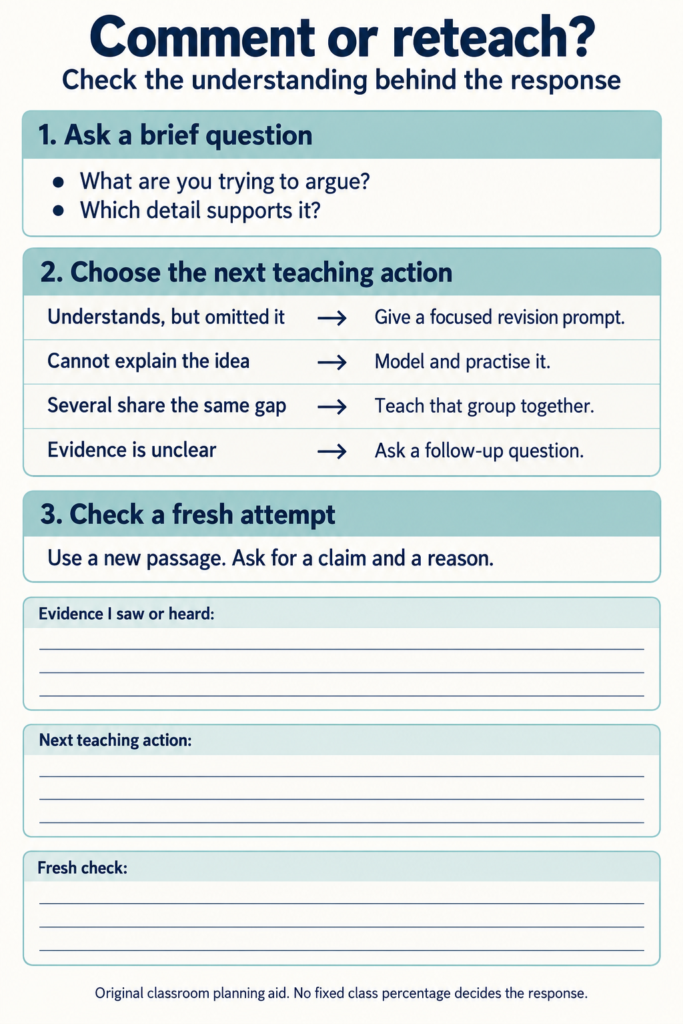
Use the printable card and planning table to record the evidence you heard, your next teaching action and the fresh check. A stronger attempt now is useful evidence, not proof of permanent understanding. Revisit the idea later and change your explanation if the same difficulty persists.
To discuss how JeddAI could fit into a teacher-reviewed feedback process, get in touch with the task and the decisions you want feedback to support. Keep the choice to reteach with the teacher who can see the work, hear the explanation and respond to the class.
| Response | What to check next |
|---|---|
| A: “The passage presents courage and change.” | Can the student explain what changes Mara’s position? If yes, prompt them to express that relationship. |
| B: “Mara speaks at the meeting and a bus passes.” | Can the student move beyond the events to their meaning? Model the missing step if needed. |
| C: “Recognising who is affected can prompt someone to question a prepared view.” | Ask which detail supports this claim, then check a fresh application. |
| D: “Mara always puts others first and changes the bus policy.” | Ask for evidence for the absolute claim and the outcome. Reread the limits of the passage. |
| Planning prompt | Your notes |
|---|---|
| Evidence I saw or heard | ______ |
| Follow-up question and any access support | ______ |
| Specific idea that needs attention | ______ |
| Next action: comment, model, group teaching or further check | ______ |
| Fresh task and evidence I will look for | ______ |