What can a comparison tell you that a show of hands cannot?
A class can agree that one paragraph is better while disagreeing about why. One student notices the connection between a detail and an interpretation. Another chooses the longer response. A third recognises a phrase you used earlier. Counting the votes treats those different decisions as the same evidence.
Ask students to compare a specific feature, then explain their choice independently. For this task, the criterion is: explain how a precise detail supports an interpretation. Do not introduce five other criteria at once. Sentence control and terminology can matter, but they are not the decision this small task is designed to inspect.
AERO’s formative assessment guidance describes gathering information about student understanding and asking students to explain their thinking so that teachers can choose the next step. The exercise below is an original application of that principle. It is not a validated diagnostic test, an official exemplar or a way to assign an exam grade.
What can you put in front of the class?
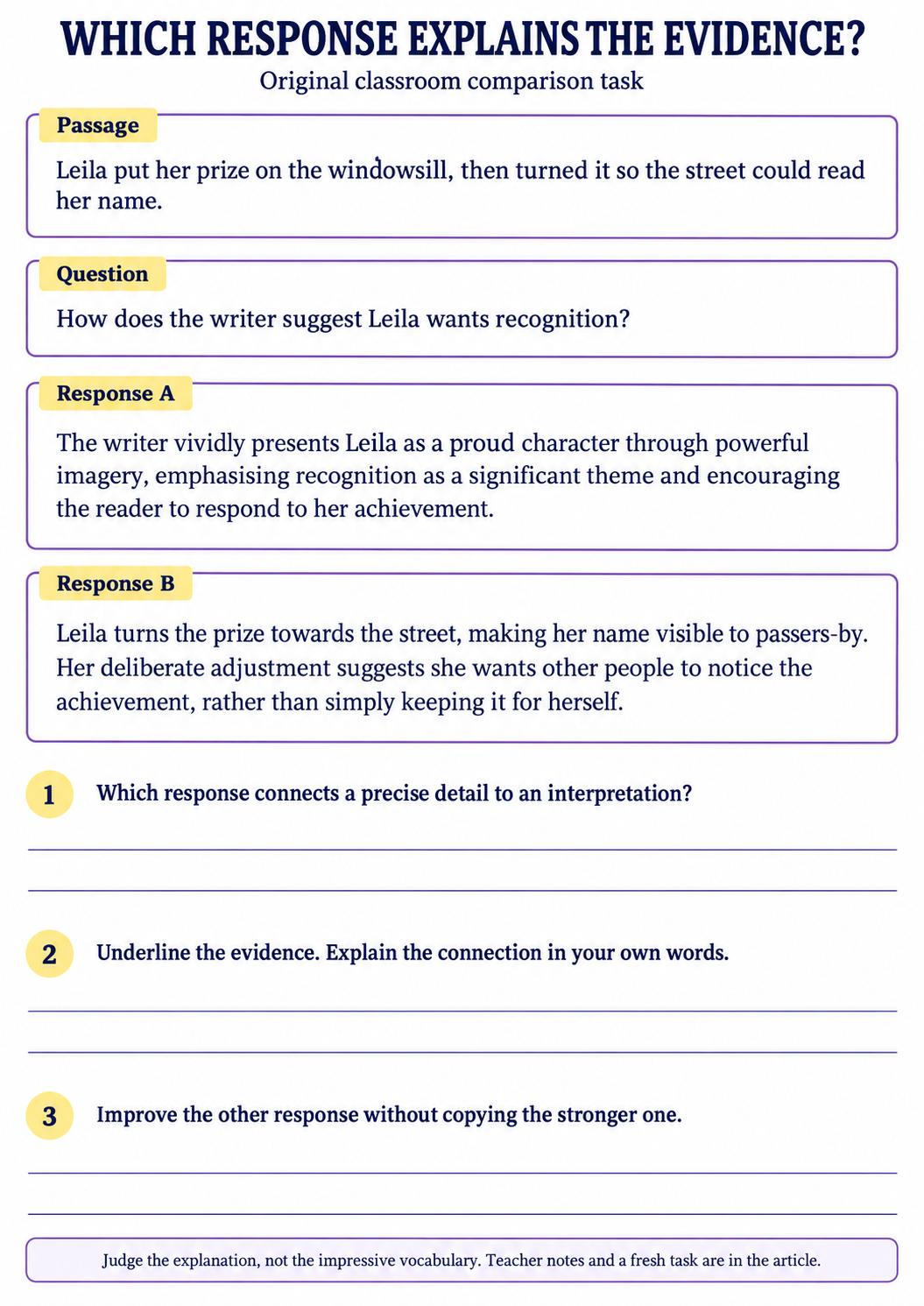
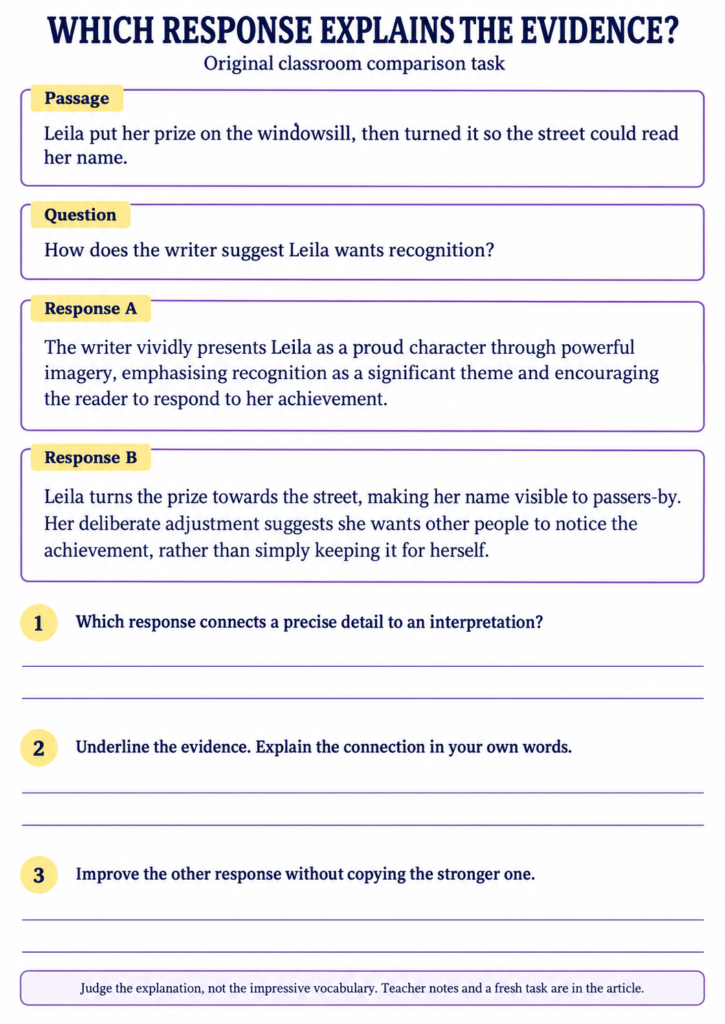
Use the printable comparison sheet or copy the following passage and responses. All three are invented for this exercise. Present A and B with the same font and layout, without labels such as “weak” and “strong”. Read the passage aloud if decoding it would otherwise obscure the reasoning you want to inspect.
Passage: Leila put her prize on the windowsill, then turned it so the street could read her name.
Question: How does the writer suggest Leila wants recognition?
Response A: The writer vividly presents Leila as a proud character through powerful imagery, emphasising recognition as a significant theme and encouraging the reader to respond to her achievement.
Response B: Leila turns the prize towards the street, making her name visible to passers-by. Her deliberate adjustment suggests she wants other people to notice the achievement, rather than simply keeping it for herself.
Ask students to complete three prompts: Which response connects a precise detail to an interpretation? Underline the evidence and explain the connection in your own words. Improve the other response without copying the stronger one.
Collect or scan the individual notes before inviting discussion. A spoken explanation, pointing to words or a scribed answer can make the thinking visible when writing fluency would hide it. Record the support used; an assisted explanation and an independent written response answer different questions.
What is the stronger response doing?
B connects the act of turning the prize towards the street with the visibility of Leila’s name. It then explains why that deliberate adjustment supports the idea that she wants other people to notice her achievement. The explanation could not be moved unchanged to any passage about success.
A offers plausible but broad claims about pride, imagery and recognition. It does not identify what in the sentence supports those claims or explain how a particular choice works. “Powerful imagery” sounds analytical, but the phrase does not do the missing reasoning.
One possible repair is: “Turning the prize so that her name faces the street makes the achievement available for other people to see. That extra adjustment suggests Leila wants public recognition.” Other wording can work. Look for the detail, the explanation and a defensible interpretation, rather than a match with this sentence.
Do not turn the answer into a rule that B is better because it has two sentences or uses simpler words. Nor does the passage prove that Leila is arrogant, that anyone actually notices the prize, or that all readers dislike her. Ask a student making one of those claims to identify the evidence for the extra conclusion.
How do you use a right choice with the wrong reason?
“B is better because it is longer” gives you a useful teaching decision. The student has selected the stronger response but has not yet stated the criterion. Ask which words in B explain the significance of turning the prize. Then ask what would be lost if that explanation were removed.
“A is better because it says imagery” suggests that terminology is being treated as sufficient evidence of analysis. Return to the passage: what action does Leila take, what changes because of that action, and how does that support the proposed interpretation? If the student cannot explain the action, model that connection before asking for a repair.
“B explains how other people could see her name” is more informative. Ask the student to point to the detail and explain why public visibility matters to the question. They may be ready for a new attempt, but recognising an explanation beside a model is not the same as producing one.
When the difficulty is specifically a correct technique label without an explanation, the lesson on moving beyond technique spotting provides separate modelling and practice. This comparison task has a narrower job: revealing the rule a student is using to judge two responses.
What fresh task checks whether the reasoning carries over?
Hide the two responses and give students this new original passage: “At assembly, Leila slid the certificate beneath her folder when the camera turned towards her.” Ask: How does the writer suggest Leila avoids attention? Require a precise detail and an explanation; do not supply another pair of answers to choose from.
One possible response is: “Leila hides the certificate as the camera turns towards her, reducing what the camera can show. The timing connects that concealment with the prospect of being photographed, suggesting that she wants to avoid attention.” The passage does not establish why she wants privacy or whether the photographer captures her.
A response that says only “imagery shows she avoids attention” leaves the connection unstated. A response claiming that she is ashamed of cheating adds a cause the passage does not supply. A student who explains the timing and concealment in ordinary language has shown the target reasoning even without naming a technique.
Check the work against the same criterion. If the student explains B well but cannot construct a fresh explanation, model how to move from the new detail to a claim and then provide guided practice. Do not record the earlier correct choice as independent success.
What should you keep for the next lesson?
Keep the initial choice, the reason, the attempted repair and the response to the fresh passage. Those four pieces let you distinguish recognising an explanation from building one. A brief note such as “chose B for length; after modelling, explained the camera timing with a prompt” is more useful than a label of “weak analysis”.
Use the decision table below to plan follow-up, not to sort students into permanent groups. On another passage the same student may need a different kind of support. The feedback comment bank can help you retain a useful prompt, provided you choose it after inspecting the actual response.
If your department is considering JeddAI for teacher-reviewed feedback, get in touch to discuss how teachers will check the evidence behind a comment and the next task it proposes. Contact or a meeting is the main next step for a department; individual teachers can also use the secondary account link.
| What the student shows | Useful next teaching step |
|---|---|
| Chooses B because it is longer. | Locate the specific explanation and compare it with the criterion. |
| Chooses A because it names imagery. | Model the link between the action, visibility and recognition. |
| Explains B, but repeats a generic claim on the camera passage. | Model the new connection, then practise with support. |
| Explains the camera timing and concealment independently. | Acknowledge that reasoning and check it later in a fuller response. |