Why can a correct label leave the analysis unfinished?
“The writer uses personification” identifies a choice, but it does not explain the meaning of that choice in a particular passage. Adding “to engage the reader” can leave the same gap. Before asking a student to add more analysis, find out whether they can explain the passage in ordinary words.
The original examples below use the same technique in contrasting situations. They let you inspect the student’s interpretation separately from their recall of terminology. The responses are invented teaching examples, not real student work or official exemplars. There is no fixed sentence count or claim that one formula will meet every assessment criterion.
AERO’s formative assessment guidance recommends asking students to explain their thinking and using that information to decide what to teach next. This task applies that principle: a student who understands a passage but cannot name the technique needs different help from one who can name it but misreads the situation.
What changes when the same technique appears in two contexts?
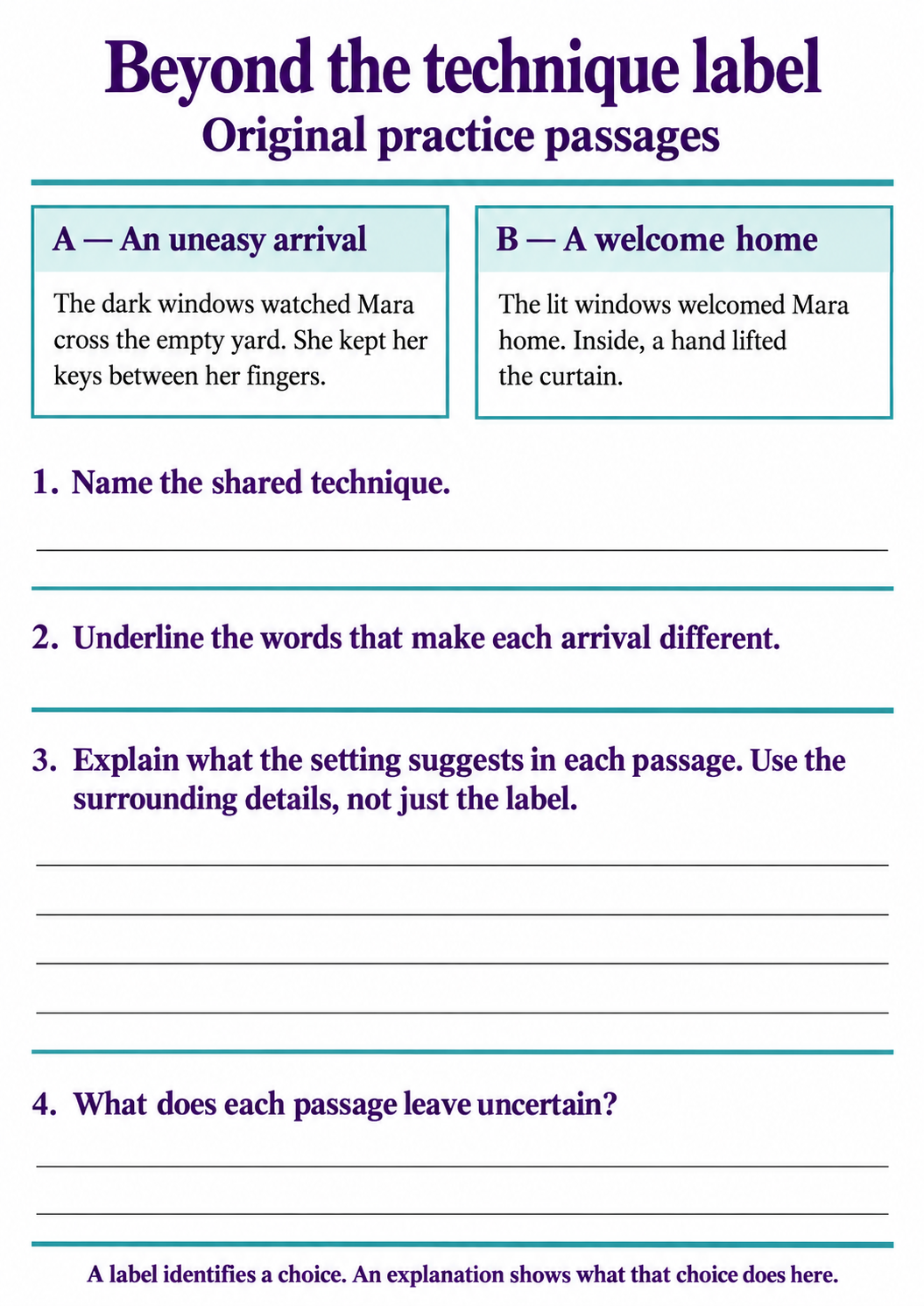
Passage A: The dark windows watched Mara cross the empty yard. She kept her keys between her fingers.
Passage B: The lit windows welcomed Mara home. Inside, a hand lifted the curtain.
Both passages personify the windows, assigning them actions associated with people. In A, “watched” combines with “dark”, “empty” and Mara’s grip on her keys to suggest a guarded arrival. Those details can support a reading of unease; they do not establish that an attacker is actually present.
In B, “welcomed” appears beside “lit”, “home” and the movement of a hand at the curtain. Together they suggest being received at an occupied home. The passage does not identify the person at the window or explicitly state Mara’s feelings. Ask students which details support their reading and what remains uncertain.
The printable worksheet labels these situations “An uneasy arrival” and “A welcome home”. Those headings deliberately scaffold the comparison. Use it for guided practice, then remove that support for the fresh task later in this article. Success with an answer suggested by a heading is not evidence of independent interpretation.
What should you ask a student who gives a generic effect?
Imagine the response: “The writer uses personification to make it interesting.” The label fits, but the effect could be attached to either passage. Ask, “What changes if ‘watched’ becomes ‘welcomed’?” Then ask the student to connect that change to another detail. This requires a decision about meaning instead of another general claim about readers.
If the student explains the contrast orally, ask them to write that explanation beside their evidence. A usable comment is: “You have identified personification. Explain what ‘watched’ suggests here, using one surrounding detail to support your reading.” If they cannot yet explain it, discuss the action and context together before requiring an independent revision.
Do not insist that every reader must feel the same emotion. “The description suggests that Mara is guarded” is a claim to test against the text. “It makes every reader terrified” adds a universal response the passage cannot establish. Encourage a supported interpretation rather than a dramatic effect word.
What should you do when the interpretation goes beyond the text?
Now imagine: “The windows are people waiting to attack Mara.” This response supplies a meaning, but treats the figurative action as literal and adds an attack the passage does not describe. Asking for “more detail” could deepen the error.
Ask, “Are the windows literally watching? Which words suggest Mara may be cautious? Which words establish an attacker?” The final question has no answer in this passage. Help the student separate a supported suggestion of unease from a confirmed event. A useful revision task is: “Explain the impression created by the watching windows, then state one thing the passage leaves uncertain.”
A student may propose a different reading, such as a house that seems observant. Ask them to account for “dark”, “empty” and the keys. Do not mark down a defensible interpretation simply because it differs from the model, but do require the explanation to fit the details it uses.
What does a supported explanation look like?
One possible explanation of A is: “Personifying the windows as watching makes the setting seem watchful. Alongside the dark windows, empty yard and Mara’s grip on her keys, this suggests a guarded arrival. The description creates that impression without confirming who, if anyone, is watching her.” The explanation connects the choice to context and states its limit.
For B, a possible response is: “The windows ‘welcomed’ Mara, presenting the house as a receiving presence. The light and the hand lifting the curtain support this impression of an occupied home. The passage leaves the identity of the person inside unstated.” This uses the same label but reaches a different interpretation because the evidence differs.
Show students which part names the choice, which part explains its significance and which details support the reading. These jobs may be combined in different ways. When a paragraph also has problems with relevance, evidence and sentence control, prioritising paragraph feedback can help you choose a first revision task.
How can you check understanding on a fresh passage?
Use this new original passage without the arrival headings or model answers: “The empty chair waited at the dinner table. Nobody moved it.” Ask students to explain what “waited” suggests, support the explanation with the second sentence and identify something the passage does not reveal.
A possible answer is: “Giving the empty chair the action of waiting suggests an absence or an unfilled place. ‘Nobody moved it’ shows that the place remains, which can strengthen a sense of expectation. The passage does not say who should occupy it, why they are absent or whether they will return.” Other readings may work if the student explains their evidence.
A claim that the absent person has died goes beyond the supplied text. A response that merely identifies personification leaves the meaning unexplained. If a student can explain the unfilled place but forgets the term, teach or revisit the term without treating their interpretation as absent. Record the specific next step rather than a single verdict of “weak analysis”.
What should you retain in a reusable feedback record?
Keep the student’s actual explanation, the evidence they used, the question you asked and what the next attempt showed. The record below distinguishes interpreting the passage from recalling a label. You can adapt the feedback comment bank to store prompts, but choose them after reading the student’s work.
If your department is considering JeddAI for a teacher-reviewed feedback process, get in touch with examples of the decisions teachers need to check. A useful starting point is how you distinguish a correct label, a supported explanation and an interpretation that needs revisiting. Keep that judgement visible in any feedback workflow.
| Student response | What to check next |
|---|---|
| “Personification makes it interesting.” | Can the student explain a particular meaning using surrounding words? |
| “The windows are people waiting to attack.” | Can the student distinguish figurative suggestion from a literal event and an unsupported claim? |
| Explains the guarded arrival but cannot name personification | Teach or revisit the term while recognising the interpretation already demonstrated. |
| Prompt | Your note |
|---|---|
| Student’s explanation and selected words | ______ |
| Need: terminology, interpretation, evidence or qualification | ______ |
| Question or model that addresses this need | ______ |
| Specific revision task | ______ |
| What the fresh chair passage showed | ______ |