What should decide the first feedback priority?
A paragraph can contain a mistaken interpretation, weak evidence, a vague technique label and a grammar error at once. Marking every feature does not tell the student which change to begin with. Start by naming the learning goal and identifying the problem that most obstructs it. Then check whether the student can see that problem and knows how to approach it.
The priority depends on the task. If students are learning to support an interpretation, a claim contradicted by the passage may need attention before a sentence-level correction. If the task specifically practises subject–verb agreement, the grammar may be the point of the exercise. There is no universal instruction to leave grammar until last.
AERO’s formative assessment guidance connects feedback to evidence of students’ understanding and to the next teaching step. The example below is an original way to make that decision visible. It is invented practice material, not student work, an official exemplar or a tested ranking of feedback priorities.
What does a paragraph with several problems look like?
Use this fictional passage: Elena saw the new student standing by the locked art room. She put her lunchbox down. “The key is at the office,” she said, and walked there with him. When they returned, she held the door while he carried in his wet painting.
The task is: “Explain what Elena’s actions suggest about welcoming a newcomer.” Here is an invented response: “Elena refuses to help the new student, showing how lonely she is. The writer use dialogue to make the reader feel sorry, it is interesting. This shows friendship.”
Several issues deserve attention. The opening contradicts Elena’s actions; the claim about loneliness is unsupported; the explanation of dialogue is vague; “writer use” has an agreement error; and the middle sentence joins ideas awkwardly. The response does identify a real feature, dialogue. Keep that observation available, even though its significance has not yet been explained.
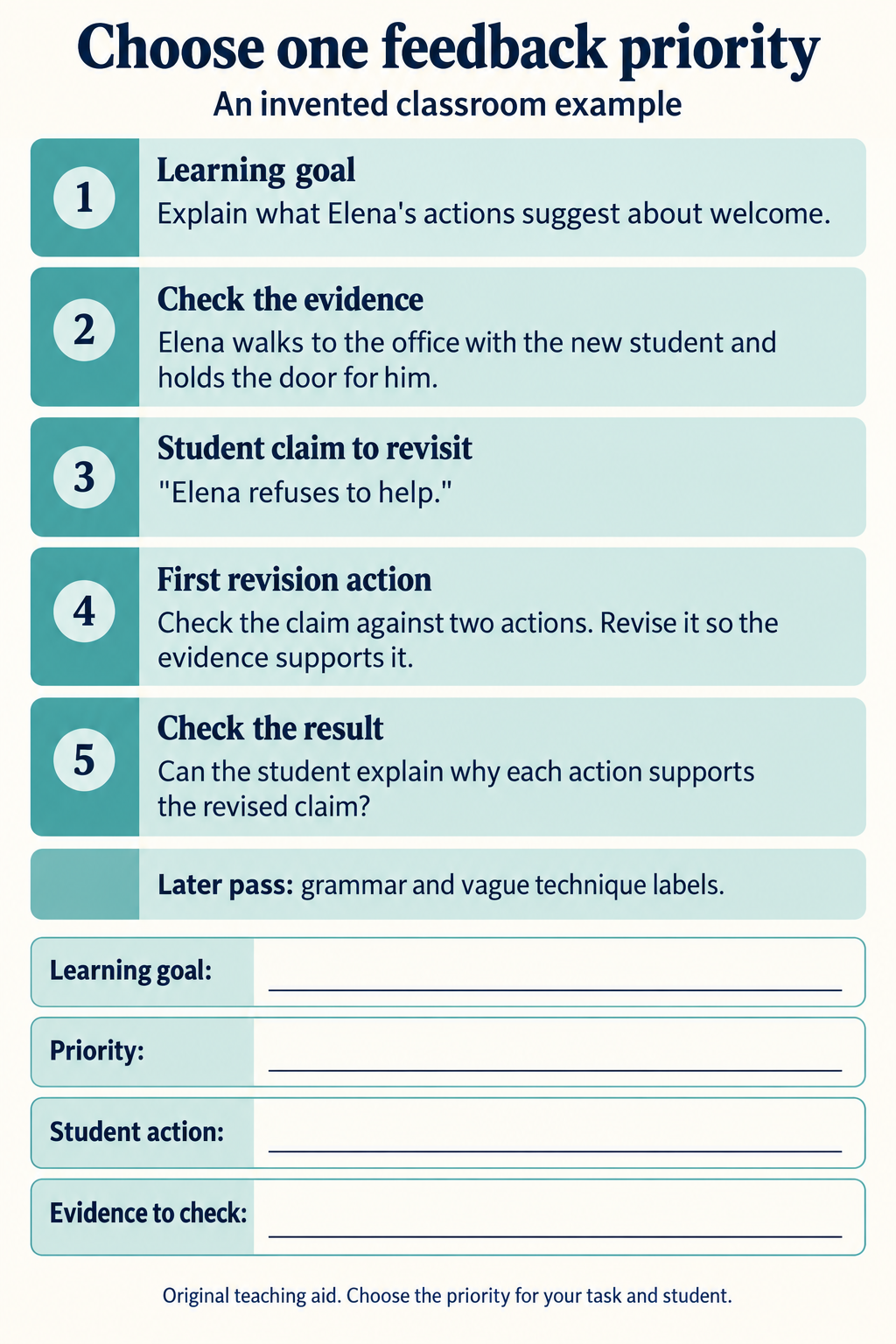
For this learning goal, start with the interpretation. Polishing the sentence about Elena refusing to help would leave the central reading wrong. The table below separates the teacher’s observations from the first student action. If the learning goal itself is unclear, the guide to turning a rubric descriptor into a student action can help you make it observable.
How can you turn the priority into a usable comment?
First ask, “What does Elena do after she tells the student where the key is?” Let the student answer aloud or point to the passage if that makes their reasoning easier to inspect. They may have missed a line, misunderstood who walked to the office, or written the opposite of what they intended. Those possibilities call for different amounts of support.
If the student can identify her actions, try this comment: “Check your opening claim against Elena walking to the office with the student and holding the door. Rewrite the claim so it fits those actions, then explain how each action supports your view of welcome.” This gives a location, a task and something to check without supplying the finished interpretation.
If the student cannot explain the actions, return to the passage together before asking for revision. Model how one detail supports a claim, then ask the student to reason through the other. A written instruction cannot replace an explanation the student needs. Record the next step in the feedback comment bank if useful, but check its fit before reusing it.
Tell the student what is deferred: “First we’ll make the interpretation fit the passage. We’ll check the grammar and the explanation of dialogue afterwards.” Deferring an issue should create an order for the work, not silently suggest that everything else is correct.
What would count as a worthwhile first revision?
A possible revision is: “Elena makes welcome practical by helping the new student gain access to the art room. Walking to the office with him turns information into assistance, while holding the door helps him bring in his painting.” This is one supported interpretation, not the only acceptable wording. Ask the student to explain the connections rather than copy the model.
Compare that with a smaller change: “Elena helps the new student. The writer uses dialogue to make the reader feel sorry.” The first claim is now accurate and the grammar is corrected, but the paragraph still does not explain how the actions support its view of welcome. The revision task is not complete just because two errors disappeared.
Check the student’s explanation beside the paragraph. If it reveals sound thinking that has not reached the page, ask them to add the missing connection. If the reasoning is still uncertain, revisit one detail. Keep any praise specific to the change you can see: “Your claim now matches her actions; show why those actions matter to the idea of welcome.”
When should you return to the issues you deferred?
Once the argument is supported, decide whether the technique sentence earns its place. In this example, it could explain how Elena’s words give the newcomer useful information, or it could be removed if the paragraph already explains the actions clearly. Do not keep a technique label merely because it sounds like analysis.
Then address sentence control using the version the student actually intends to keep. “The writer uses” fixes the agreement error, but correcting a sentence that will be removed may not be the most useful first task. If the error recurs across the student’s writing, plan a separate short exercise rather than assuming one correction resolves it.
Allow time for these passes. The ten-minute returned-feedback lesson offers a structure for a brief model, student revision and a check. The sequence is flexible: a student who can handle two related changes may tackle them together, while another may need a conversation before attempting the first.
How can you check the priority on a fresh paragraph?
Try a second invented passage: Arun said, “Sit here,” but left his bag on the chair. Sam waited, then moved to another table. Ask the student what this passage suggests about welcome, and require a claim supported by the actions. Do not show the Elena model while they work.
A possible answer is: “Arun’s invitation does not become practical welcome: the bag still blocks the offered seat, and Sam leaves.” This fits the contrast between words and actions. The passage does not establish why Arun leaves the bag there, so an explanation that he deliberately wants to exclude Sam needs more evidence.
Use the planning record below to save the learning goal, the priority, the student’s action, what can wait and the evidence you will inspect. A useful record explains why you chose the order. It should not become another list of everything the student has done wrong.
If you want to discuss how JeddAI could support a teacher-reviewed feedback process, get in touch with a task and the kinds of decisions you need to make. Keep the final priority grounded in the student’s work and the learning you are checking.
| Observation | Decision for this task |
|---|---|
| Claim contradicts Elena’s actions | First check: can the student identify and explain the actions? Revise the interpretation against two details. |
| Loneliness is asserted without support | Revisit with the opening claim. Ask what evidence would justify this inference. |
| Dialogue is named but its effect is vague | Later pass: explain what the words do here, or remove the sentence if it adds nothing. |
| Agreement and sentence control need attention | Edit the sentences retained after the argument is revised; plan further practice if the pattern persists. |
| Prompt | Your decision |
|---|---|
| Current learning goal | ______ |
| Evidence of the main obstacle | ______ |
| What I will ask before deciding | ______ |
| Student’s first revision action | ______ |
| What can wait and when we will return to it | ______ |
| What I will check in the revision and a fresh task | ______ |