Why is “use better evidence” difficult to act on?
A student who receives “use better evidence” still has several decisions to make. Is the detail irrelevant? Have they changed the words? Does the quotation leave out a qualification? Or have they chosen something useful but not explained it? A longer quotation will not fix all four problems.
The examples below let you distinguish these decisions before writing a comment. They use an invented library notice and passage, so you can share the complete material with a class. They are practice tasks, not real student work or official assessment exemplars. The aim is to make a claim fit the evidence, rather than to collect impressive-sounding quotations.
AERO’s formative assessment guidance recommends asking students to explain their thinking and using that information to choose the next teaching step. Here, that means asking why a student chose a detail before deciding whether they need a prompt, an explanation or another example.
What can students select from this short passage?
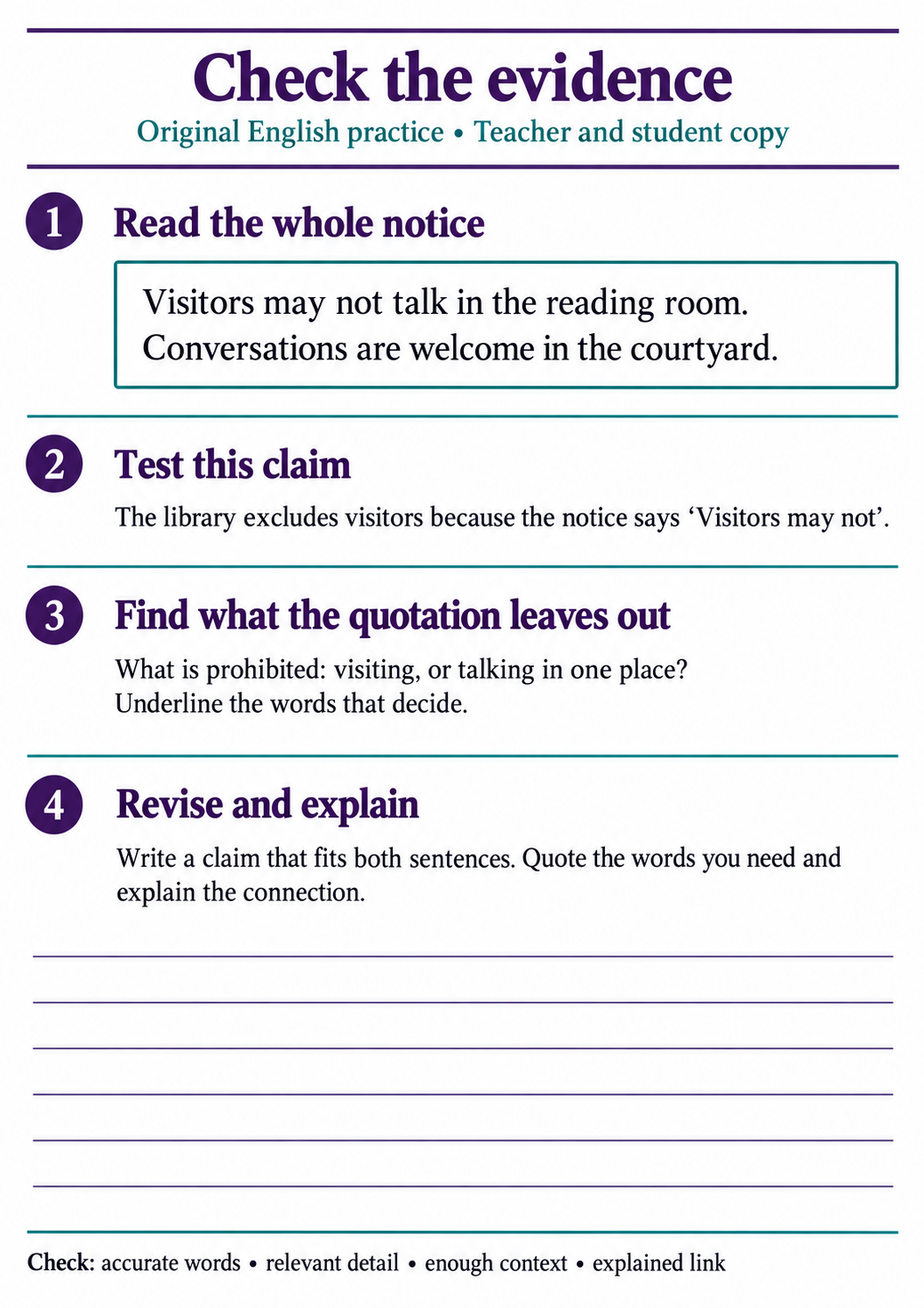
Use this original passage: The library notice said, “Visitors may not talk in the reading room. Conversations are welcome in the courtyard.” Imani read it, then moved two chairs into the courtyard so she could talk with her grandfather without disturbing the readers. His red scarf hung over one chair.
Ask: “How does Imani respond to the library’s rules?” A defensible claim is that she finds a way to continue the conversation while respecting the reading room’s quiet. The action of moving the chairs and the stated reason both support that reading. The scarf adds a visual detail, but its colour alone does not explain her response to the rules.
Before showing a model answer, ask the student to choose a detail and explain its relevance aloud or in writing. The answer may reveal that they understand the event but selected the wrong words, or that they have misunderstood the rule itself. Those are different teaching problems.
How should feedback change for different evidence problems?
For irrelevant evidence, imagine: “Imani follows the rules because her grandfather has a ‘red scarf’.” Ask, “What does the colour tell us about her response to the rule?” If the student cannot make a supported connection, ask them to locate an action that does. A usable comment is: “Replace the scarf detail with an action that shows how Imani responds. Explain why that action matters.”
For an inaccurate quotation, imagine: “The notice says ‘Visitors may talk in the reading room’.” The missing “not” reverses the rule. Ask the student to compare their quotation with the full sentence, restore the missing word and reconsider any interpretation built on it. Treat this first as a check of the work, without assuming why the omission happened.
For missing context, imagine: “The library excludes visitors because the notice says ‘Visitors may not’.” Those three words occur in the source, but the cut makes a restriction on talking appear to be a restriction on visiting. Ask, “What exactly may visitors not do, and where?” Then have the student revise both the quotation and the claim. Adding words while keeping the same claim would leave the misreading intact.
For unexplained evidence, imagine: “Imani respects the rule because she ‘moved two chairs into the courtyard’.” This is relevant and accurate. Ask the student to explain why that location matters. They could connect the move to the notice allowing conversation there, and to Imani’s purpose of avoiding disturbance. They do not need to replace a useful quotation just because the explanation is incomplete.
What would a supported revision look like?
One possible revision is: “Imani works within the rule while keeping the conversation going. She ‘moved two chairs into the courtyard’, where the notice says conversations are welcome, so talking with her grandfather does not disturb the readers.” The claim, action and explanation now fit together. Other wording is valid if it preserves those relationships.
Compare this with: “Imani is respectful because she follows the rules.” It may be a reasonable claim, but it does not identify the action or explain how it fits the rule. Repeating the claim in different words is not a substitute for evidence. Ask the student to point to the part of their revision that does each job.
If the student can explain the connection orally but not in the paragraph, ask them to put that explanation beside the quotation. If they cannot yet explain it, return to the notice and the action together. A comment should not demand an independent step that has not been taught. When several problems compete for attention, the guide to prioritising paragraph feedback shows how to choose a first task and return to the others.
How much of the quotation should a student include?
Keep the words needed to support the claim without changing the source’s meaning. There is no useful fixed word count for every quotation. “Visitors may not” is short but misleading here. “Visitors may not talk in the reading room” preserves the action and location that the rule restricts.
A longer quotation is not automatically stronger either. Copying the whole passage could include the irrelevant scarf and still leave the connection unexplained. Ask the student to mark which words do the work, then read the surrounding sentence to check that the selection is fair. If your task requires a particular quotation convention, teach that separately from choosing relevant evidence.
How can you check the learning on a fresh notice?
Give students this new, original notice without the library model beside it: “The sports hall is closed during lunch on Tuesday. The outdoor court remains open.” Ask them to assess this claim: “There is nowhere to play sport at lunchtime because the notice says ‘The sports hall is closed’.”
A supported response should identify two limits. The hall closure is for Tuesday lunchtime, and the outdoor court remains available. A possible revision is: “On Tuesday at lunch, the notice directs activity away from the closed hall while leaving the outdoor court open.” The notice does not tell us whether someone will actually play, what equipment is available or why the hall is closed.
Look for the student preserving the time restriction and considering the second sentence. A student who simply adds “Tuesday” but still claims that nowhere is open has fixed only part of the problem. Use the printable library task for supported practice and this sports-hall notice as a separate check. Both can be answered in words, without requiring a technique label.
What should you keep in a reusable feedback record?
Record the actual evidence problem, the question you asked, the revision task and what the new attempt showed. The table below gives a short record to copy. Avoid saving “needs better evidence” as if it explains the decision. The feedback comment bank can help you organise comments, but each one still needs to match the source and the student’s work.
If you are considering JeddAI for a teacher-reviewed feedback workflow, get in touch with the kinds of tasks and evidence decisions your department handles. A useful discussion starts with the work teachers need to inspect. Keep the teacher’s check of the source, the claim and the proposed next step visible in that process.
| What you notice | What to ask the student to do |
|---|---|
| Irrelevant detail: “red scarf” | Choose an action that answers the question and explain the connection. |
| Inaccurate words: “may talk” | Restore “not”, then recheck the interpretation. |
| Clipped context: “Visitors may not” | Identify the restricted action and place; revise the claim as well as the quotation. |
| Relevant quote without a connection | Explain why moving to the courtyard fits the rule. Keep the useful evidence. |
| Prompt | Your note |
|---|---|
| Student’s claim and selected detail | ______ |
| Decision to revisit: selection, accuracy, context or explanation | ______ |
| Question that will reveal the student’s thinking | ______ |
| Specific revision task | ______ |
| What the fresh passage showed | ______ |