Which part of the exam pack should you open?
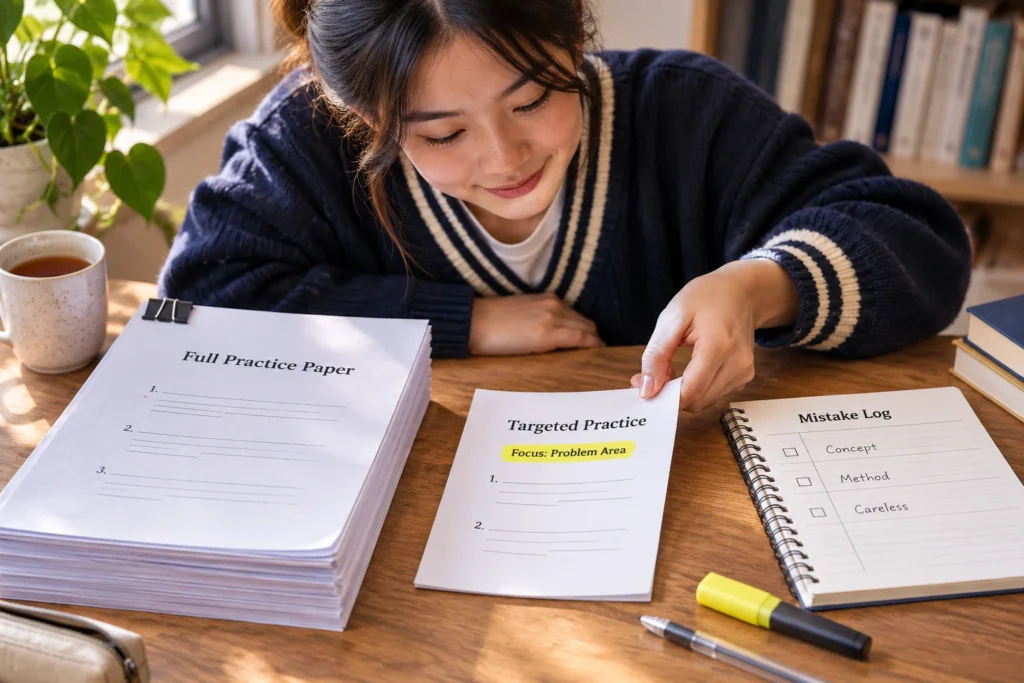
Keep the question, your answer and the feedback for that question together. In the NSW English Standard 2025 HSC exam pack, the marking guidelines describe the criteria for mark ranges. The marking feedback discusses qualities seen across responses. A comment about many papers is a prompt to inspect yours. You may already have done what it recommends.
For example, the feedback on Paper 1, Section I, Question 2 discusses how clearly students explained the influence of role models. It identifies two connected jobs for the writer: choosing a detail that bears on the influence and explaining the particular quality the person learned. That is specific enough to test on a practice answer. Copying a phrase about “influence” into your introduction leaves both jobs undone.
Use the past-paper library to find the relevant authority, then choose your course, year and question. If you move to an older paper, check that the material still fits the task your teacher has set. The 2025 example here shows how to read feedback from that paper.
Can you spot the problem in this practice answer?
Read this original practice passage. “When a radio went quiet on Aunt Vi’s bench, she put the screws in a saucer. ‘Tell me what you’ve tried,’ she said to its owner. Years later, a boy brought me a broken radio. Before I opened the case, I pulled up a stool for him.”
The practice question asks how the narrator shows what Aunt Vi taught them about dealing with people. Here is a first attempt: “Aunt Vi fixes radios and later the narrator fixes a radio too. This shows that Aunt Vi was a role model.” Cover that response and answer the question aloud. What has the narrator learned to do for the person waiting beside the bench?
The first attempt notices a real parallel, the two radios, but that parallel alone suggests an interest in repairs. The question asks about dealing with people. You could leave the word “radio” in place and add “positive”, “powerful” or “significant” before “role model”. The reader would still have to supply the missing explanation.
What would one useful revision look like?
Go back to the two interactions. Vi asks the owner to tell her what they have tried. The narrator offers the boy a seat before opening his radio. Try a revision that connects those actions. For instance: “Vi invites the owner into the repair by asking what they have tried. Years later the narrator’s first move is to pull up a stool for the boy. The gesture carries on Vi’s habit of making the person who brought the problem feel included.”
Test the wording against the passage. “First move” is supported by “before I opened the case”. Saying the boy learned to repair the radio would go further than the ending allows. The stool makes space for him. We never see what he does next.
Now write your own single-sentence version. A useful test is whether a reader could identify both the habit and the two details that carry it across time. A shorter answer can work if it does those jobs. This practice passage and its possible answers were written for this exercise.
How do you know whether that comment applies to your own answer?
Return to your paper. Underline the words where you name what the role model taught the person. Put brackets around the detail that supports your interpretation. Draw a line between them only if you can finish the sentence “This detail matters because …” using the meaning of this particular text.
If both parts are present and the explanation fits the question, leave the sentence alone and inspect another part of your response. If the evidence is present but the inference is missing, add the inference. If the detail points to a different idea, look for a better detail before polishing the wording. The table below gives you a place to record the decision.
Can you make the same decision on a fresh passage?
Try this second invented passage. “When our team met, Sal always asked the newest player to speak first. At my first rehearsal as conductor, I lowered my baton and turned to the two players at the back. ‘What can you hear from there?’” Explain one way Sal’s example shapes the conductor’s behaviour.
One answer is that the conductor learns to invite people who might otherwise go unheard. Sal calls on the newest player, and the conductor pauses to ask the players at the back for their perspective. The answer uses different details from the radio passage. It also avoids claiming that the players were unhappy or that the rehearsal improved afterwards. Neither outcome is given.
Write the change you made in the exam error log while the reason is fresh. “Link the later gesture to the earlier invitation” gives you something to look for in a new response. “Improve analysis” gives you little to check.
If you want another round of feedback on a practice response, you can create a student account and bring that particular question to JeddAI.
What if the report comments on something you already did?
Read one response beside the exact wording of the question. A comment about a common weakness can be irrelevant to that response, even when it sounds familiar. If you can point to a precise answer, supporting evidence and an explanation, choose a different issue or ask your teacher which revision would have the greatest effect.
For practice with a particular set text, browse the study-guide catalogue and check the title and contents against your course. Keep the official question and its marking materials beside your response when judging how well your revision answers it.
| Decision | Example from the radio passage |
|---|---|
| What does the question ask? | How the narrator learned to deal with people. |
| Which part of my answer needs work? | Repeating that both characters fix radios leaves the effect on people unexplained. |
| Which detail changes my reading? | The stool is offered before the narrator opens the radio. |
| What can I now explain? | The narrator repeats Vi’s habit of including the owner in the repair. |
| How will I check the next attempt? | Use the rehearsal passage. Identify the learned habit and explain how the later action shows it. |