What do you need your next attempt to tell you?
Another completed paper is easy to count. It is less useful if you finish it with the same unanswered question about your learning. Before opening the next one, complete this sentence: “I need to find out whether I can…” The ending might be “expand brackets correctly”, “choose relevant evidence for an unfamiliar question” or “finish all sections within the available time”.
These are different jobs. A short set of carefully chosen questions can show whether you have changed a particular method. A full paper can show what happens when you have to manage several kinds of task in sequence. Neither format is automatically the more serious option.
The decision routine below is an original planning aid. It is not an official exam recommendation or a tested formula for allocating study time. Use it with your teacher’s advice, the work you have already completed and the conditions of your course.
When is targeted practice the better next step?
Choose a focused task when the response gives you a specific problem to work on. “Algebra is weak” is too broad. “When expanding brackets, I multiply the first term but leave the second unchanged” identifies an action you can inspect and practise.
Consider this invented example. A student solves 3(x + 2) = 21 by writing 3x + 2 = 21. The useful next task is to explain why both terms inside the brackets must be multiplied by 3, then try an equation with different numbers. Completing another whole paper immediately may produce another instance of the same mistake without resolving it.
The corrected working is 3x + 6 = 21, then 3x = 15, so x = 5. Substituting gives 3(5 + 2) = 21. For an independent check, hide that model and solve 4(x − 1) = 20. The result is x = 6: expanding gives 4x − 4 = 20, and substitution gives 4(6 − 1) = 20.
After the focused task, include the skill in a mixed set where the question does not announce which method to use. Otherwise, you have checked performance with a strong clue but not whether you can select the method. The mistake-log worked example shows how to record the changed decision and the result of a new attempt.
When does a full paper give you evidence you are missing?
Use a full paper when the question concerns the whole performance: coverage across sections, pacing, decisions about which questions to attempt, or maintaining clear responses over the required duration. Choose material suited to your course and follow its instructions, including permitted materials and any arrangements that apply to you.
Here is a second invented situation. A student can explain answers from each section when practising separately, but has not attempted the sections together. The concern is whether early answers take so long that the final section is rushed. Another isolated question will not show how time is distributed across a full attempt.
Before starting, record the paper, conditions and what you intend to observe. Afterwards, note where time was spent, which responses were incomplete and whether those responses can be completed correctly when time is available. Being unable to finish does not by itself prove a pacing problem: a gap in understanding may have caused the delay.
NESA’s HSC exam-paper library provides past papers with marking guidelines and feedback. Check the subject and year rather than assuming every older question matches your current course. The past-paper library links to official authorities so you can find materials for your jurisdiction; it does not reproduce their exam papers.
What if the result does not tell you which problem to tackle?
A total mark can hide several causes. Return to a response you lost marks on and compare the question, your working and the marking guidance. Did you misunderstand the demand, leave out knowledge, choose an unsuitable method, or run out of time? Treat your first explanation as something to check, not a label to attach permanently.
If you cannot explain a correction, ask your teacher about that response before choosing a larger practice task. A useful question is: “I can see this step is wrong, but I do not understand why. Can you help me identify what I should practise?” Bring the original work so the conversation is about evidence.
You do not need to settle on one format for the rest of revision. A full paper might identify a gap that needs focused work. A focused task might go well, but a later mixed or timed attempt might show that you still need help selecting the method. Let the result change the next choice.
How do you plan the check, rather than just the task?
Write down how you will judge the attempt before you start. For the brackets example, look for multiplication of both terms, correct equation solving and a substitution check. For the pacing example, look at completion and time allocation alongside the quality of the answers. “I spent an hour studying” does not answer either question.
AERO’s spacing and retrieval explainer describes spreading learning over time and giving students opportunities to recall and use what they have learnt. That supports returning to a skill later and trying to explain it independently. It does not prescribe a universal ratio of full papers to targeted questions.
Keep a later check in the plan, and leave time to review it. The revision planner can help you give the task and its review separate places in the week. If you only have time for a section today, record it as section practice; do not treat its result as evidence that you completed the whole paper under exam conditions.
What can you put on the decision sheet today?
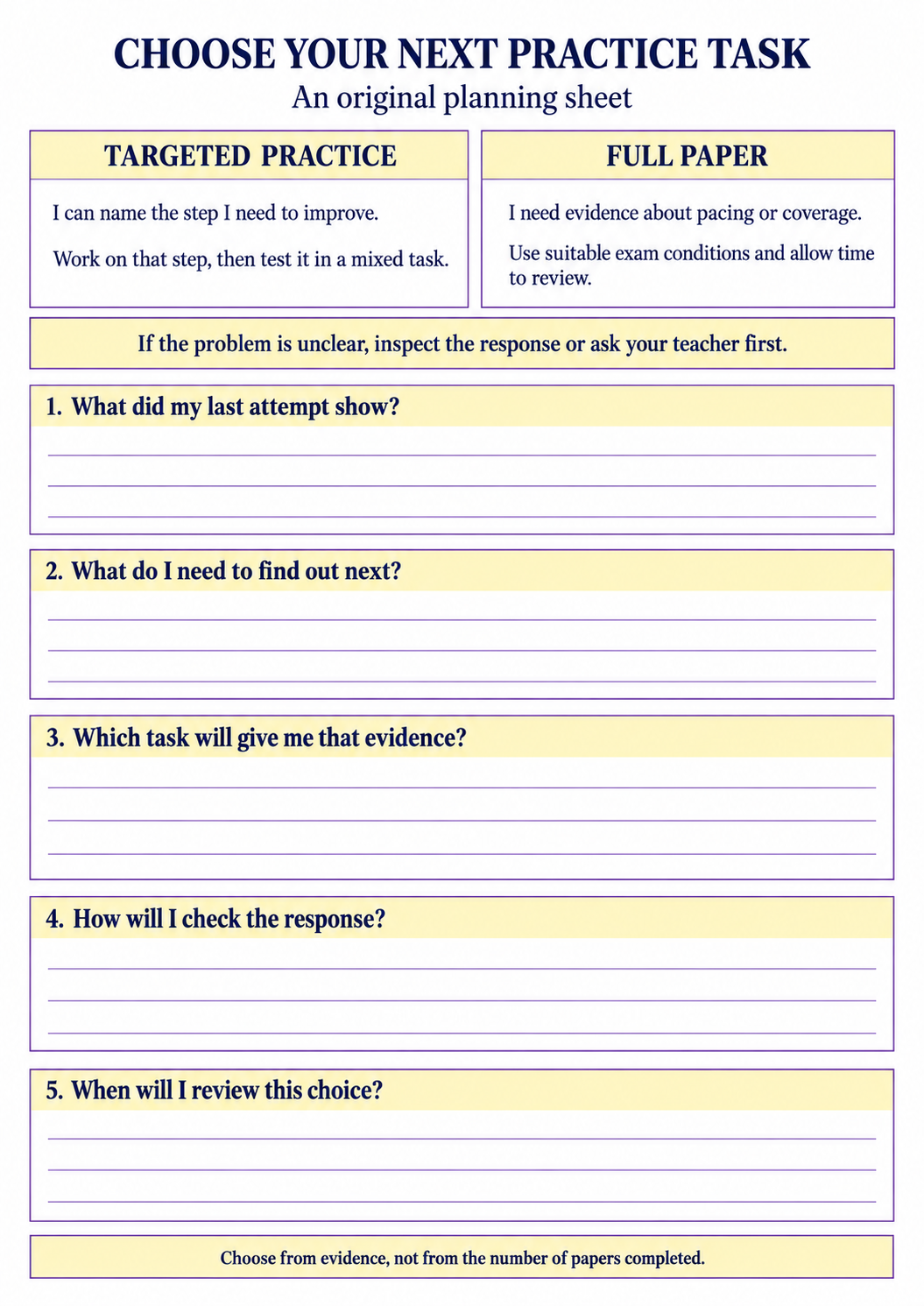
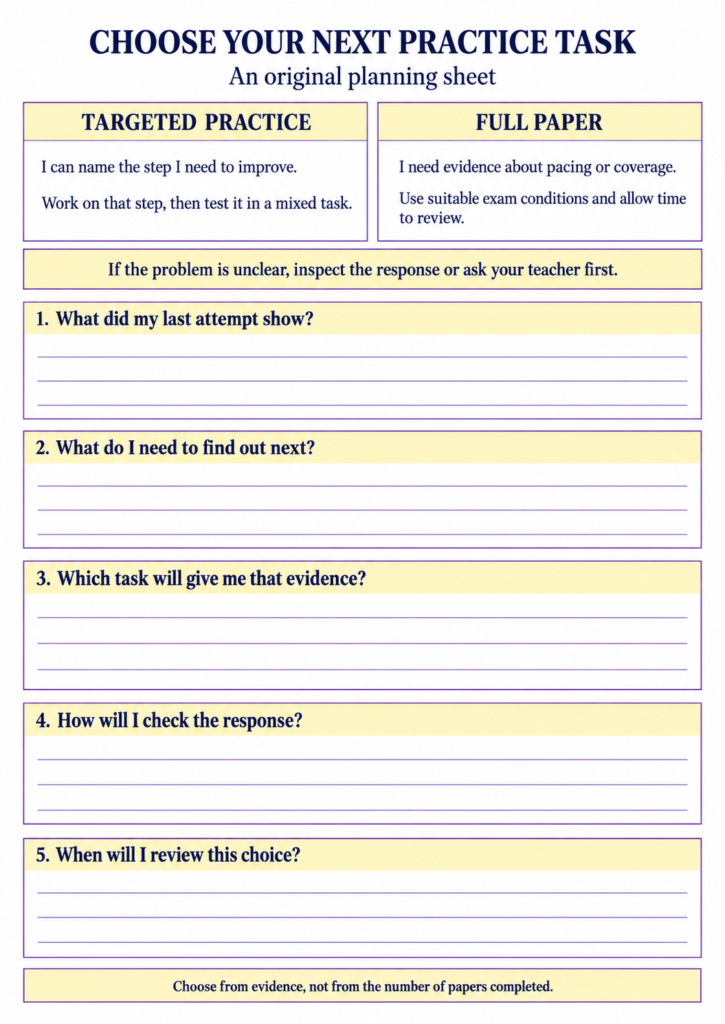
Use the printable sheet or copy the five prompts below. Start with one observation from actual work, one question about your learning and a task that can answer it. Add the check and the point at which you will reconsider the choice. Keep the note short enough to use while planning your next session.
For example: “I expanded only one term in two equations. I need to explain multiplication across brackets. I will review one worked correction, then solve a changed equation without it and check by substitution. Tomorrow I will include that skill in a mixed set and inspect my working.” This describes a focused session and a later check, without claiming that one correct answer establishes mastery.
For written responses, JeddAI can provide feedback to consider alongside the question and your teacher’s guidance. Use the student account link to explore it, then identify a specific revision task rather than treating a comment as a final verdict.
If the problem is missing knowledge of a set text or course, browse the study guides for a relevant resource. This general practice decision does not depend on purchasing a particular guide.
| What you observed | Useful next step | What to check afterwards |
|---|---|---|
| A particular method fails repeatedly. | Explain the correction and practise a changed case. | Can you use and explain it without the model? |
| Separate sections go well; whole-paper pacing is unknown. | Attempt a suitable full paper under the relevant conditions. | Completion, time allocation and answer quality together. |
| A low total, but the cause is unclear. | Inspect a response and ask for help with the unresolved step. | Can you name what needs learning before planning more practice? |
| A corrected method works only in a labelled exercise. | Try a mixed task later. | Can you select the method without being told to use it? |
| Prompt | Your note |
|---|---|
| What did my last attempt show? | ____ |
| What do I need to find out next? | ____ |
| Which task will give me that evidence? | ____ |
| How will I check the response? | ____ |
| When will I review this choice? | ____ |