Why is a shared theme only a starting point?
“Both texts explore responsibility” tells a reader what you will discuss, but leaves the relationship unexplained. Do they present the same problem? Does one challenge the other’s answer? What has changed for the reader? Your argument begins when you can answer one of those questions with evidence.
The University of North Carolina Writing Center advises writers to select meaningful points of comparison and explain their significance, rather than simply catalogue similarities and differences. The exercise below applies that principle to two complete passages written for this article. They are invented practice material, not extracts from prescribed texts or official assessment exemplars.
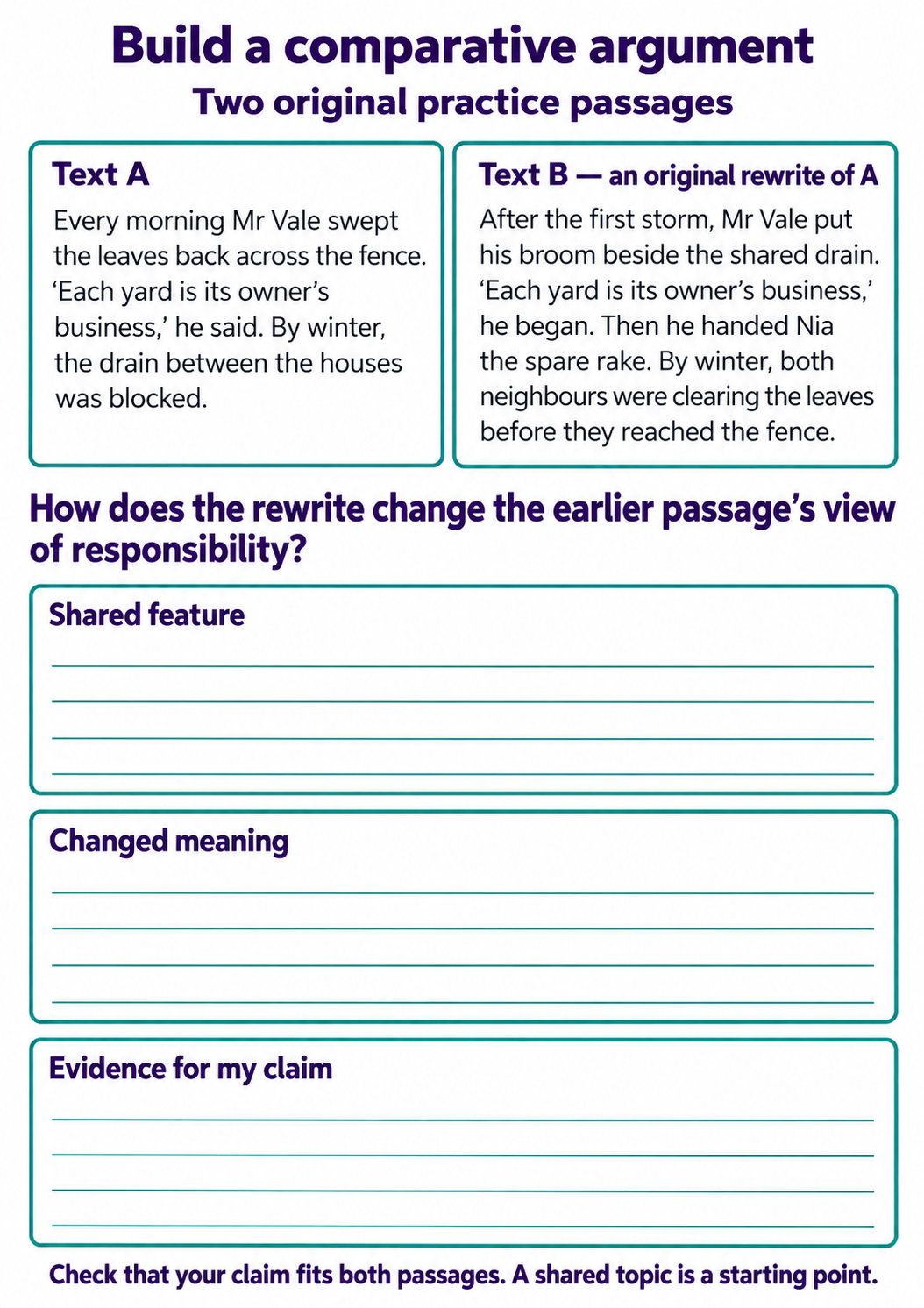
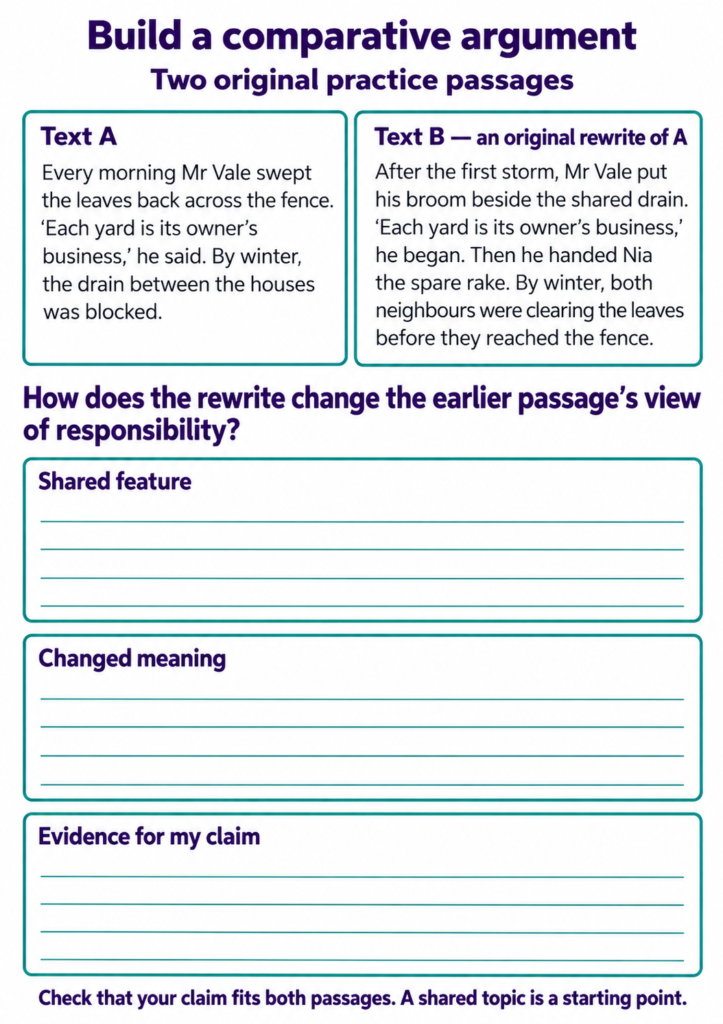
What changes between these two original passages?
Text A: Every morning Mr Vale swept the leaves back across the fence. “Each yard is its owner’s business,” he said. By winter, the drain between the houses was blocked.
Text B, an original rewrite of A: After the first storm, Mr Vale put his broom beside the shared drain. “Each yard is its owner’s business,” he began. Then he handed Nia the spare rake. By winter, both neighbours were clearing the leaves before they reached the fence.
The question is: “How does the rewrite change the earlier passage’s view of responsibility?” B deliberately rewrites A, so the repeated character, leaves, fence, saying and winter ending form part of that relationship. In an assignment on real works, a shared topic alone would not prove that one writer responded to another. Establish the relationship your task asks you to examine.
In A, Mr Vale’s saying accompanies an action that sends leaves across the boundary. The blocked drain exposes a problem with treating the yards as separate concerns. B retains the saying, but follows it with a shared task. Handing over the rake and clearing leaves together show a practical change that the words alone would not establish.
How can you turn the comparison into a defensible thesis?
Start with a rough claim: “Both passages are about responsibility.” It is true, but does not answer how the rewrite changes the earlier view. Add the contrast: “A shows the limits of treating responsibility as a private matter; B offers cooperation as a response.” Now test whether each half fits the details.
A more precise version is: “By keeping Mr Vale’s saying while changing his actions, the rewrite turns a failed attempt to keep responsibility within separate yards into a shared response to the drain problem.” This identifies a retained feature, a change and its significance. It does not need to name every similarity in the passages.
Reject the stronger-sounding claim that “B abolishes ownership.” The fence remains, the saying remains and neither passage describes an ownership arrangement changing. A qualified argument is more useful than an ambitious claim the evidence cannot support. For a longer response, plan your English essay around a small number of such claims before drafting.
What could a comparative paragraph look like?
One possible paragraph is: “The rewrite makes responsibility a shared practice by changing what follows Mr Vale’s claim that each yard is its owner’s business. In A, he sweeps leaves ‘back across the fence’, shifting the problem beyond his boundary; the blocked drain then exposes the limits of that response. B repeats his saying but follows it with him handing Nia ‘the spare rake’. Its ending shows both neighbours clearing leaves before they reach the fence, replacing the earlier blockage with preventative cooperation. The boundary remains, so the change concerns how the neighbours deal with a shared problem rather than the disappearance of separate yards.”
The opening gives the paragraph a comparative claim. The discussion of A explains an action and its consequence. The move to B identifies both the retained saying and the changed action, then the ending limits the conclusion. Those are jobs the sentences do, not a required number of sentences or a formula that guarantees marks.
Notice that the paragraph does not retell everything in A and then everything in B. It selects details that answer one question about responsibility. Point-by-point and text-by-text structures can both work; follow your task’s requirements and make the connection explicit whichever organisation you use.
How do you distinguish evidence from invented context?
You can observe that the two versions end differently. You cannot infer a historical movement, an author’s politics or a publication context from the words “first storm” or “By winter”. These are invented passages with no supplied historical setting. Adding a story about social change would create evidence rather than analyse it.
With your studied texts, check the relevant context in reliable course materials or primary sources, then show how it helps explain a specific choice. Avoid a detached sentence about “modern values” that could sit beside any quotation. Likewise, a later text may retain, complicate or redirect an idea; it need not reject everything in the earlier work.
The comparison grid below keeps three decisions together: what you noticed, how it works in A and what changes in B. Fill it with details first. If a proposed argument needs information the grid cannot supply, find evidence or narrow the claim.
Can you answer a different question with the same passages?
Before reading the answer, try this: “How do the two endings shape the reader’s judgement of Mr Vale’s response?” Write a comparative claim and support it with the final sentence of each passage. This checks whether you can adapt your reasoning to a new question, rather than reproduce the model paragraph.
A supported answer could say that A’s blocked drain gives Mr Vale’s repeated sweeping a damaging consequence, inviting criticism of his narrow approach. B’s ongoing joint clearing offers a more constructive response by preventing the leaves from reaching the fence. The endings support a contrast in practical behaviour; they do not prove that the neighbours are permanently friends or that no drain could ever block again.
If your first answer only lists “blocked” and “clearing”, add what that contrast suggests about the response. If it claims permanent friendship, remove or qualify the unsupported conclusion. Use the exam error log to record the precise revision you needed, so your next practice task tests that decision.
How should you apply this to the texts you are studying?
Begin with the actual assignment question and a relationship you can establish. Choose one point of comparison, locate accurate evidence in each work and explain the significance of the difference. For drama or film, the evidence may include staging, performance, sound or framing as well as words. Check the scene and edition rather than relying on a remembered quotation.
Use the printable paired passages for practice, then copy the blank argument record below for your own texts. Read the resulting claim against both works: what supports it, what complicates it and what should it stop short of saying? You are aiming for an answer that survives those checks.
For further writing support, the Essay Writing guide card on this page provides a purchase option. Check the listed contents against the help you need before buying.
If you need a resource for a particular text instead, browse the study-guide catalogue to find the matching title.
| Feature | A: meaning in context | B: change in meaning |
|---|---|---|
| The saying about each yard | Accompanies pushing leaves across a boundary. | Retained, but followed by offering a rake. |
| The leaves and fence | Separate-yard action leaves a shared problem unresolved. | Joint action deals with leaves before they reach the fence. |
| The winter ending | A blocked drain exposes the limit of the response. | Ongoing shared clearing offers a constructive alternative. |
| Decision | Your note |
|---|---|
| Question and established relationship between the works | ______ |
| One meaningful point of comparison | ______ |
| Evidence and explanation from the earlier work | ______ |
| Evidence and explanation from the later work | ______ |
| What is retained, changed or challenged — and why it matters | ______ |
| A qualification or limit on my claim | ______ |