Which exam are you preparing for?
Imagine finding a recent English paper with exactly the right course name. You recognise the heading, know where the stimulus booklet goes and have a free afternoon. Before you start the timer, check one more detail. Which syllabus was that cohort sitting, and which one will you sit?
For NSW English Standard, this matters across the 2026–27 changeover. NESA identifies Term 4 of 2026 as the start of teaching the new Year 12 syllabus and 2027 as its first HSC examination. A student who sat the 2026 HSC and a student who started Year 12 in Term 4 of the same calendar year are preparing under different arrangements. On NSW Curriculum, find English Standard 11–12 Syllabus (2024) and expand “Implementation from 2026” to check which cohort the change applies to.
Write down your jurisdiction, course, level or pathway where relevant, and examination year. Then find the current syllabus and exam specifications for that combination. An old paper has two dates worth keeping separate in your notes. One is the year it was sat. The other is the syllabus version against which you are checking it.
What does the English Standard example actually show?
In the past-paper library, choose HSC English. On NESA’s site, select English Standard, then the 2026 exam pack. Open Paper 1 and read its cover. Section I asks students to attempt Questions 1–5. The cover gives ten minutes of reading time, ninety minutes of working time and twenty marks for each of two sections. Those are facts about that paper.
Next, return to the English Standard 11–12 Syllabus (2024) on NSW Curriculum. Under Assessment, choose HSC examinations. The specifications and annotated samples are on that page. The new Paper 1 retains the two-section structure and those overall timings. Its Section I allows five to six short-answer questions. The annotated sample illustrates five. A student who builds a plan that works only for five questions has treated one example as a promise.
The sample’s introductory note is helpful here. NESA explains that relevant past questions can illustrate the new syllabus. You can therefore keep an older question when you can identify what it practises. Similar headings and timings give you a reason to investigate the match. They do not settle whether the prescribed text, content or particular question suits your course.
How do you decide what to keep from an older question?
Start with one item. Underline what it asks you to do, circle the evidence or text it requires and write the skill you want to practise in the margin. Compare those details with the applicable syllabus content, the current exam specification and what your teacher has assigned. If your class studies a different text, a familiar command word will not supply the missing reading.
Keep the item as written when you have its stimulus, its demand fits your current work and the answer would show the skill you want to check. Use it as a narrower exercise when a part transfers but the original task does not. If you replace a prescribed text or change the demand, label the result as your own practice question. Its old marking guidelines cannot establish a mark on the changed task.
Set an item aside when the required material is missing or its demand belongs to another course. You might still study that topic out of interest. For an exam revision session, pick a question that can tell you something about the course you are actually taking.
When you select an item, open its stimulus and the matching guidance where available. Check the year on each file. If guidance for that sitting is still to come, record the gap and ask your teacher before allocating yourself a mark.
What would a useful skill-only exercise look like?
Here is an original English exercise. It is fictional and uses no official exam question. Read these two sentences. “Eli chalked the closing time on the bakery door. After the last bus passed, he rubbed out the five and wrote a six.” Explain how the change to the sign shapes your understanding of Eli’s decision.
One response reads, “At first, the closing time looks settled. Rubbing out the five and writing a six shows that Eli chooses to keep the bakery open longer. The passing bus puts that choice at a particular moment, but the passage leaves his reason open.” The answer explains the change using the actual words. Saying that Eli certainly expects his daughter on the next bus invents a motive the passage does not give.
Suppose an old extended-response task required a prescribed novel you have never studied. Replacing that novel with this tiny passage would change both the evidence and the scale of the response. The two-sentence exercise can help you practise making a supported inference. It cannot tell you how well you can sustain an extended response on your prescribed text. Write down that limit before you count the session.
Can you tell which result would count as exam practice?
Try three decisions before checking the worked table. First, the current course includes analysis of an unseen text and you have the complete stimulus for a suitable older question. Second, the old question requires a text outside your course. Third, the old paper’s timing matches the new specifications, but you have checked only its first section. Which result could you reasonably record in each case?
For the first, record performance on that individual question if its demand matches. For the second, put the original question aside for prescribed-text practice, or design a separate exercise with your teacher and say what changed. For the third, record a timed section at most. You have no evidence yet that the remaining sections fit, or that you can manage the whole performance within time.
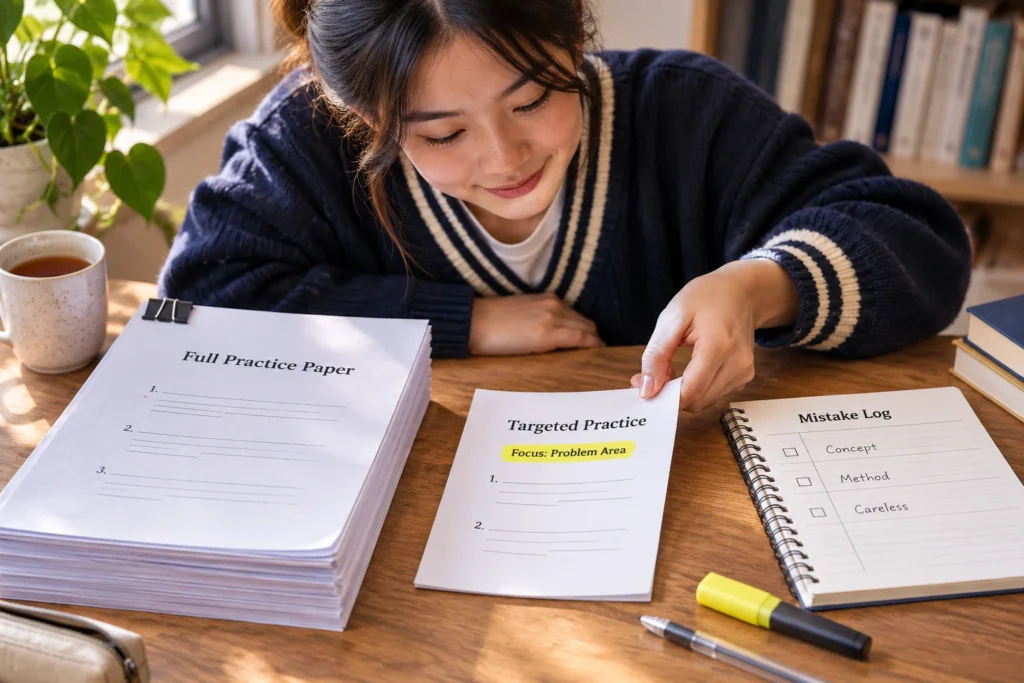
Use the guide to choosing between a full paper and targeted practice once you have checked suitability. A whole paper can answer a pacing question only when its tasks and conditions are an appropriate rehearsal. A carefully selected older item can be enough for a different question, such as whether you can explain a particular detail independently.
What should you write on the paper before starting?
Copy the short record below. A useful note might read, “English Standard, 2027 HSC. Older Paper 1, one unseen-text item with its stimulus. Practise explaining how a detail conveys meaning. Check the explanation against the question. This result tells me about one response. I will check possible question counts in the current specification and test my whole-paper pace separately.” That is enough to return to the task later without misreading the result.
If you cannot decide whether the question fits, bring the item and the current syllabus or sample to your teacher. Ask about the precise uncertainty, such as whether the prescribed text still applies or whether the required response is a different length. A note saying “format uncertain” is more useful than a mark against the wrong criteria.
If you need to revise a particular set text, browse the study guides for the text you are studying. For a written practice response, the student JeddAI link offers a way to seek feedback on your draft. Keep the question and course details alongside it so you can judge whether a suggested change answers the task.
| What matches? | Decision | What the result can show |
|---|---|---|
| Course demand and available stimulus match. | Keep the question as written. | How you answered this item under the conditions you used. |
| The reading skill fits but the required text or task has changed. | Design and label a separate skill exercise. | Your use of that skill on the new material. |
| Only the cover and timing have been checked. | Inspect each section before planning a full rehearsal. | No whole-paper conclusion yet. |
| Check | Your note |
|---|---|
| My course and exam year | ______ |
| Current syllabus or exam specification | ______ |
| Older paper, year, question and required material | ______ |
| Matching skill and evidence, or mismatch | ______ |
| Use as written, adapt for practice, or set aside | ______ |
| What the result can and cannot show | ______ |