What does the thesis need to do?
A thesis gives your response a position: an answer someone could reasonably question and that your analysis can support. “The text explores belonging” identifies a topic. It does not explain how belonging works in this text, what complicates it or what the writer invites us to notice. Begin with those decisions before trying to make the sentence sound impressive.
For Texts and Human Experiences, connect the particular experience represented in the text to your interpretation. You might examine a conflict between a public ideal and a private experience, or a change in what a character values. Choose the relationship the evidence actually supports. Not every question needs an anomaly, and adding a module term does not create an argument.
Use the task and text list for your own cohort. NESA states that Year 12 teaching of the 2024 English Standard and Advanced syllabuses begins in Term 4, 2026, with their first HSC examinations in 2027. An older video can still prompt useful writing practice, but check its course-specific advice against your current task. The passage and questions below are original practice material, not official examination questions or prescribed-text extracts.
How can a tension help you move beyond a topic?
At 00:46 in Jeddle’s video on a Human Experiences thesis, the on-screen advice contrasts setting up a tension with merely stating, identifying or describing. Apply that idea by finding two details that do not sit comfortably together. Then explain the relationship. A claim that something is “complex” leaves the reader waiting to hear what the complexity is.
Practise with this question: “To what extent does the passage present recognition as a source of belonging?” Read the complete invented passage before writing an answer. Recognition means whose contribution is acknowledged here; belonging concerns who is included in the community’s account of itself.
At the library reopening, Noor watched the mayor pull a cloth from the brass plaque. It listed the volunteers who had carried books above the floodwater. “These are the people who kept our town together,” he said. Noor remembered her mother arriving home with swollen hands after three nights of lifting boxes. She searched the names twice. Her mother stood beside the refreshment table, straightening the cups. When the applause began, she joined in. On the bus home, Noor opened the notebook in which she had recorded the flood. Beneath the list of rescued books, she wrote her mother’s name. The next morning, the same names shone on the library wall.
The ceremony celebrates a shared achievement, yet the public list omits someone whose work the passage establishes. Noor’s private record offers another form of recognition. The ending matters: the plaque remains unchanged. Together, those details support a tension between the promise of inclusion and the limits of the public account.
What changes across three possible thesis statements?
First attempt: “The passage explores recognition and belonging.” This is relevant vocabulary, but it could introduce many different arguments. Ask what the relationship between those ideas is. Does recognition include people, exclude them, depend on who controls the record, or change across the passage?
Second attempt: “Recognition makes everyone feel that they belong.” This answers more directly, but “everyone” reaches beyond the evidence. We are not told exactly how Noor’s mother feels, and the omission complicates a wholly positive reading. Her applause alone cannot establish that she feels included, forgives anyone or accepts the omission.
A more defensible thesis is: “The ceremony offers a shared identity, but the missing name exposes the limits of belonging built on selective recognition. Noor’s private record acknowledges her mother’s work without showing that the community has corrected its public account.” The first sentence makes a judgement; the second uses the ending to bound it.
This is one supported interpretation, not a sentence to memorise. “Selective” describes the record’s limited inclusion; the passage does not establish deliberate discrimination or explain how the list was made. If your explanation depends on the mayor intentionally excluding Noor’s mother, either find evidence for that intention or revise the claim.
How do you answer “to what extent” without becoming vague?
Make the degree of agreement meaningful by explaining its conditions. Here, recognition can offer belonging through a shared story, but the ceremony does not acknowledge every contribution. You can defend that judgement with the speech, the missing name and the unchanged plaque. Writing “to a large extent” without that reasoning adds little.
Qualification is not indecision. Compare “Recognition is sometimes good and sometimes bad” with “The ceremony’s promise of unity is limited by whose work its public record leaves out.” The second tells the reader which feature of this passage limits the claim. You do not need to assign a percentage or split every essay into an equal number of agreeing and disagreeing paragraphs.
Before keeping a thesis, test it against one supporting detail and one awkward detail. Ask what would have to be true for the claim to hold. If you argue that private recognition repairs the community’s exclusion, the unchanged plaque is a problem: it shows no public correction. Narrowing the argument to Noor’s personal acknowledgement makes it more accurate, not less thoughtful.
Can you make the thesis answer a different question?
Try this independent prompt on the same passage: “How does the contrast between public and private records shape our understanding of memory?” Write your own thesis before reading the possible answer. Use the plaque and notebook, but decide what their relationship now reveals about memory rather than simply replacing “belonging” with “memory”.
One possible answer is: “By contrasting the permanent public plaque with Noor’s private notebook, the passage presents collective memory as incomplete and personal records as a way to preserve what it leaves out.” The unchanged wall supports the limit: preserving a contribution privately is not the same as changing the public account.
Check your attempt in three places. Underline the part that answers “how”; point to the textual contrast that supports it; then identify any claim about motive or outcome that the passage does not establish. A different interpretation can work if you explain those connections. The goal is a defensible response, not agreement with the model wording.
How do you use this method with your own text?
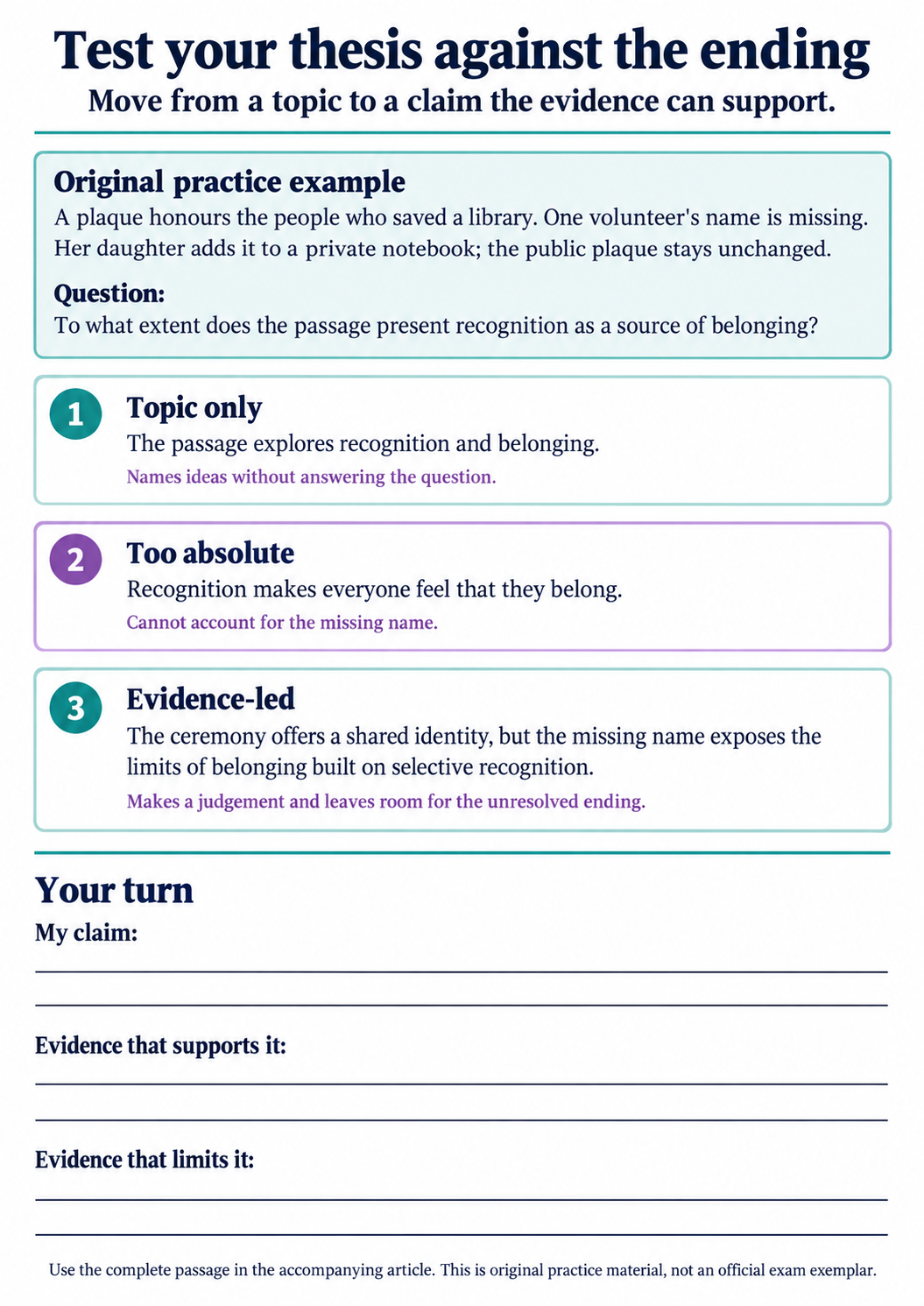
Write the question, your current claim, a supporting detail and a detail that complicates it. The printable sheet below compares the three thesis versions and leaves space for those checks. Its summary is a reminder of this practice passage; use the complete passage when judging a claim. The accessible tables repeat the comparison and provide a reusable record.
For a whole-text response, test the thesis across relevant moments in the work, not just one convenient quotation. Include the writer’s choices in your reasoning: the contrast between a public speech and a private action, for instance, does more here than a list of themes. Follow your actual task conditions; this short exercise does not set a required introduction length or paragraph count.
Once the thesis can survive that check, use the guide to planning an English essay to develop the supporting argument.
If you repeatedly overclaim, record the exact problem and your next check in a separate practice attempt. The exam error log can help you keep that record and test whether your next response improves.
For structured writing practice, the Essay Writing guide has a Buy link on this page. Browse the study-guide catalogue if you need support for your particular text; check the guide against your course and cohort before buying.
You can also try JeddAI with a practice response. Include the question, then compare any suggested revision with your evidence. Keep an interpretation you can defend, and question advice that invents a motive or makes the ending say more than it does. Feedback is useful when it helps you make and explain that decision.
| Attempt | What it does | What to check |
|---|---|---|
| Topic only | The passage explores recognition and belonging. | What relationship between the ideas does it establish? |
| Too absolute | Recognition makes everyone feel that they belong. | Does the passage establish everyone’s feelings? What about the omission? |
| Evidence-led | The ceremony offers a shared identity, but the missing name exposes the limits of belonging built on selective recognition. | Use the unchanged plaque to limit what Noor’s private record achieves. |
| Decision | Your notes |
|---|---|
| Question and scope | Exact question; passage or whole text: ______ |
| Working thesis | My answer is: ______ |
| Support | Detail and how it supports the claim: ______ |
| Complication | Detail that limits or challenges the claim: ______ |
| Revision | What I will change or qualify, and why: ______ |