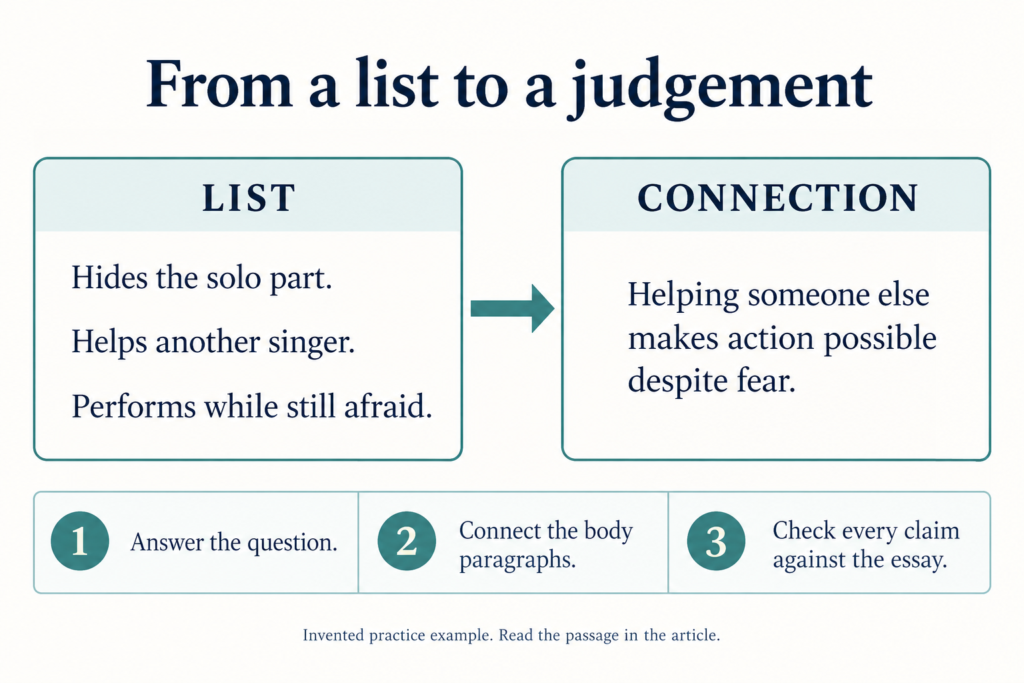
What should your conclusion add?
Imagine covering your body paragraphs and reading only your final paragraph. Does it tell you what the argument amounts to, or merely name the topics you covered? ‘The text explores fear, friendship and courage’ gives the reader a list. It leaves the relationship between those ideas unexplained. Your ending should make that relationship clear without starting another argument.
The University of North Carolina’s Writing Center recommends showing how your points fit together, rather than simply repeating them. It also cautions against introducing a new subtopic or evidence that belongs in the body. The worked exercise below applies those general writing principles to an invented story. It is practice material, not an official exemplar or a response to a prescribed text.
What does a repetitive conclusion look like?
Use this short invented passage: ‘At rehearsal, Mara hides the solo part under her chair. When a younger singer loses his place, she quietly counts him back in. In concert, she still grips the page, but she stands beside him and begins.’ The practice question is: ‘How does the story present courage?’
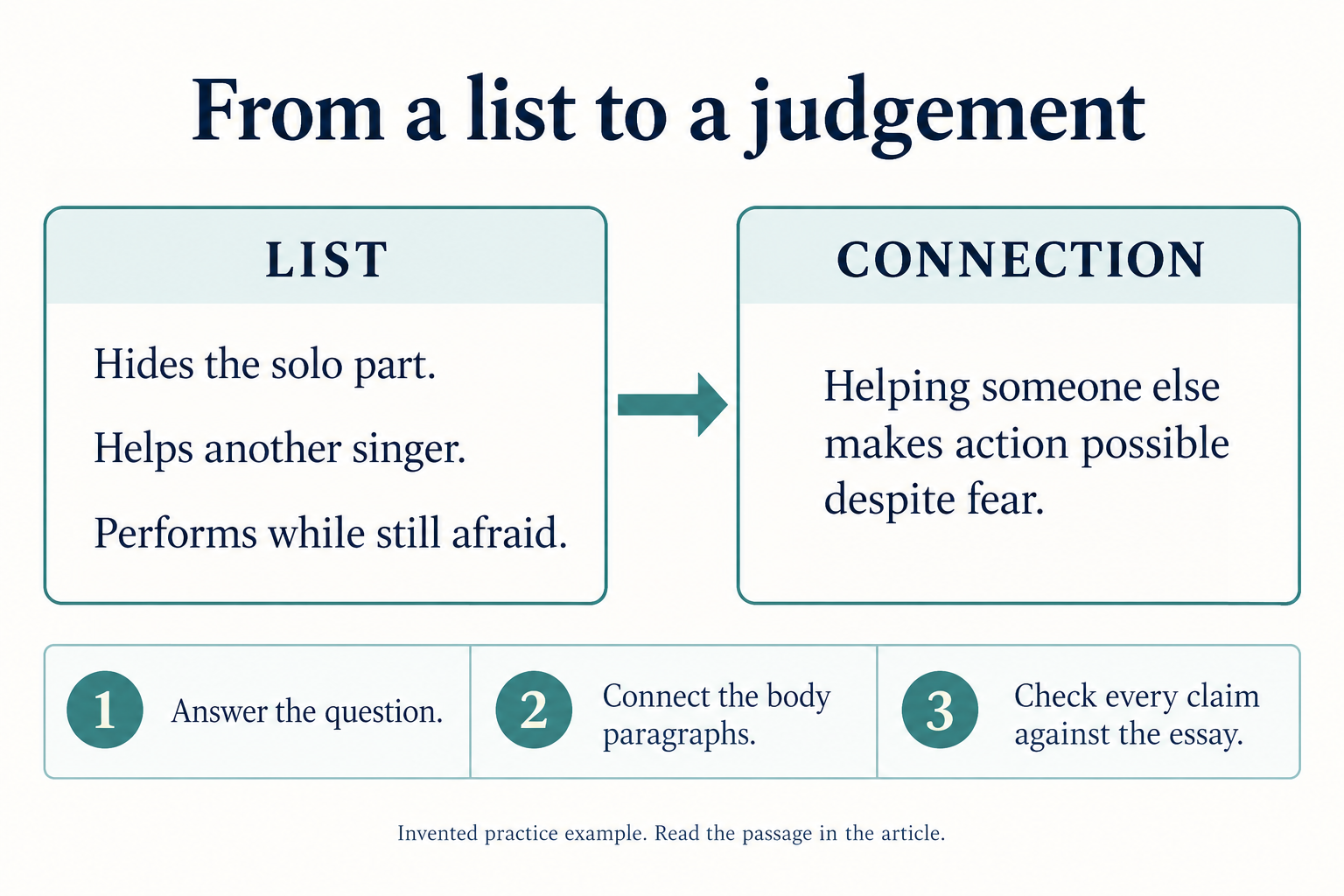
Suppose your essay develops three points: hiding the solo part suggests a wish to avoid being heard; helping the younger singer gives Mara a reason to participate; and gripping the page as she begins suggests that fear has not disappeared. These are claims you would need to explain through the details in your body paragraphs.
A weak ending might read: ‘The story shows courage through fear, helping people and singing. The writer uses events and characterisation to explore courage. Therefore, courage is very important.’ Nothing here is completely unrelated, but the ending could fit many stories. It repeats the subjects of the paragraphs and adds a broad statement instead of explaining what this particular sequence reveals.
How can you turn those points into a judgement?
Ask what changes across the moments and what stays unresolved. Mara first avoids the solo, then supports another singer, then performs while still showing signs of fear. The useful connection is that concern for someone else gives her a reason to act despite that fear. That is more precise than saying she becomes confident or that friendship solves everything.
A revised conclusion could read: ‘Courage in this story develops when Mara’s concern for another singer becomes stronger than her wish to remain unheard. Her hands still grip the page, so performing does not erase fear; it shows that supporting someone else can make action possible despite it.’
The first sentence answers the question and connects the earlier and later moments. The second keeps a limit that the evidence requires: Mara acts, but she is not shown becoming fearless. This ending assumes your body has already explained those details. It does not replace that analysis. If the reasoning appears here for the first time, develop it in the body before relying on it in the conclusion.
How do you check that the ending is earned?
Underline the main claim in each sentence of your conclusion. Beside it, write the body paragraph that supports it. If you cannot find one, either revise the claim or build the missing argument earlier. This check catches an ending that suddenly introduces a different interpretation because it sounds impressive.
Watch the strength of your language. ‘The story proves that cooperation always removes fear’ goes beyond this passage and conflicts with Mara gripping the page. ‘Can make action possible despite fear’ fits the proposed reading more closely. Qualifying a claim is useful when it makes your meaning accurate; adding ‘perhaps’ everywhere without a reason only makes the judgement harder to follow.
You can briefly refer to evidence you have already analysed, as the model does with the page in Mara’s hands. Avoid dropping in an unexplained quotation or another scene to rescue the ending. If that material is essential to your argument, it needs space and explanation before the conclusion. Follow any specific instructions your teacher has given for the task.
What can you do when the last paragraph is too long?
Label each sentence by its job: answer, connection, qualification, repeated summary or new argument. Keep what helps the reader understand your final judgement. Cut a sentence that only says you have finished, and combine two sentences that make the same point. There is no required sentence count in this exercise; the task and the complexity of your argument determine what you need.
Use the blank planning table below before rewriting your own ending. If you keep listing paragraphs instead of connecting them, put that precise problem in your exam error log. A useful repair task is ‘write one sentence showing how my two strongest claims relate’, followed by a check on a different practice question.
Can you apply the same check to a new question?
Try another invented example. A new student is offered a seat at lunch but stays quiet. Later, classmates ask her to explain a puzzle she has solved, and she volunteers to bring another puzzle the next day. The question is: ‘How does the story present belonging?’ Assume your body has explained the difference between being welcomed and being able to contribute.
Write a conclusion that connects those moments. One possible answer is: ‘The story presents belonging as more than being offered a place. The student’s decision to bring another puzzle suggests that being invited to contribute gives her a reason to participate again.’ Check that your version connects the moments without claiming that she never feels excluded or uncertain afterwards; the example does not establish that.
For more guided practice, the Essay Writing guide lists lessons on thesis development, body paragraphs, introductions and conclusions. Check its contents to decide whether it fits the skills you need to practise next.
For an essay on a text you are studying, browse the study-guide catalogue for relevant text and skills resources. Use your actual question and evidence when you revise; the invented examples here are a method to practise, not sentences to paste into another essay.
If you want feedback on your next practice response, try JeddAI. Then check any suggested change against the question and your text before deciding whether to use it.
| Check | Mara worked example | Your essay |
|---|---|---|
| Question to answer | How does the story present courage? | ______ |
| Two claims to connect | She avoids the solo; she helps another singer | ______ |
| Relationship between them | Helping gives her a reason to act despite fear | ______ |
| Important qualification | Gripping the page suggests fear remains | ______ |
| Where the body establishes this | Analysis of hiding, helping and gripping the page | Paragraph(s): ______ |
| Final editing decision | Remove the list; state the connection and its limit | Keep / cut / develop earlier: ______ |