What must your plan answer?
Write the question at the top of your page. Identify what it asks you to explain and what material you must use. ‘How’ asks you to connect the writer’s choices to an interpretation; naming a theme will not do that work by itself. Check the task instructions too. A plan for one passage is not automatically a plan for a whole-text essay.
The University of North Carolina Writing Center describes a thesis as an interpretation that answers the question and can be supported with evidence. It also treats that answer as revisable. Use that principle here: sketch an answer after looking at the details, then test it. You do not need to polish an introduction before deciding what you can argue.
Practise with this original, invented passage. It is not an extract from a prescribed text or an official examination. Question: ‘How does the passage challenge the idea that loyalty requires agreement?’
At the committee table, Leila slid the bridge plan back towards her father. ‘The lower rail is loose,’ she said. He straightened the ribbon laid across his notes. ‘Everyone else is ready.’
Outside, the neighbours applauded as he lifted the scissors. Leila stayed by the gate. ‘You could stand beside me for once,’ he said. She fetched the toolkit. ‘I am beside you,’ she replied, ‘but I am not sending children across that.’
They tightened the loose rail. Before the opening, her father tested each joint while Leila held the torch. Neither mentioned the ribbon.
How do you turn details into a working answer?
First collect a few details that matter to this question: the father’s appeal to everyone else’s readiness, Leila’s refusal to join the ceremony, her decision to fetch tools, and their joint inspection at the end. These details give you more to work with than a theme list such as ‘family, courage, loyalty’. Each can help establish what loyalty means in this situation.
A weak answer is: ‘The passage shows that loyalty is important.’ It names the topic but leaves the question unresolved. Try this working answer instead: ‘Leila’s objections and repair work present loyalty as protecting others, rather than agreeing with them in public.’ You can now ask whether every planned point helps prove or qualify that interpretation.
Keep the claim within the evidence. The passage does not establish that the father never cares about safety, or that Leila always knows best. Its ending shows them checking the bridge together. That detail can support a change in their relationship; it cannot prove that every disagreement has a happy outcome.
What belongs in each paragraph plan?
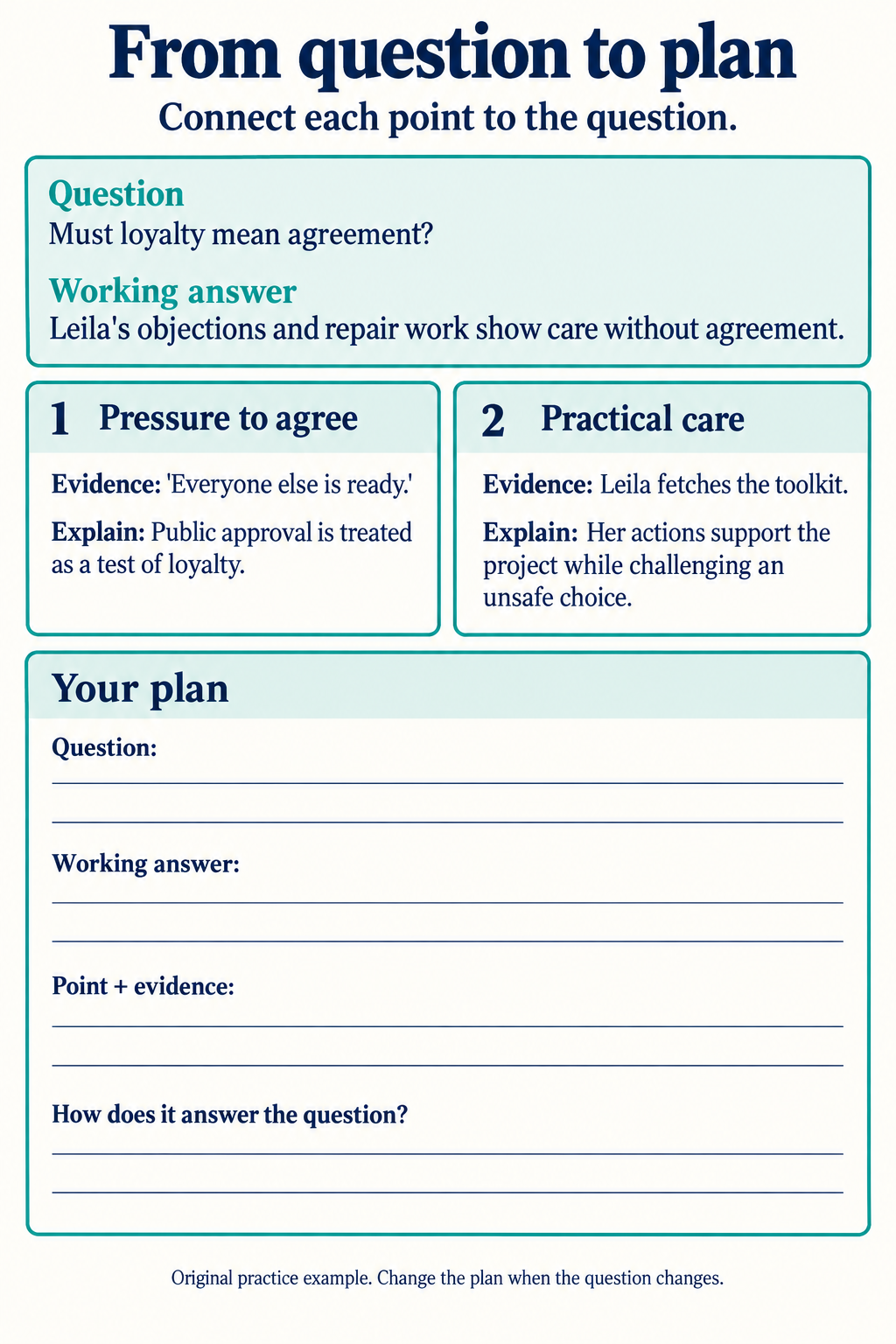
For the first paragraph, plan a point about pressure to agree. Use ‘Everyone else is ready’ alongside ‘stand beside me for once’. The first line appeals to the group’s apparent consensus; the second connects participation to personal loyalty. Your reasoning should explain how that pressure makes Leila’s refusal look disloyal before her practical actions offer a different reading.
For the second paragraph, plan a point about practical care. Use the toolkit and the final shared inspection. The contrast between ceremony and checking allows you to argue that supporting someone can involve delaying their preferred action. This paragraph develops the answer rather than repeating that Leila disagrees. Two points suit this short exercise; they are not a rule for every essay.
Keep three things together in your notes: the point, the precise evidence, and why that evidence matters to the question. A note saying ‘dialogue technique’ is incomplete. A note saying ‘dialogue makes agreement a test of loyalty’ has a job. You can add further detail as you write, but the connection should already be visible.
How can you tell whether the plan will produce analysis?
Test one point by expanding it into a short practice paragraph: ‘The father’s language initially presents agreement as a public test of loyalty. His appeal to everyone else’s readiness treats the group’s approval as a reason to proceed, while asking Leila to stand beside him makes her objection seem like a personal rejection. Her return with tools offers a competing form of support: she remains involved while refusing an unsafe opening. The contrast challenges the assumption that caring for someone means endorsing their decision.’
This model explains a relationship between details. It does not just retell the sequence or attach a technique label to each sentence. It is one defensible reading of our invented passage, not an official exemplar. Check that your own paragraph likewise says what the evidence lets you conclude and why that conclusion answers the question.
Now look across the plan. If both points make the same claim with different quotations, combine them or give the second a new job. If a point has no usable evidence, investigate it before drafting around it. Your conclusion should bring the argument together; the worked guide to an essay conclusion without repetition shows how to make that final connection.
What changes when the question changes?
Try a new practice question on the same passage: ‘How does the passage show a change in authority?’ Replacing ‘loyalty’ with ‘authority’ in the old thesis is not enough. A possible new answer is: ‘Authority shifts from the father’s control of the ceremony towards a shared responsibility to check the bridge.’ Test that against the ending rather than assuming it must be true.
The first point could now compare his command of the public opening with his appeal to the crowd. The second could examine the final image of father and daughter working together. Some evidence remains useful, but its job changes: you are explaining who directs action and how that changes. Do not claim Leila completely replaces her father; he still performs the inspection.
For your own practice, put the two questions and plans side by side. Circle the reasoning that changed. If only a few nouns changed, reread the task. Record a recurring planning problem and your next check in the exam error log, so the next attempt tests a specific improvement instead of producing another unexplained score.
What should you keep on your planning sheet?
Use the sheet below to record a working answer, two distinct points and an evidence check. Add or remove points to fit the actual task. On a familiar practice text, try a short planning interval and then write one paragraph. Judge the plan by whether it helps you make a supported argument, not by how neat or long the notes look.
Keep the plan beside the draft. If writing exposes a weak claim, revise both. You can use JeddAI on a practice response and compare any suggested changes with your question, evidence and plan. Check the advice yourself; a fluent suggestion is not a reason to abandon a reading that you can defend.
For more structured essay practice, the Essay Writing guide is linked with a purchase button on this page. You can also browse the study-guide catalogue to find material for a particular text. A guide can support your preparation, but your chosen evidence and reasoning still need to answer the question in front of you.
| Planning decision | Your notes |
|---|---|
| Question and scope | What must I explain, and which text or passage must I use? ______ |
| Working answer | My answer to this question is: ______ |
| Point 1 | Claim: ______ Evidence: ______ Why it answers the question: ______ |
| Point 2 | Different claim: ______ Evidence: ______ Why it answers the question: ______ |
| Evidence that complicates my answer | Detail: ______ What I must qualify: ______ |
| Final check | Does every point help answer this exact question? What changes before drafting? ______ |