What should a colleague be able to understand without attending the meeting?
Give the record a simple test: could a teacher who missed the meeting tell whether they may use the proposed workflow tomorrow? “Pilot discussed; team happy to continue” leaves too much to memory. It does not identify the activity, the material, the people involved or the point at which another decision is needed.
Put the current outcome near the top: proceed within a stated scope, repeat a limited test, gather missing evidence, or stop. Record the decision-maker and the date. Use the school’s actual arrangements for authorisation; the person writing the minutes does not acquire that authority by completing a template.
The Australian Framework for Generative AI in Schools includes human responsibility, testing and ongoing monitoring within its guidance. This decision record is an original planning aid for keeping those responsibilities visible. It is not an official form, a certification or a substitute for the school’s existing approval process.
How do you separate evidence from the conclusion drawn from it?
Give each important item a reference that colleagues can retrieve: a dated observation note, a task-pack version, a correction log or a particular supplier document. Beside it, state what was inspected and what the item cannot establish. A link labelled “demo” is much less useful than “Rehearsal note E1, 5 November, task pack P1, two staff accounts”.
For example, observing a teacher correct a comment in a rehearsal supports a statement about that observed step. It does not establish that another teacher has the same access, that every error will be noticed or that students can use the feedback. Keep those gaps beside the positive finding so they remain visible at the next meeting.
The guide to what to measure in a school AI feedback pilot explains how to gather correction, revision and workload evidence. Link those results from the decision record rather than copying every measurement into the minutes. This record should explain what the evidence led the school to decide.
What does a completed record look like in a fictional example?
Consider an entirely invented review meeting on 5 November. A faculty has rehearsed a feedback process with staff-written practice paragraphs in task pack P1. Note E1 records that a reviewer spotted and corrected an unsupported claim. Note E2 records that the team has not rehearsed what happens when the usual reviewer is absent. No student work, student access or assessment marks have been tested.
A vague outcome would be “Trial successful; continue next week.” A more useful entry is: “Decision D1, version 1: repeat the staff rehearsal with task pack P2 to test the backup-review procedure. Limit use to the named staff and invented paragraphs. No student work, student access or grading. Return the findings for review on 12 November.” In this exercise, the school’s authorised decision-maker agrees that limited step; the example grants no permission to another school.
The rationale should name both the useful observation and the remaining gap: E1 shows a correction during the first rehearsal; E2 leaves reviewer absence unresolved. P2 will use a different invented paragraph so the team must inspect fresh work. The decision is to investigate that gap, not to declare the wider process reliable.
Add a stop condition that staff can apply: if the agreed reviewer or backup cannot check the output, stop the rehearsal at that point and record what happened. Do not improvise a release route. The example’s scope expires at the 12 November review unless the authorised decision-maker records a further decision.
How do you write an action that can actually be closed?
“Sort out review” is difficult to hand over or verify. Write the action, the responsible person, a due date and the evidence needed to close it. In the fictional record, the faculty lead must arrange the backup-review rehearsal by 10 November. Closure requires an observation note showing the backup locating the task and response, checking the comment and carrying out the agreed correction or stop step.
A rewritten checklist alone does not close that action: the requested rehearsal has not happened. Record it as “procedure revised; observation still due”. If the owner cannot complete the action, keep it open, record the reason and refer any proposed change of scope or date to the decision-maker. Do not let a missed date silently turn into permission.
Assign a named colleague in your working copy, with a clear role and a backup where needed. The public example uses role labels because it describes no real staff. Keep student names and response text out of the general decision summary; point to any necessary detailed evidence in the school’s approved location.
What changes at the follow-up meeting?
Continue the invented example. On 12 November, note E3 shows that the backup completed the agreed rehearsal. The team can close that action against E3. It still has no evidence about student use or a classroom feedback cycle. Finishing the backup test does not expand the permitted users or material.
Suppose the decision-maker now allows one further staff rehearsal, limited to the same invented-material scope, ending on 19 November. Record D1 version 2, the new end date, the reason and the evidence reference. State that version 2 replaces version 1 from the decision date. Retain version 1 so a later reader can understand the earlier limit and why it changed.
Keep a separate field for a proposal that has not been approved. “Investigate a classroom trial” might become an action to prepare a new proposal, with its own evidence and school requirements. It is not the same decision as “start a classroom trial”. A supplier demonstration, an action marked complete and a school authorisation answer different questions.
Use the school AI pilot checklist alongside the record to track wider preparation and responsibilities. If the tool configuration, intended use, users or material changes, identify that change explicitly and ask the authorised people which checks and decisions need revisiting. Do not assume an earlier record covers the new proposal.
How can you check whether your record is clear enough?
Give a colleague D1 version 2 and this fresh question: “The backup rehearsal passed. Can another faculty now upload its students’ essays?” The answer is no under the example’s recorded scope: it permits named staff using invented material. Ask the colleague to point to the relevant words, not simply guess the intention of the meeting.
Try a second question: “A checklist has been rewritten, but nobody has observed the backup using it. Is the action closed?” Again, no: the closure evidence required an observed rehearsal. If readers disagree, improve the action and scope wording before anyone relies on it. These questions test the clarity of the record, not the quality of a particular AI product.
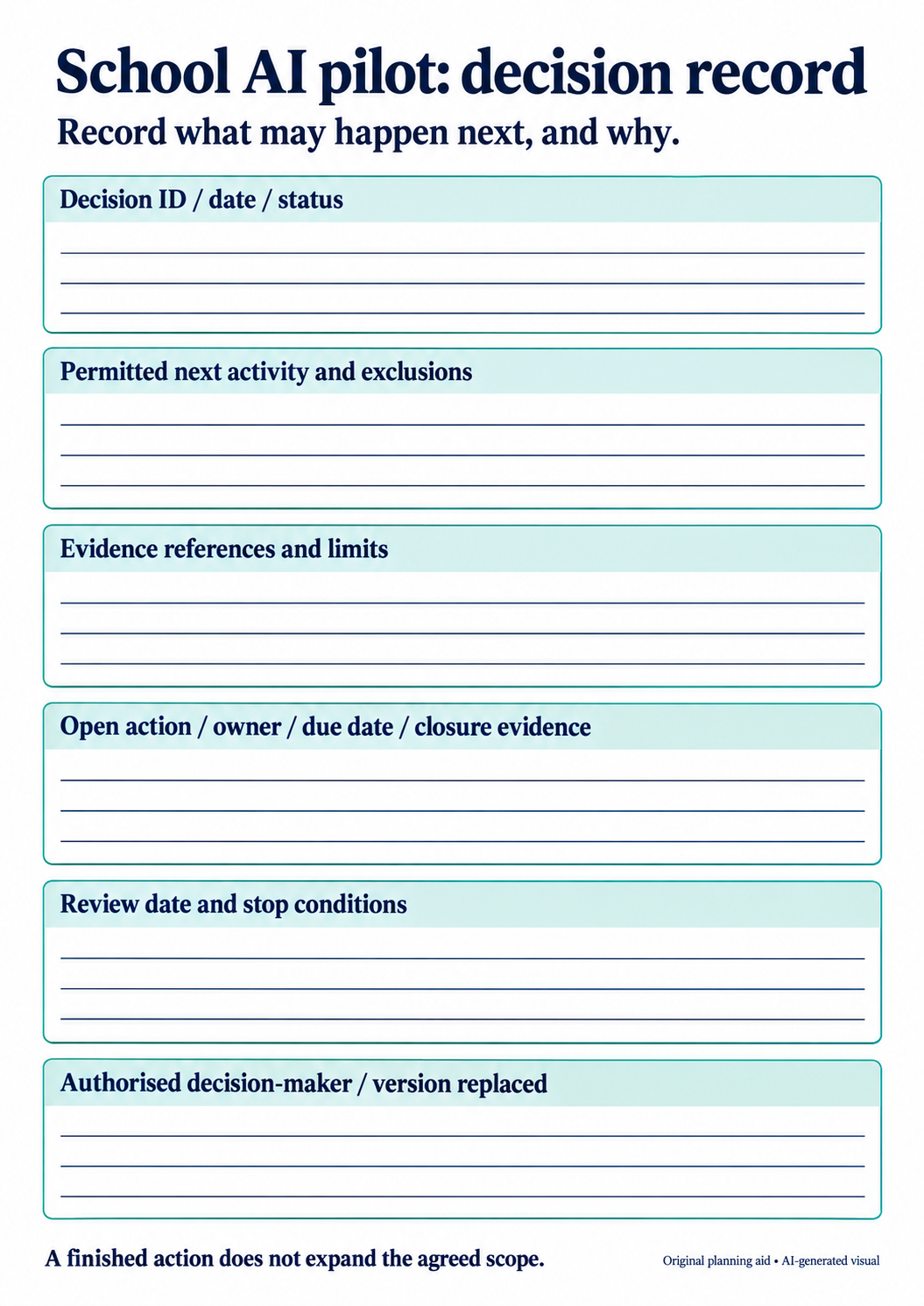
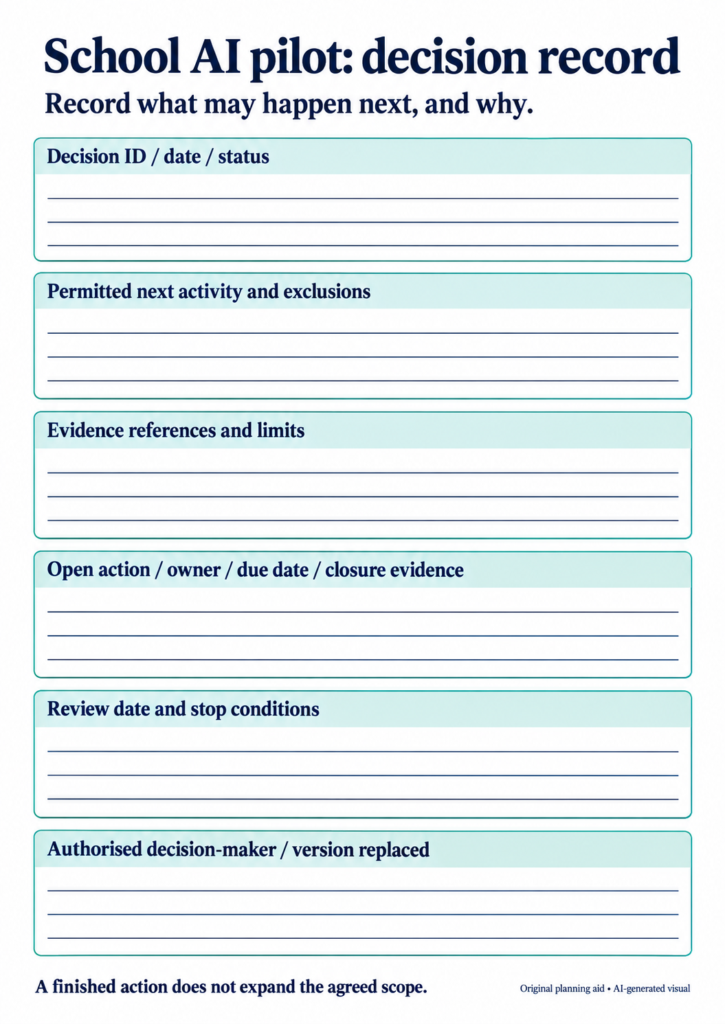
Copy the blank table below or print the worksheet. Complete it with the actual decision-maker, then read the decision, exclusions, outstanding actions and review date back to the group. Circulate the agreed current version through the school’s normal process. Keep unresolved reservations and the response to them visible rather than smoothing them into a sentence saying everyone agreed.
If your school is considering JeddAI, bring your proposed task and unresolved evidence questions to a school enquiry or meeting. Use the conversation to establish what needs demonstrating. Record any supplier information as evidence for the school to assess, and keep the school’s decision separate from the discussion.
| Record item | Example entry |
|---|---|
| Outcome and limit | Repeat a staff rehearsal with pack P2; named staff and invented paragraphs only. No student work, student access or grading. |
| Evidence and gap | E1: correction observed using P1. E2: backup review not rehearsed. No student feedback cycle tested. |
| Open action | Faculty lead arranges backup rehearsal by 10 November. Close only against an observation note of the agreed review steps. |
| Stop and review | Stop if the agreed reviewer or backup cannot check the output. Review on 12 November; permission ends then unless a further decision is recorded. |
| Decision authority | Record the actual authorised decision-maker and decision date in the school’s working copy. This example is fictional. |
| Field | Your record |
|---|---|
| Decision ID / date / status | ______ |
| Permitted next activity and exclusions | ______ |
| Evidence references and limits | ______ |
| Open action / owner / due date / closure evidence | ______ |
| Review date and stop conditions | ______ |
| Authorised decision-maker / version replaced | ______ |