What should the faculty meeting produce?
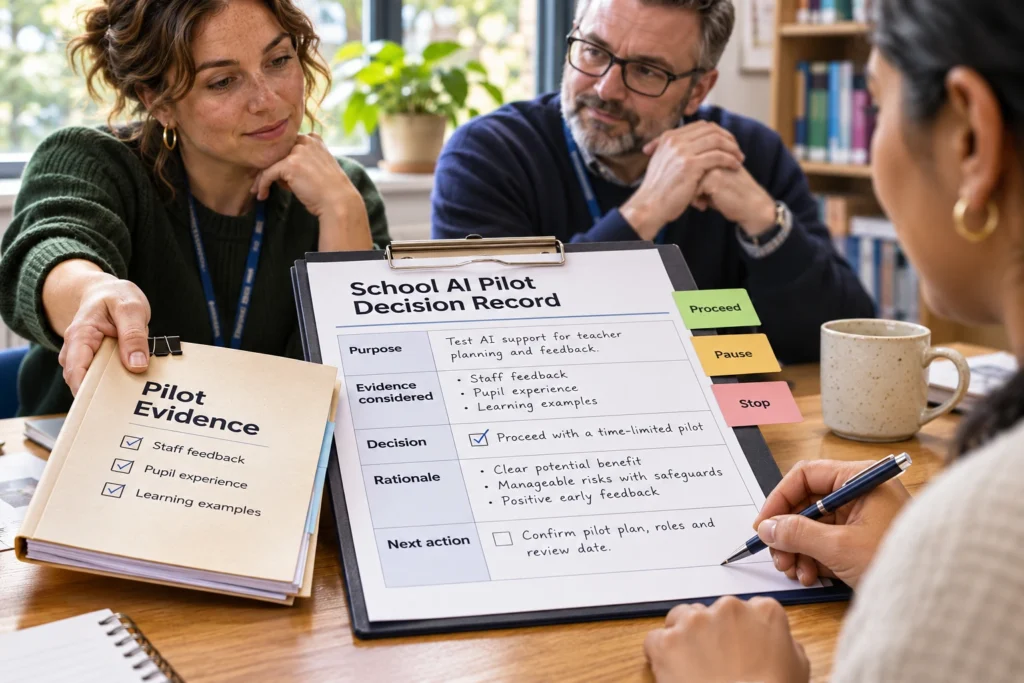
A meeting can end with enthusiasm while leaving nobody able to say which work may be used or who is responsible for checking the results. Aim for a short decision record. It should describe the proposed use, identify the evidence still needed and name the person who can authorise the next step under the school’s arrangements.
Separate a staff demonstration using invented material from a trial involving student work, and separate both from using outputs in a graded assessment. They are different proposals. Agreement to explore a tool should not silently become agreement to upload a class set or use suggested marks.
The Australian Framework for Generative AI in Schools provides guidance about teaching, wellbeing, transparency, fairness, accountability and data protection. It is an aspirational framework, not a product approval. The meeting routine here is an original planning aid; apply the school’s current policies and decision-making process to the actual proposal.
Which teaching problem and proposed use are you discussing?
Replace “We want to try AI marking” with a task someone could inspect. For example: “We want to examine whether draft feedback on a Year 9 analytical paragraph identifies unsupported claims and gives a usable revision step.” This is a proposed question, not a claim that any product has already achieved it.
Write down the subject, task, criterion, intended users and what the output would influence. Would a teacher use it to draft a comment, would students see it, or would it contribute to a mark? Name what is outside the trial. If the question changes during the discussion, update the proposal before deciding what evidence is needed.
Bring a permitted sample task and its criterion, plus an example of feedback the faculty considers useful. A demonstration using unrelated material may explain an interface but leave your teaching question unanswered. Plan a student revision opportunity if the eventual trial is intended to improve feedback use.
What evidence belongs behind an answer about people and data?
Ask who can approve this proposed use and which material they permit. Record the answer in a place the team can find again. Removing names is not, by itself, a complete answer about whether work may be used. Its content and context may still identify someone, and the school’s conditions still apply.
Ask where inputs and outputs would be held, who could access them, what the service retains, how the information is used, and how deletion would be requested and checked. Obtain the relevant supplier information for the proposed configuration and take unresolved points to the school’s responsible staff. Do not turn a salesperson’s general assurance into a finding about your setup.
Try this follow-up to “The system is secure”: “Which current document or setting answers our question about access and retention, and who at school will review it?” The useful meeting output is an evidence reference, an owner and a next action. This article does not certify a service or settle the school’s legal obligations.
Use the school AI pilot checklist to keep the wider planning items together. A tick should refer to evidence, not stand in for it. Keep personal student information out of the faculty’s general action list; use the school’s approved location for any detailed material that needs restricted access.
How will human review, access and questions work?
Ask who will inspect each output before it influences feedback or a decision, and when that inspection fits the workflow. “Teachers remain responsible” needs a practical account: can the reviewer see the original work and criterion, change or reject a suggestion, and stop its release? Rehearse those steps with permitted practice material before relying on a verbal description.
Discuss an awkward example. Suppose a draft comment refers to a quotation that is absent from the response. Who notices it, corrects it and records the problem? Who decides whether similar outputs need another check? This is an invented failure scenario for planning, not a report about a product or a school.
Ask how staff and students with access needs would participate, what information affected people would receive, and how someone could question an output or the use of the tool. Name the person who handles the concern and the route for a teacher to reconsider the work. Check these arrangements with the people responsible for them; an information sheet alone does not answer every access question.
The Framework retains human responsibility and includes monitoring, contestability and disclosure. Use those ideas to ask concrete questions about the proposed workflow. Do not infer that a tool meets them merely because its demonstration has an edit button or a reassuring label.
What would a useful decision look like in a worked example?
Consider this fictional meeting record, not a case study. An English faculty proposes examining feedback on three invented practice paragraphs. Its learning question is clear and a teacher can review the outputs against the task. However, the team has not obtained an answer about retention for its intended setup, and the process for handling a disputed comment has no owner.
A weak record says, “Demo looked good; start with one class.” A stronger record says, “Do not start the student-work trial. The digital learning lead will obtain the retention information; the faculty head will agree the review and concerns process with the relevant staff. Return the revised proposal to the authorised decision-maker before any student work is used.”
The team could separately ask whether a staff rehearsal with invented material is permitted under its existing arrangements. That narrower activity would test the review steps, not resolve the unanswered data question or authorise a class trial. Keep the two decisions separate in the record.
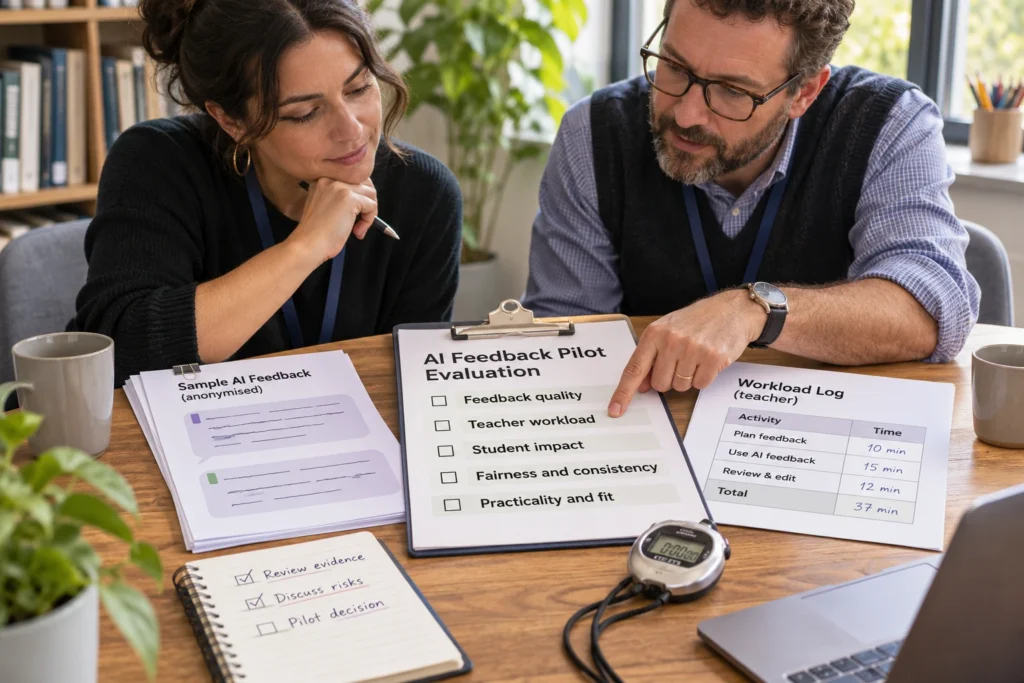
When the proposal is ready for a permitted trial, agree how it will be evaluated. The guide to what to measure in a school AI feedback pilot covers correction counts, student revision evidence and complete teacher effort. Use those measures to investigate the question; avoid choosing a universal pass score before you understand the task.
How can you use the worksheet in a faculty meeting?
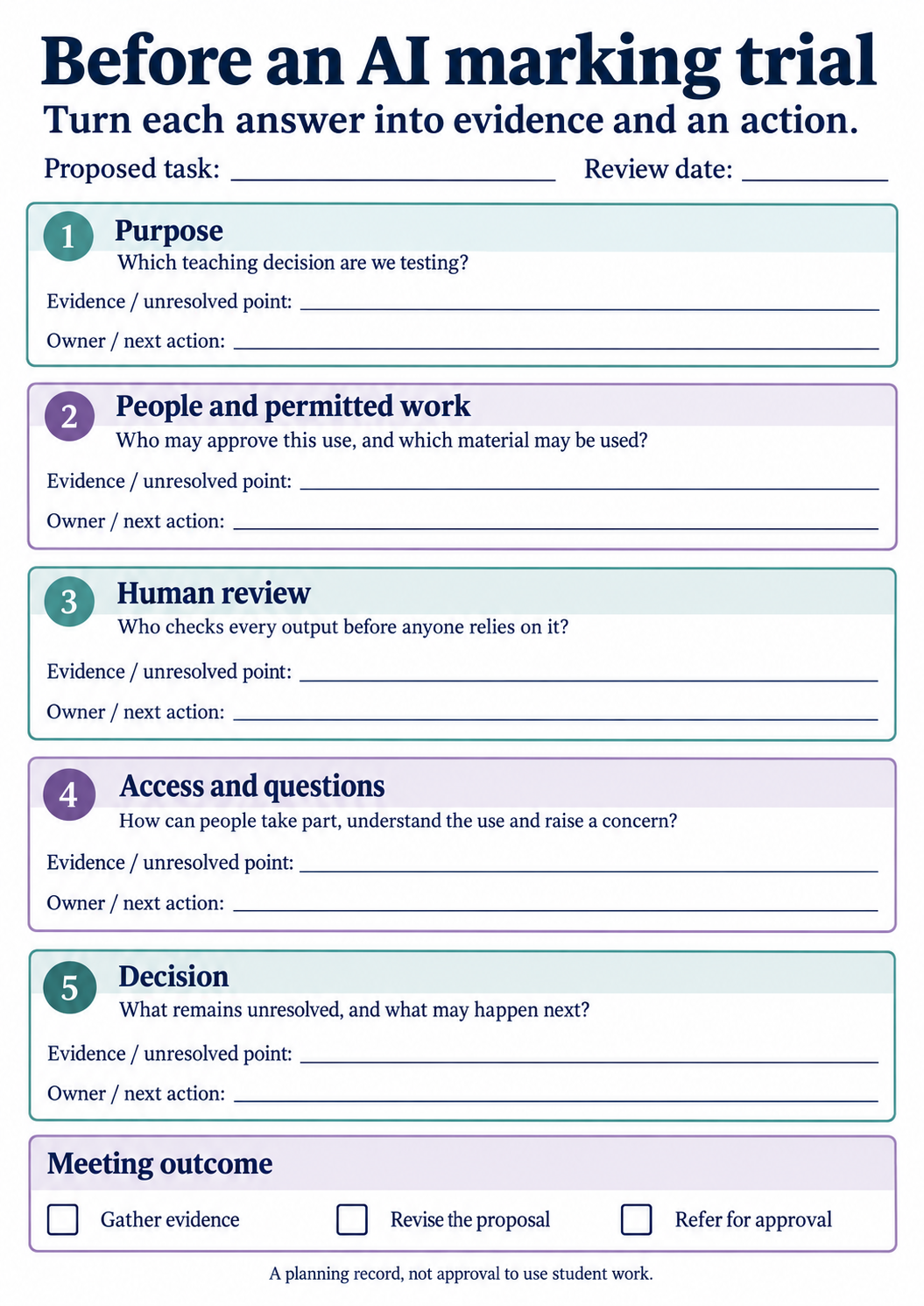
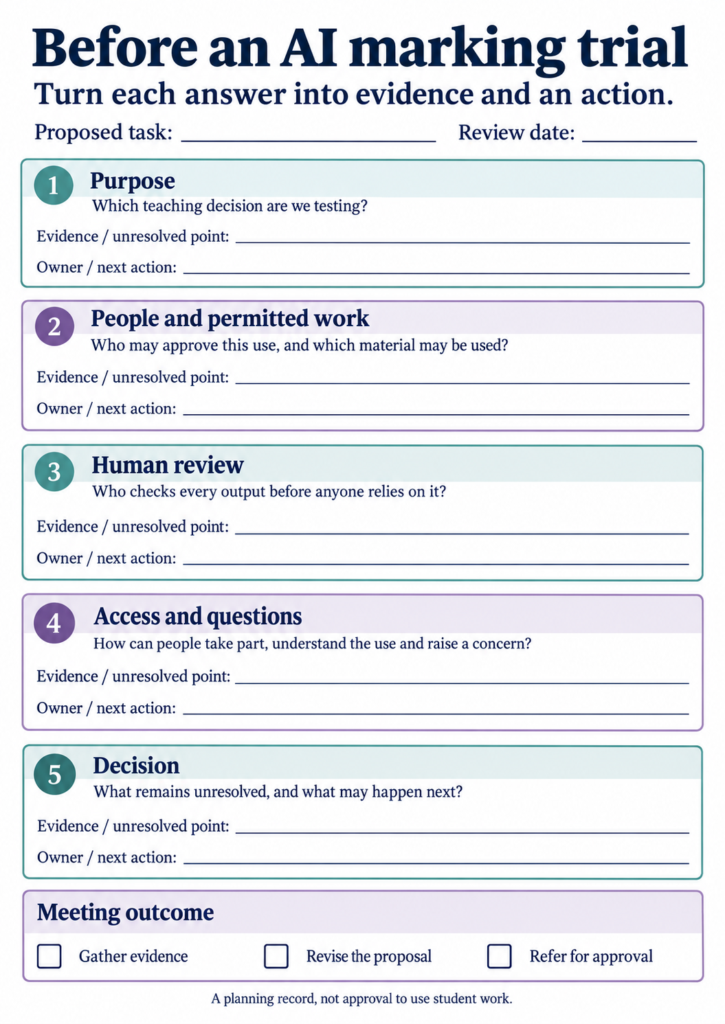
Send the proposed use and available evidence with the agenda. At the meeting, work through purpose, permitted material, human review, access and concerns, then the next decision. The printable worksheet gives each area space for an evidence reference or unresolved point and an owner or action. The table below adds examples of evidence to request.
Distinguish a confirmed fact from an expectation and an open question. “The teacher can reject a suggestion” should point to something the team has checked. “This will reduce our workload” remains an expectation until the complete process has been observed. Assign a date to each action and a review date to the proposal; avoid marking an unknown as a pass.
Finish by stating what may happen next, what must wait and who has authority over that decision. Possible outcomes include gathering missing evidence, revising the scope or referring the proposal for approval. A meeting record can support the school’s process without replacing it.
If you are considering JeddAI, discuss a school trial with our team using your proposed task and outstanding questions. A meeting can help establish what needs demonstrating and which information your school needs. Keep the final decision with the school’s authorised people and retain the evidence behind it.
| Question | Evidence to request | Record before deciding |
|---|---|---|
| What teaching decision are we testing? | Task, criterion, proposed use and exclusions | Question agreed; scope still open: ______ |
| Which material may we use? | School decision and relevant supplier information for the setup | Evidence reference / owner / due date: ______ |
| Who reviews before use? | Demonstrated review, correction and release steps | Reviewer / unresolved step: ______ |
| How can people participate and question it? | Access arrangements, information and concerns route | Responsible person / missing arrangement: ______ |
| What may happen next? | Resolved and unresolved items beside the proposed next step | Decision-maker / action / review date: ______ |
| Available evidence | Open point | Recorded next action |
|---|---|---|
| Task and criterion agreed; staff can rehearse on invented paragraphs | Retention for the intended setup is unanswered | Digital learning lead obtains information before student-work proposal proceeds |
| Teacher review is part of the proposed workflow | No owner for disputed comments | Faculty head agrees a review and concerns process with responsible staff |
| A narrower staff rehearsal is possible to propose | Its permission has not been established here | Ask the authorised decision-maker; do not treat rehearsal as approval for a class trial |