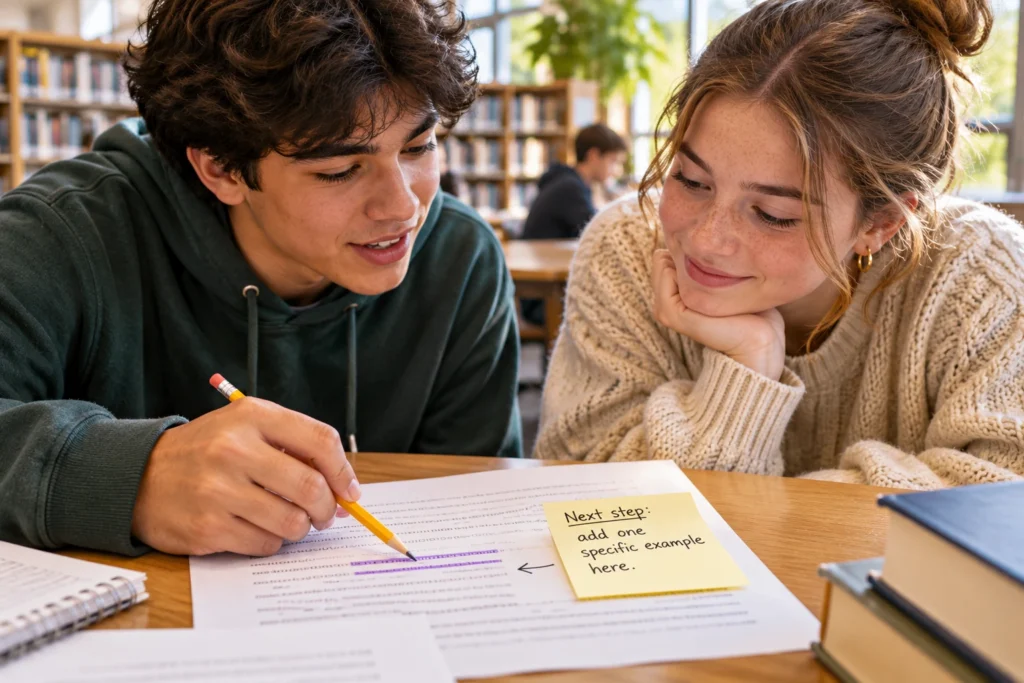
What should students learn from watching you revise?
A finished answer shows where you ended up. A useful demonstration also shows what made you change direction. Before modelling, name the decision students need to learn: checking a claim against every relevant value, connecting a quotation to an interpretation, or choosing a method that fits a problem. Avoid trying to demonstrate every possible improvement at once.
AERO’s explicit instruction guidance describes clear demonstrations, supported practice and the gradual removal of scaffolds. This article applies that guidance to an original data-comparison exercise. The rainfall values and places are invented. They are practice material, not weather records, research findings or an official assessment exemplar.
The learning goal here is to compare two places in each recorded month, support the comparison with paired values and keep the claim within what the data show. Students need to recognise that a monthly rainfall total is an amount measured in millimetres. Check that they can read the table before asking them to revise a claim about it.
How can you make the revision decision visible?
For the teacher model, use January rainfall of 48 mm at Wattle and 35 mm at Banksia, followed by February rainfall of 62 mm and 20 mm respectively. Display the two-row table with the first attempt: “Wattle is always wetter because of the hills.” Ask students to locate the evidence for each part of that sentence before you demonstrate the revision.
Think aloud: “I need to compare the places within each month. In January, 48 is greater than 35; in February, 62 is greater than 20. Wattle recorded more in both months. But I only have two months, so ‘always’ goes beyond this table. The table also gives me no information about hills or the cause of the difference.” Point to the values as you speak.
Now write one supported revision: “Wattle recorded more rainfall than Banksia in both months: 48 mm against 35 mm in January, and 62 mm against 20 mm in February.” Explain that you have changed the scope, supplied the comparisons and removed an unsupported cause. Longer words would not have fixed those problems.
Pause at a decision worth discussing: “Could I keep ‘always’ if I added the numbers?” The numbers support the two recorded comparisons, but cannot make the wider claim true. Let students explain that limit. You have given the answer to this teaching example; the next task should require them to make a decision of their own.
What makes the next example different enough to practise on?
For guided practice, change the relationship as well as the values. In March, Wattle records 30 mm and Banksia 45 mm. In April, Wattle records 55 mm and Banksia 40 mm. Give the claim “Banksia was wetter in both months.” Ask students to revise it using the table. Do not show the answer below until they have attempted the task.
Begin with two prompts: “Which place recorded more in March?” and “Is the comparison the same in April?” Ask students to point to both pairs before they write. If they read across the wrong row, show how the month and column labels organise the data, then let them try the comparison again. Do not turn an unfamiliar table layout into a test of unsupported guessing.
A teacher check is: “Banksia recorded more rainfall in March, with 45 mm compared with Wattle’s 30 mm, but Wattle recorded more in April, with 55 mm compared with Banksia’s 40 mm.” Different wording is fine. The essential change is that neither place recorded more in both months. The reversal must survive the rewrite.
A response that copies “Wattle recorded more in both months” has borrowed the model’s conclusion without checking the new values. A response that lists all four numbers but never compares them has supplied evidence without doing the requested reasoning. In either case, ask the student to explain one pair before deciding what to teach next.
When should you remove a prompt or keep it?
If students can compare each pair and explain why the original claim fails, remove the month-by-month questions on the next attempt. Keep the learning goal: compare the places in each month and justify the claim. If they cannot yet make the comparisons, retain a focused prompt or model the missing step again. There is no fixed number of attempts after which support must disappear.
Keep access supports distinct from prompts that supply the reasoning. A readable table, clear units, enlarged text or an appropriate way to answer may still be needed when a student is ready to make the comparison independently. Removing these does not make the subject check more informative.
The guide to teaching students to explain their revisions provides a way to inspect the reason alongside the change. Here, ask what happened to “both months” and why. An accurate revision with an uncertain explanation calls for a follow-up question, not an automatic judgement that the student has mastered or failed the idea.
How can you check a fresh attempt without the model?
Use a third table: in May, Wattle and Banksia each record 40 mm; in June, Wattle records 65 mm and Banksia 50 mm. Set the same task: compare the places in each month and support your answer with values. Put the earlier model and guided answer out of sight. This adds an equality case, so neither previous conclusion can simply be copied.
A possible answer is: “The places recorded equal rainfall in May, at 40 mm each. In June, Wattle recorded more, with 65 mm compared with Banksia’s 50 mm.” Check for the equal comparison, the correct June comparison, units and a claim bounded to these months. The data do not establish why the amounts differ.
If a student says Wattle recorded more in both months, ask them to compare the two May values. If they give a correct oral comparison but struggle to write it, support the expression while keeping track of what they reasoned through themselves. One successful short task is useful evidence; return to the skill later before treating it as secure.
For a wider decision about repeating an explanation or giving a focused prompt, use the guide to when to reteach instead of writing another comment. Record what you saw in this attempt so the next teaching step addresses the actual difficulty.
How can you adapt the model to students’ own work?
Choose a parallel example with the same kind of decision and manageable subject content. In English, you might model narrowing an interpretation on one short passage, then use a different passage whose details lead somewhere else. In mathematics, choose a new problem that requires the same method but makes a copied answer visibly inadequate. Check prerequisite knowledge rather than adding difficulty for its own sake.
The printable sheet gives students the model and the March–April task without the teacher answer. Use it for supported practice; use the separate May–June table for the independent check. The data tables below reproduce the image content as text and add that final task. These materials are for practice; follow the applicable conditions before providing help on an assessed task.
To fit modelling, revision and a check into returned-work time, adapt the ten-minute returned-feedback lesson. Allow more time when the responses show a need for it. A model earns its place by making a difficult decision visible, not by getting everyone to produce your sentence.
If your faculty is considering JeddAI, get in touch to discuss how teacher-reviewed feedback could lead into classroom revision and follow-up. Bring a permitted practice task and the decisions you want students to learn. Teachers can also explore the free-account option below; the teaching model and the subsequent check still need your judgement.
| Month | Wattle (mm) | Banksia (mm) |
|---|---|---|
| January | 48 | 35 |
| February | 62 | 20 |
| Month | Wattle (mm) | Banksia (mm) |
|---|---|---|
| March | 30 | 45 |
| April | 55 | 40 |
| Month | Wattle (mm) | Banksia (mm) |
|---|---|---|
| May | 40 | 40 |
| June | 65 | 50 |