What claim are you trying to prove?
Use this original practice question: “How does The Merchant of Venice expose a gap between moral claims and behaviour?” It is a close-reading exercise, not an official exam question. The examples below use the Folger Shakespeare Library text of Act 3, scene 1 and Act 4, scene 1. Check quotations and line references against the edition your class uses.
“The play explores mercy and revenge” identifies relevant ideas but does not answer the question. A more useful starting claim is: “Characters’ appeals to humane behaviour become unstable when they conflict with a desire for revenge or control.” This is a claim to investigate, not a sentence to memorise for every essay.
Choose moments that let you test that claim. You could compare the turn in Shylock’s speech from shared vulnerability to revenge with the difference between the court’s language of mercy and its treatment of him. For the broader planning process, use the guide to planning an English essay before writing. Here, the work is deciding what these particular scenes will support.
What changes when you read the whole speech?
In Act 3, scene 1, Salarino asks what use Antonio’s flesh could be to Shylock. Shylock answers by invoking revenge and listing the wrongs Antonio has done him. His question “Hath not a Jew eyes?” then begins an appeal to bodily experience, feeling and vulnerability shared with Christians. The repeated questions challenge the religious distinction used to deny him equal consideration.
Do not stop there. The speech moves from being hurt to answering hurt with revenge. Shylock presents retaliation as behaviour learned from the Christians who mistreat him. That turn complicates a reading of the speech as a straightforward appeal for tolerance: the argument for shared humanity is also used to justify repeating violence.
You can acknowledge the antisemitic hostility directed at Shylock without accepting his demand for Antonio’s flesh. Explain both parts of the speech. “Shylock is only a villain” erases the injuries he names; “Shylock only wants equality” overlooks the revenge he explicitly seeks. Neither statement accounts for the whole passage.
For your notes, separate three things: what Shylock alleges, how his speech persuades, and what you infer from its movement. A character’s self-defence is evidence to analyse, not automatically the play’s final moral judgement.
How does the trial complicate the language of mercy?
In Act 4, scene 1, Portia, disguised as Balthazar, asks Shylock to be merciful. Her image of mercy falling like rain presents it as a blessing that reaches both giver and receiver. She connects mercy with a form of power greater than the authority represented by a ruler’s sceptre.
Compare those claims with the later action. Portia’s reading of the bond prevents Shylock from taking Antonio’s flesh without shedding blood. After invoking another law against Shylock, the court turns him from claimant into someone whose own life and property are at risk. The Duke initially pardons his life before he asks.
Antonio then proposes terms that include Shylock becoming a Christian. The Duke threatens to withdraw the pardon if Shylock will not comply. The scene therefore supports a more exact argument than “mercy triumphs”: Antonio is saved, but the mercy offered to Shylock becomes conditional and coercive.
This reading does not require pretending that Shylock has been willing to spare Antonio. His refusal is part of the problem the scene creates. The force of the comparison lies in watching people who demand mercy decide what it will mean when they hold power over their opponent.
How can you turn the comparison into a paragraph?
Here is an original model for the practice question: The trial exposes a gap between the language of mercy and the conditions imposed on its recipient. Portia’s declaration that “The quality of mercy is not strained” presents mercy as freely given, while the rain image makes its benefits seem generous and shared. Yet the later demand that Shylock convert, backed by the Duke’s threat to revoke his pardon, places him under compulsion. The shift from an ideal spoken aloud to a condition enforced in court invites readers to question how far the victors practise the principle they praise. Antonio’s rescue is real, but it does not make the treatment of Shylock uncomplicated.
Notice the order: a claim answering the question, a precise piece of language, an explanation of its meaning, then an action that tests it. The paragraph explains the relationship between the two moments. It does not merely attach a technique label to one quotation and move on.
You could defend a different emphasis, including the court’s attempt to save Antonio after Shylock refuses payment. To make that reading convincing, still account for the conversion condition and the threatened loss of pardon. Difficult evidence should change or qualify your answer, rather than disappear from it.
Can you test a new claim without copying the model?
Now change the question: “How does the play complicate the relationship between money and personal attachment?” Return to the exchange with Tubal later in Act 3, scene 1. Start with the deliberately limited claim, “Shylock values everything only for its price.” Find a moment that supports this reading and one that challenges it before revising the claim.
Check your reasoning against these possibilities. Shylock counts the cost of the diamond and reacts to reports of Jessica’s spending, so money clearly matters. But his response to the loss of the turquoise ring recalls Leah and his life before marriage. Its importance cannot be reduced to its resale price. A defensible revision might argue that the scene moves between financial loss and the loss of a personal attachment.
That is one possible interpretation, not a complete essay. Explain why the ring changes your initial claim, then consider the surrounding anger and desire for revenge rather than turning Shylock into a purely sentimental figure. You are practising a habit: let a specific detail correct a statement that is too broad.
Use the downloadable card and blank table to repeat the process with another question. Record the speaker, act and scene beside each moment. If your explanation could be pasted unchanged into an essay about any text, add the detail that makes it about this play.
What should you revise after checking the evidence?
Underline the words in your claim that require the strongest proof: “only”, “always”, “everyone” or “completely”. Keep them only if your evidence warrants them. Check that your paragraph answers the actual question and that a later event has not been treated as if it happened before the speech you analyse.
If the same problem keeps returning, record it in your exam error log: name the overstatement, save the evidence that corrected it and set a fresh practice task. Use the log to track a change in reasoning rather than the number of quotations collected.
For further text-specific study, explore The Merchant of Venice study guide. Use it alongside the full play, and test any interpretation against the passages rather than collecting quotations without their context.
You can also browse the study-guide catalogue for other texts and writing skills. For feedback on a practice response, try JeddAI, then check suggested changes against the play and your teacher’s task before revising. A fluent sentence still needs an accurate quotation and a defensible argument.
| Step | Evidence or decision |
|---|---|
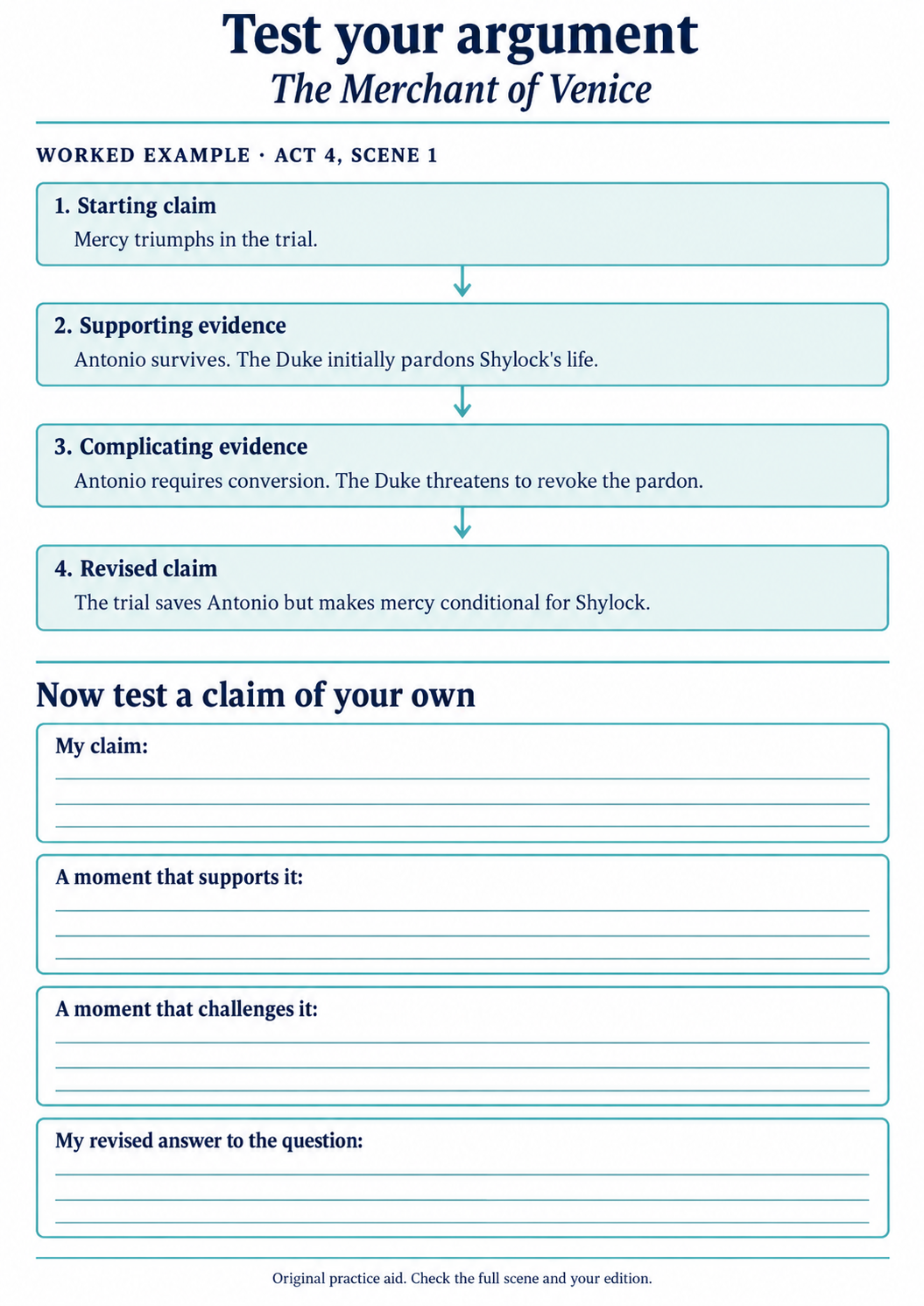
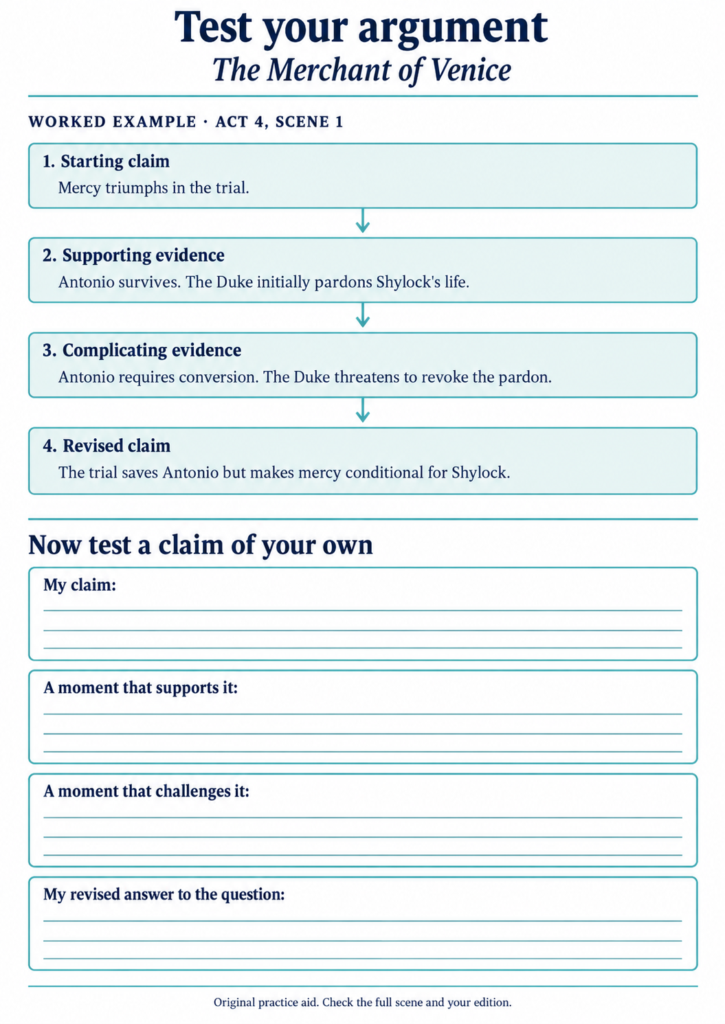
| Starting claim | Mercy triumphs in the trial. |
| Supporting moment | Antonio survives; the Duke initially pardons Shylock’s life. |
| Complicating moment | Antonio requires conversion; the Duke threatens to revoke the pardon. |
| Revised claim | The trial saves Antonio but makes mercy conditional for Shylock. |
| Your task | Your notes |
|---|---|
| Question and starting claim | ______ |
| Supporting moment: speaker, act and scene | ______ |
| What its language or action shows | ______ |
| A moment that challenges the claim | ______ |
| Revised answer to the question | ______ |