Where should you begin a character analysis?
Start with a decision you can locate. ‘Hamlet is indecisive’ gives you a label; ‘Hamlet puts away his sword when he finds Claudius apparently praying’ gives you an action to investigate. Ask four questions: what could the character do, what do they choose, why, and what does the audience learn from that choice?
The reason matters because the same outward action can serve different purposes. Refusing to kill might express mercy, fear, uncertainty or a wish for a more destructive revenge. Read the surrounding speech before choosing a label. The examples here use Acts 3.3, 4.7 and 5.2 of the play; check wording against the edition you are studying, since spelling and line numbers vary.
Why does Hamlet spare Claudius in the prayer scene?
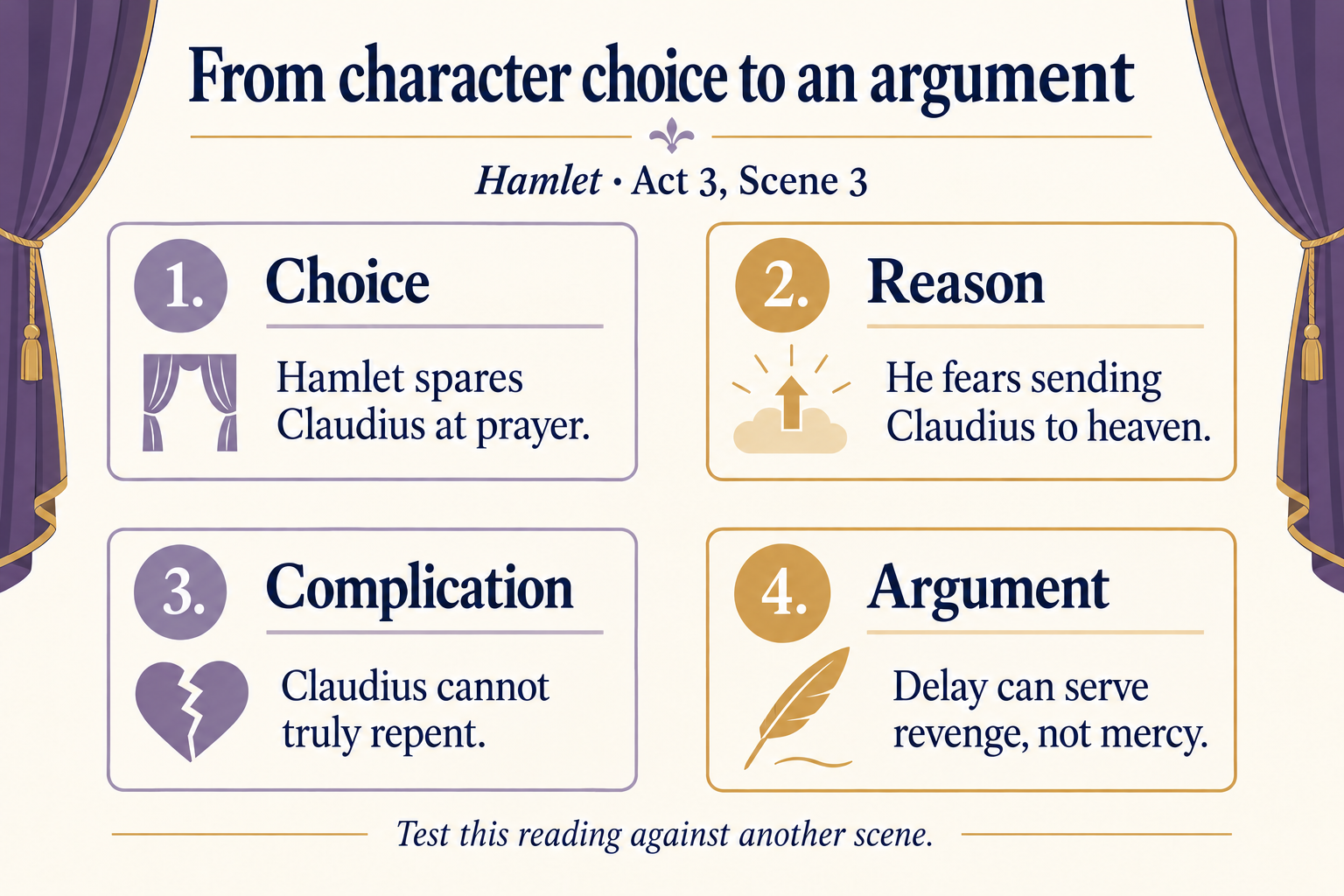
In Act 3, Scene 3, Hamlet sees an opportunity to kill Claudius. His opening phrase, ‘Now might I do it pat’, presents the moment as convenient. He then imagines that killing a man at prayer would send that man to heaven. He puts away the sword because he wants a punishment that reaches beyond Claudius’s earthly life.
That sequence complicates the claim that Hamlet simply cannot act. In this speech, he reasons towards a more severe revenge. You can argue that thought intensifies the desire for punishment instead of restraining it. Keep the claim local: this moment supports that reading, but it does not explain every delay or decision elsewhere in the play.
Shakespeare also gives the audience information Hamlet lacks. Before Hamlet enters, Claudius admits that he cannot sincerely repent while retaining the rewards of the murder. After Hamlet leaves, Claudius acknowledges the failure of his prayer. Hamlet’s decision therefore rests on a mistaken reading of the kneeling figure. The dramatic irony makes the gap between outward appearance and inward purpose central to the scene.
How does Claudius turn guilt into a conflict about power?
Claudius does more than confess that he feels bad. He asks whether he can be pardoned while keeping what the murder secured: his crown, ambition and queen. His attempt to pray exposes a conflict between wanting forgiveness and wanting to retain the benefits of the crime. The audience hears that conflict directly, rather than relying on Hamlet’s judgement of him.
A useful argument is that recognising wrongdoing does not automatically produce moral change. Claudius can name the problem without surrendering what sustains it. Support that interpretation with the terms of his own question about pardon, then explain the significance of his kneeling and failed prayer. Naming ‘religious imagery’ alone would leave the important reasoning unfinished.
What does comparing Hamlet with Laertes reveal?
In Act 4, Scene 7, Claudius asks what Laertes would undertake to prove his love for his murdered father. Laertes answers that he would cut Hamlet’s throat even in a church. This is a declaration, not an event that happens on stage. He subsequently commits to an actual plan: using poison on his sword in the arranged fencing match.
The contrast with the prayer scene is sharper than ‘one thinks and one acts’. Hamlet treats the possibility of salvation as a reason to postpone the killing; Laertes declares that a sacred place would not restrain him. Yet both can subordinate moral limits to revenge. Claudius’s prompting also matters: the exchange shows how another person can turn grief and filial duty towards a murderous scheme.
Do not let the comparison freeze Laertes in that position. In Act 5, Scene 2, he registers a conflict with his conscience, suffers from the poisoned weapon and exposes the plot. He then asks Hamlet to exchange forgiveness. That later choice complicates his earlier declaration and gives you a way to discuss recognition and responsibility as well as revenge.
How can you turn the comparison into an analytical paragraph?
Here is an original model, offered as one defensible reading rather than a response to memorise: ‘Shakespeare makes revenge troubling through both delay and determination. In the prayer scene, Hamlet postpones killing Claudius because he wants punishment beyond death, so his apparent restraint serves a harsher purpose. Laertes, by contrast, declares that even a church would not prevent his revenge. Their different responses to a religious setting expose a shared willingness to let vengeance override moral limits. Laertes’s later appeal for forgiveness complicates that willingness, suggesting that the play also allows a belated recognition of responsibility.’
The paragraph makes a claim, connects two precise moments and explains why the contrast matters. Its final sentence checks the argument against later evidence. To develop it, add short quotations from your edition and examine the words that do the work. To adapt it to an essay question, change the claim to answer that question; do not merely attach its keywords to this paragraph.
What can you practise with the evidence grid?
Copy the grid below and complete the blank row for a choice you have not used here. Give an act and scene, separate observation from interpretation, and add a later moment that tests your reading. You have a workable row when another reader can find the evidence and understand how it supports the idea. A trait such as ‘loyal’ or a theme word such as ‘revenge’ is only a starting point.
Use the exam error log to record one recurring weakness in your own analysis: retelling the event, treating a speech as an action, or naming a technique without explaining it. Set a small next task, such as rewriting two sentences to connect the choice to your argument, then check a fresh paragraph for the same weakness.
For further study, open the Hamlet study guide and check that its course level matches your needs.
You can also browse all study guides to find the appropriate text and course. This article is general literary analysis; it does not claim that Hamlet is prescribed for your current examination.
If you want feedback on the paragraph you have written, try JeddAI on your own paragraph. Keep the play beside you and check any suggested interpretation against the scene. Feedback should help you revise your reasoning, while the evidence and final argument remain yours.
| Choice and scene | Evidence to locate | Interpretation to test |
|---|---|---|
| Hamlet puts away his sword: 3.3 | His concern that Claudius would reach heaven | Delay can pursue harsher revenge; compare with a later action. |
| Claudius attempts prayer: 3.3 | His question about pardon while retaining the rewards of murder | Acknowledging guilt does not ensure a willingness to change. |
| Laertes joins the fencing plot: 4.7 | His church declaration and decision to poison his sword | Revenge crosses moral limits; test against his forgiveness in 5.2. |
| Your character and scene: ______ | Choice, words and stage action: ______ | Idea and a moment that complicates it: ______ |